
-
Your next favorite book
is waiting.
Summary | Excerpt | Reviews | Beyond the book | Read-Alikes | Genres & Themes | Author Bio
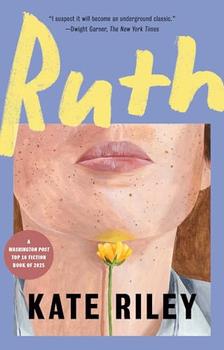
A Novel
by Kate Riley Book Reviewed by:
Kate Riley's excellent debut novel Ruth follows its eponymous heroine from her early childhood in the 1960s into wifehood, motherhood, and middle age in an Anabaptist community in Michigan. Riley doesn't explain all at once the rules or beliefs of Ruth's world; instead, the reader grasps the setting little by little, through snatches of Ruth's life that are, especially at first, devoid of larger context. We learn, for example, that her family lives in Gracefield, the "most Southerly of the Brotherhood's three North American Dorfs"; that her mother grew up in the "Western Colonies" before fleeing east; that at the Dorf, as with "baptism and marriage, dessert was not a given." As the book goes on and Ruth grows older, Ruth and the reader put together a fuller—although still constantly surprising—picture: the Dorf is a Hutterite colony in which "the Sermon on the Mount was their only charter, all goods were held in common, and a young person such as herself had no task other than discerning whether to accept Christ into her heart and seek baptism."
This last part is difficult for Ruth—she loves Christ (she thinks), but she never feels or says the right thing. She's odd, somewhat of an outsider; she loves language and often makes limp jokes, usually hinging on thin wordplay, that others mostly don't get. It's not that she feels like she doesn't belong at the Dorf, but rather that she's always failing to meet its standard. It was "relief from pride and curiosity that Ruth prayed for," Riley writes; the qualities that make her a great literary protagonist are of little use before God.
Riley tells the story of Ruth's life in medium-length snippets, in which seemingly significant plot points (marriage, children) unfold matter-of-factly, without fanfare or tension, and mostly take a backseat to Ruth's internal struggles and questions. She wants to accept Christ and be baptized, but when she requests baptism as a teenager, she fails the elders' test: when they ask her what her relationship with Christ is, she gives a series of wrong, disappointing answers. (When an elder gives her own answer, Ruth can't even understand it: "That was what a relationship with Jesus Christ was like: beyond Ruth, too real and true for her own mind to hold… she was tried and frustrated and began to cry.")
Ruth grows up, but her wit, her irreverence, and her feeling of being an outsider remain. Riley has an incredible gift for language—for a perfect, strange phrase; for hilariously dry punchlines; and for depicting the idiosyncrasies of an insular community. Ruth goes to public high school, as all Dorf teenagers do; she becomes a member of the Shalom, a newly-created caste of Dorf members meant to combat the intimacy and favoritism between family members by assigning nonmarried young adults to live at different families' houses. "The Shalom would also have group activities to themselves, the elders forecast… completing work projects, and discussing serious issues in a weekly assembly," Riley writes of the Shalom's creation. "A snack budget had already been allocated."
Despite her lack of talent for cooking, Ruth is sent to culinary school at the local community college, where she befriends Kim, whose openness about her life makes Ruth "sick with intimacy." She invites Kim and Kim's boyfriend to dinner at the Dorf, where the two civilians charm everyone, to Ruth's pride—but when dinner ends, Kim turns to Ruth: "You've got to get out of here. You can stay with my family as long as you need," she says. But Ruth doesn't want out; she wants, she realizes after Kim apologizes, "a friend who knew she was suffering but would not make her talk about it." Her perpetual failure to feel what others feel, her constant grasping at something she doesn't know if she will ever reach—that is suffering, yes, but not suffering she wants to be rescued from.
She marries a man named Alan, who seems promising before marriage but becomes immediately irritating afterwards: he begins calling her "Mom," rarely laughs at or acknowledges her jokes, tells the same stories over again (to Ruth, a sin: she wishes for "a ray gun that shot beams of humiliation"). Riley's powers of observation about the gamut of emotions of romantic relations are as keen as those of novelists specializing in romance, marriage, and divorce. About Ruth's burning teenage crush on fellow Shalom Calvin, she writes: "She felt onto something. Her every thought and action was dignified by the prospect of sharing it with him"; when Alan, that disappointing husband, wears a backpack that is empty but for a single envelope, she writes that Ruth "could not explain why its deflated form made her furious." But Riley's sights are set on something else, something past interpersonal relationships, something bigger and more opaque.
Ruth works, clumsily raises their three children, feels ungenerous and ungrateful. Towards the end of the book, she begins to think more about the people she knows who left the community, like her brother, now a university professor, and her son, whom she visits in Chicago, where she realizes that he belongs on the outside. But Ruth, for all her doubt and shame and "brainy female despair," as she puts it—for all the depressive spells in which she can't get out of bed and her children have to stay at other people's homes—Ruth does belong at the Dorf. She's an outsider, but not a judgmental one; she feels isolated but not independent; her differences are not a comment on "groupthink" but represent a genuine struggle for faith and happiness. It is an amazing feat of Riley's that Ruth depicts a strange kind of happiness at the same time that it depicts a sad and lonely life—that it shows something worth striving for, despite Ruth's suffering at having yet to reach it.
 This review
first ran in the August 27, 2025
issue of BookBrowse Recommends.
This review
first ran in the August 27, 2025
issue of BookBrowse Recommends.

If you liked Ruth, try these:
The History of a Difficult Child
by Mihret Sibhat
Published 2024
A breathtaking, tragicomic debut novel about the indomitable child of a scorned, formerly land-owning family who must grow up in the wake of Ethiopia's socialist revolution
by Miriam Toews
Published 2020
Based on real events and told through the "minutes" of the women's all-female symposium, Toews's masterful novel uses wry, politically engaged humor to relate this tale of women claiming their own power to decide.
by Jane Smiley
Published 2011
A riveting new novel from the Pulitzer Prize–winner that traverses the intimate landscape of one woman’s life, from the 1880s to World War II.

L.A. Women by Ella Berman
Two ambitious writers in 1960s LA face betrayal when one writes a novel based on the other's life.






Your guide toexceptional books
BookBrowse seeks out and recommends the best in contemporary fiction and nonfiction—books that not only engage and entertain but also deepen our understanding of ourselves and the world around us.

