
-
Your next favorite book
is waiting.
Summary | Excerpt | Reading Guide | Reviews | Beyond the book | Read-Alikes | Genres & Themes | Author Bio
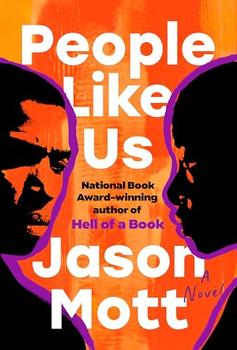
A Novel
by Jason Mott Book Reviewed by:
Jason Mott's novel People Like Us follows two storylines, both centering Black American writers. A third-person narration focuses on Soot, also featured in Mott's previous National Book Award-winning Hell of a Book, as he lives in grief over his teenage daughter's suicide and travels to a speaking engagement in Minnesota at a school where people have been left grasping for meaning after a shooting. In alternating chapters, a first-person narrator and winner of the NBA ("The Big One," see Beyond the Book) undertakes a life-altering journey to Europe after receiving a death threat from a mysterious man named Remus and being taken under the wing of a French billionaire.
Each story weaves in elements that may be supernatural, neurological, or character idiosyncrasies. Soot claims to have the ability to "time travel," which functions as a device for a narrative made up of many flashbacks, but the reader may endorse his ex-wife's view that this is simply "memory"—later, Soot feels it's "madness." The unnamed author-narrator says that he has a "condition," which seems to manifest partly in his espousing strongly held beliefs about realities that appear doubtful. He insists that a young man named Dylan who works for his billionaire is someone he calls "The Kid," and that a server in a bar is from the American South even though she says she's Sicilian. Kelly, an old flame the narrator encounters later in the book, questions what he means by his "condition"—"Being an asshole?" Still, he's more than capable of charming the reader with an endless supply of corny, upbeat humor that seems like both a sincere personality trait and a well-honed coping mechanism:
"Paris. The City of Light. Birthplace of croissants and existentialism. Home of Joan of Arc, the Louvre, clown college, and Disneyland.
Me and my band of merry Americans and ex-Americans and demi-Americans broadside the city of Bogart and Bergman just before lunchtime, carrying the sun on our shoulders and with the smell of liberty, American exceptionalism, and Jim Crow heritage effervescing from our loins."
The narrator's fantastical voyage alludes to the broad history and storytelling tradition of American escape to Europe. At the billionaire's villa, he is reminded of the likes of James Baldwin and Nina Simone, Black American artists who sought new life on the streets of Paris, and his benefactor proposes a fairy-tale deal: bottomless financial support in exchange for his agreement never to return to the United States. Can he adapt to this new existence, one that he wants but feels at odds with? Parallel to this dilemma runs Soot's reliving of his divorce from his wife, a teacher disillusioned by the culture of acceptance around school shootings, and her subsequent move to Toronto with their daughter while he stubbornly stayed behind in North Carolina, citing attachment to land inhabited by his family for generations. He zooms in on moments with his ex and their child, trying to understand where everything went wrong.
Meanwhile, the decision of whether to agree to the billionaire's terms that the author-narrator faces is impossible to make, even if it shouldn't be. Europe is Eden and America the forbidden fruit (if not of knowledge, exactly, then at least of what can't be unseen, which seems to be the salient point of the whole Genesis story, anyway) and this isn't a tale that can be lived backwards; he's already soured the deal by bringing the rotting apple with him. His forays through Italy and France are bright with the illusion of freedom from the racial violence of America but he carries another iteration of violence in the form of a smuggled firearm and the dread of Remus trailing him.
Like watching a horror film, we want the characters to be safe and happy, agonize over the details of how they can be, but know it's all ultimately useless. In Soot's case, because we already know what happens to his family; in the author-narrator's case, because we know what he's living is the foregone reality of America. The two storylines inform one another in an intriguingly disconcerting way, making it impossible to attribute a singular tone or mood to the novel. Soot's story, almost by nature, feels more solid and necessary than the other, and there are times when the European narrative wears thin—not due to the writing's engaging bombast or humor, but simply the inessential details and extra polish.
Still, People Like Us is the special kind of book that leaves an imprint on the mind, that thrives on subtext even as it also says a lot directly. The word "plot" can mean what happens in a story, or a piece of land like the one Soot insists on keeping; in Mott's novel, the things that happen begin to feel less like distinct events and more like a fixed place. Soot's sobering storyline holds the reader in an eternal present that lowers the stakes and tension of what transpires with the author-narrator, his would-be murderer, and his benefactor, even as this situation spins out of control. Despite the compelling premises of both stories and the larger-than-life busyness of the latter, the book is more about impressions than action. People Like Us is honest about America, gun violence, and racism, but isn't any kind of impassioned plea for the reader to look closer at these things. Instead, it evokes the ethereal melancholic ache of waking from a dream where things were somehow different, somehow better, that moment when you simultaneously understand the dream was never real while feeling it still within your grasp—eminently relatable, bittersweet bargaining—and then suggests this may not be a wasted sentiment, that beyond the outer limits of acceptance, there may be yet another shore to reach.
 This review
first ran in the August 27, 2025
issue of BookBrowse Recommends.
This review
first ran in the August 27, 2025
issue of BookBrowse Recommends.

If you liked People Like Us, try these:

by Danzy Senna
Published 2025
A brilliant dark comedy about love and ambition, failure and reinvention, and the racial- identity-industrial complex from the bestselling author of Caucasia.
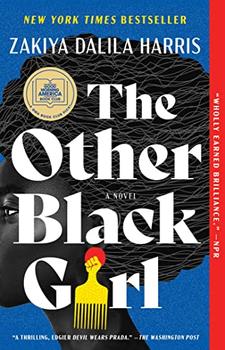
by Zakiya Dalila Harris
Published 2022
Urgent, propulsive, and sharp as a knife, The Other Black Girl is an electric debut about the tension that unfurls when two young Black women meet against the starkly white backdrop of New York City book publishing.

by Percival Everett
Published 2011
Percival Everett's blistering satire about race and publishing, now adapted for the screen as American Fiction, directed by Cord Jefferson and starring Jeffrey Wright and Tracee Ellis Ross.
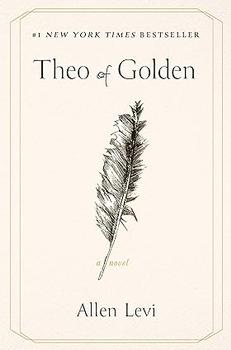
Theo of Golden by Allen Levi
One spring morning, a stranger arrives in the small southern city of Golden. No one knows where he has come from…or why…




Your guide toexceptional books
BookBrowse seeks out and recommends the best in contemporary fiction and nonfiction—books that not only engage and entertain but also deepen our understanding of ourselves and the world around us.

