
-
Your next favorite book
is waiting.
Summary | Excerpt | Reviews | Beyond the book | Read-Alikes | Genres & Themes | Author Bio
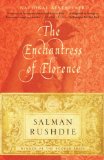
 Book Reviewed by:
Salman Rushdie's The Enchantress of Florence is a
phantasmagoria of sights, sounds, characters, and long sentences set in 16th
century Italy and the Mughal Empire.
The plot centers on a series of stories told by a mysterious interloper to the
Great Akbar. Akbar is a free thinker and a munificent ruler, so the interloper,
Uccello, is able to stay and tell his stories after many of the court believe he
should leave. The story is about the mysterious Enchantress of Florence, whose
personal history greatly interests Akbar.
The telling of stories and the similarities between Akbar's court and the
distant Italy are two of the central themes of the novel: Rushdie opines through
metaphor, character, and plot that humanity is the same regardless of situation
or fashion. The interweaving storylines, one set in Renaissance Italy, the other in the Mughal Empire,
act as mirrors of each other. Akbar's ability to understand Uccello's stories
further underscores the fact that he is a great ruler; he can imaginatively step
outside his experience to sympathize with people who live far away from him.
(The implication is that we must also learn how to do this; hence the reason
Rushdie set this tale in the 16th century.) In contrast to his
suspicious courtiers, he is able to transcend time and space to see the sameness
between people.
Akbar has magnificent imaginative powers. He is able to conjure a wife
from the ether of his mind, which causes the ladies of his harem no end of
consternation. They find themselves challenged by the paradoxical situation of
competing against another women's affection for Akbar, even though that woman
does not exist. Thus begins the confusing, labyrinthine qualities of The
Enchantress of Florence.
Rushdie's larger points that literature (storytelling) should be the agent
for understanding and that people are essentially the same is well heard and,
after 500 pages, well-explained, but the novel contemplates little else. The
plot circulates around itself, and though some scenes (sections in Italy and
Akbar's palace come to mind) are lucid and engaging, the nonlinear sections are
so frequent and so confusing that they undermine any brilliance the clearer
narrative sections possess. One finds oneself anxiously looking forwards and
backwards in the narrative for a point of reference; and the slog is difficult.
There are clear, beautiful moments to be found; and some of the characters, The
Enchantress for one, jump off the page. Yet, the plot and the connection
between the characters is unclear. By the end, it seems that the novels
objective is simply to confuse, providing neither the benefit of a satisfying
conclusion or the key to the central riddle.
Overall, there are some brilliant moments and those fond of Rushdie's earlier
works might be interested in wading into this one.
Salman Rushdie was born
in Bombay (Mumbai) in 1947.
He studied in India and England,
reading History at King's
College, Cambridge. His first
novel, Grimus, was
published in 1975. His second
novel, the critically acclaimed
and award-winning Midnight's
Children, was published in
1991. Among its honors, it has
won the Booker Prize and the 'Booker of the
Bookers,' recognizing it as
the best example of that
illustrious prize. Malcolm
Bradley in The Modern British
Novel (1994) pronounced the
book "a new start for the
late-twentieth-century novel."
Rushdie's next novel, Shame,
also won critical acclaim
and international awards.
Famously, Rushdie's next book,
The Satanic Verses,
incurred an issuance of a
fatwa – a call for his death
– by the orthodox leadership in
Iran. Rushdie went into hiding,
together with his then-wife
Marianne Wiggins, but
continued writing. All of his
subsequent work has garnered
critical acclaim. He says that
The Enchantress of Florence
was written in the aftermath
of his divorce from Padma Lakshimi
and helped him to recover from
the pain of separation.
 This review was originally published in The BookBrowse Review in June 2008, and has been updated for the
January 2009 edition.
Click here to go to this issue.
This review was originally published in The BookBrowse Review in June 2008, and has been updated for the
January 2009 edition.
Click here to go to this issue.

If you liked The Enchantress of Florence, try these:
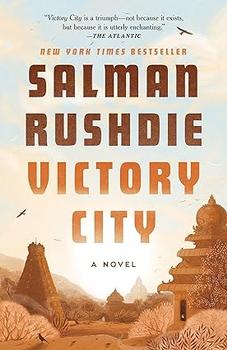
by Salman Rushdie
Published 2024
The epic tale of a woman who breathes a fantastical empire into existence, only to be consumed by it over the centuries—from the transcendent imagination of Booker Prize–winning, internationally bestselling author Salman Rushdie.
by Miles J. Unger
Published 2015
The life of one of the most revolutionary artists in history, told through the story of six of his greatest masterpieces.
by Douglas Nicholas
Published 2013
An intoxicating and spirited blend of fantasy, mythology, and history, Something Red features the most fascinating of characters, as well as an epic snowstorm that an early reader described as "one of the coldest scenes since Snow Falling on Cedars."

L.A. Women by Ella Berman
Two ambitious writers in 1960s LA face betrayal when one writes a novel based on the other's life.






Your guide toexceptional books
BookBrowse seeks out and recommends the best in contemporary fiction and nonfiction—books that not only engage and entertain but also deepen our understanding of ourselves and the world around us.

