-
Your next favorite book
is waiting.
Summary | Excerpt | Reading Guide | Reviews | Beyond the Book | Read-Alikes | Genres & Themes | Author Bio

A Novel
by Gin Phillips Book Reviewed by:
This article relates to Ruby Falls

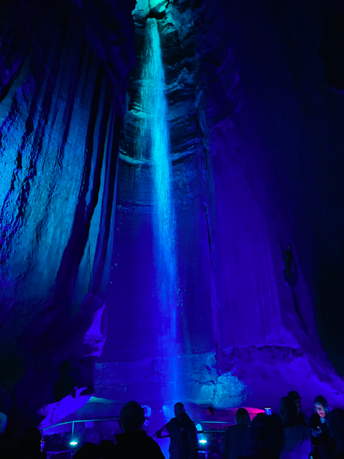 Gin Phillips's novel Ruby Falls is named after the famous underground waterfall in Chattanooga, Tennessee. The tallest (145 feet) and deepest (1,120 feet) underground waterfall open to the public in the United States is named after the wife of its discoverer, Leo Lambert, who turned it into a tourist attraction. In the novel, Leo's wife's best friend Ada falls in love with the beauty of the world underground. Despite Ada and the murder mystery in the book being fictional inventions, the history of Ruby Falls as told by Phillips is true. But there is so much more to this unique story that occurs beyond the timeframe in which Ruby Falls is set.
Ruby Falls Cave is part of Lookout Mountain, a mountain ridge that makes up part of the southern end of the Cumberland Plateau and sits at the point where Georgia, Alabama, and Tennessee meet. Prior to the discovery of Ruby Falls, locals were familiar with Lookout Mountain Cave, which had been a regular source of shelter for Indigenous tribes, outlaws, and moonshiners, and during the Civil War, it was used as a hospital and a mine for saltpeter to make gunpowder. At the turn of the 20th century, however, the Southern Railroad Company built a tunnel through Lookout Mountain that blocked the cave's natural entrance, limiting access.
Enter Leo Lambert: a chemist by trade and a caver by passion. Lambert had explored Lookout Mountain Cave when it was still accessible, and in the 1920s he set about reopening it as a tourist attraction. Along with a group of investors, Lambert raised $250,000 to drill down from the surface into the cave on the other side of the railroad tunnel. In 1928, a worker drilling with a jackhammer discovered a void in the rocks; further examination revealed an opening eighteen inches high and five feet wide, and into this opening went Leo and a small crew. After seventeen hours, the group emerged and told of the underground waterfall they'd found—the waterfall that would be named Ruby Falls after Leo's wife. Fifteen thousand pounds of dynamite later, a 400-foot elevator shaft traveled from the surface through Ruby Falls Cave and down into Lookout Mountain Cave, and by the summer of 1930, tours into the two caverns were open to the public. The tours entered the caves through the elevator inside Ruby Falls Castle, the "World's Most Magnificent Cave Entrance" built above the caves using the five million pounds of limestone excavated from the elevator shaft.
Ruby Falls became a popular attraction, but the onset of the Great Depression significantly impacted its financial viability and the Lamberts had to sell it. The new owners kept it open throughout the Depression, though Lookout Mountain Cave closed in 1935.
The 1960s saw Ruby Falls Cave designated as a Civil Defense fallout shelter, and in 1985, the cave, the waterfall, and the castle were placed on the National Register of Historic Places. In 2018 the park was expanded, and in 2022, the 93-year-old Ruby Falls Castle was updated and modernized. Today, Ruby Falls welcomes more than half a million visitors each year and has expanded its offerings to include nature-based activities, luxury treehouse lodgings, and award-winning special park events in addition to its original tour. What began as an accidental discovery is now an attraction that has created almost a century's worth of memories for families from around the world. Hopefully Phillips's novel will inspire even more to visit the waterfall and cave that satisfied Ada's curiosity and desire for independence.
Ruby Falls waterfall in 2024, photo by Asdaiang14453 via Wikimedia Commons CC BY 4.0
Filed under Cultural Curiosities
 This article relates to Ruby Falls.
It first ran in the March 25, 2026
issue of BookBrowse Recommends.
This article relates to Ruby Falls.
It first ran in the March 25, 2026
issue of BookBrowse Recommends.



The thing that cowardice fears most is decision
Click Here to find out who said this, as well as discovering other famous literary quotes!

Can you name the title?
Test your book knowledge with our daily trivia challenge!
Your guide toexceptional books
BookBrowse seeks out and recommends the best in contemporary fiction and nonfiction—books that not only engage and entertain but also deepen our understanding of ourselves and the world around us.