
-
Your next favorite book
is waiting.
Summary | Excerpt | Reviews | Beyond the Book | Read-Alikes | Genres & Themes | Author Bio
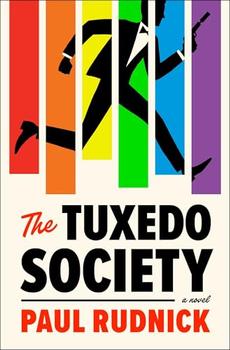
A Novel
by Paul Rudnick Book Reviewed by:
This article relates to The Tuxedo Society

 In 2012, queer audiences the world over celebrated a bisexual James Bond reveal in Skyfall—when he is sexily threatened by a villain played by Javier Bardem, Daniel Craig's Bond retorts, "What makes you think this is my first time?" The homoerotic scene proved popular among viewers, although the studio had previously tried to cut that line out.
The Skyfall scene was the exception to the rule (and, indeed, more of a throwaway line than anything—queer fans aren't expecting a Bond Boy in lieu of a Bond Girl anytime soon); action and spy movies as a genre have historically been uber-masculine and heterosexual. However, these movies' emphasis on male bodies, power, and sex appeal lends them an interesting homoerotic subtext. For an early example, Gore Vidal has talked about his work as an uncredited screenwriter on Ben-Hur (1959); although it was never explicit in the film, Vidal, a queer man himself, claims that he wrote the main characters such that their relationship could be read as a pair of ex-lovers, rather than just masculine friends. Director Quentin Tarantino has said that Top Gun (1986), a male-dominated action movie, is a gay film, and it's not hard to see why—there's a sort of erotic framing of the male body, and the relationships between Maverick and his fellow pilots are full of meaningful glances and extended touches. And Sam Mendes, the director of Skyfall, said that despite James Bond's womanizing, "there's a huge homoerotic undertow in a lot of Bond movies."
But there are also action movies and TV shows that explicitly feature their protagonists' queerness—movies that The Tuxedo Society's protagonist Andrew, a gay actor and action movie fanatic, would surely love. Below are three titles that, like The Tuxedo Society, feature queer spies and/or secret agents:
D.E.B.S. (2004), directed by Angela Robinson
This "unapologetically camp, sapphic spy film" takes place at a clandestine paramilitary academy and features a lesbian forbidden romance between a new spy and the supervillain she's tasked with catching. The movie has been lauded for normalizing queerness, as it is much more focused on spoofing more serious spy films than in explaining the intricacies of queer women's identities and desire; as a Washington Post critic put it, the movie "accepts same-sex attraction as a norm, something not at all 'unusual' or strange but something so a part of the landscape it doesn't require comment."
Atomic Blonde (2017), directed by David Leitch
Nominally about a spy desperately searching for a list of covert agents about to be exposed in Berlin, only months before the fall of the Berlin Wall, Atomic Blonde is perhaps best known now for popularizing the art of "bisexual lighting": the movie casts Charlize Theron's face in a mix of blues, pinks, and purples as she skulks around Berlin as Lorraine Broughton, the MI6 agent charged with retrieving the list of agents before the KGB can sell them out. Along the way, she becomes entangled with French agent Delphine Lasalle, leading to some spicy scenes that would fit right into the raunchy Tuxedo Society.
Q-Force (2021), created by Gabe Liedman
Q-Force may not have taken off when it released on Netflix in 2021, but the unapologetically queer and campy super-spy show draws from the same tropes and cultural touchstones that The Tuxedo Society so effectively spins into humor. This group of queer intelligence agents is an overlooked, underestimated outpost of the American Intelligence Agency (AIA) based in West Hollywood, who must learn to work with a new straight teammate to achieve the renown they deserve from their colleagues. Full of sassy comments, deep-cut references, and a robust cast of queer voice actors, Q-Force was highlighted as "splendidly queer" by The Spool, and the show's humor and tone complement The Tuxedo Society perfectly.
A silhouette of a man in front a computer, by Chris Yang.
Filed under Music and the Arts
 This article relates to The Tuxedo Society.
It will run in the July 15, 2026 issue of BookBrowse Recommends.
This article relates to The Tuxedo Society.
It will run in the July 15, 2026 issue of BookBrowse Recommends.

L.A. Women by Ella Berman
Two ambitious writers in 1960s LA face betrayal when one writes a novel based on the other's life.






Your guide toexceptional books
BookBrowse seeks out and recommends the best in contemporary fiction and nonfiction—books that not only engage and entertain but also deepen our understanding of ourselves and the world around us.

