
-
Your next favorite book
is waiting.
Summary | Excerpt | Reviews | Beyond the Book | Read-Alikes | Genres & Themes | Author Bio

A Novel
by Tom Lin Book Reviewed by:
This article relates to Babylon, South Dakota

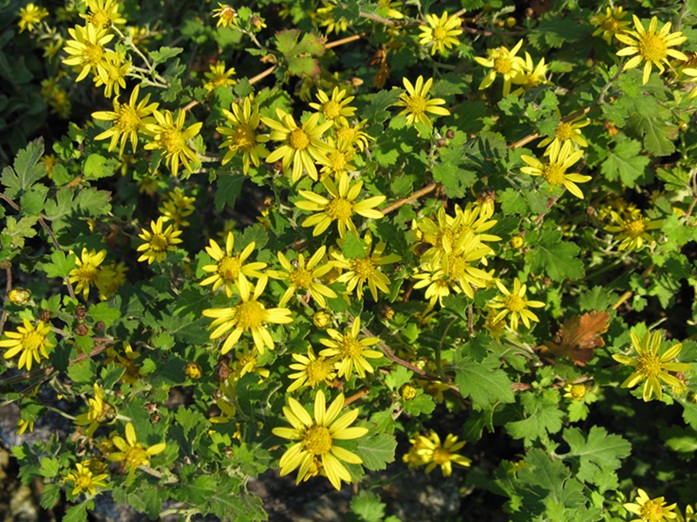 In Tom Lin's Babylon, South Dakota, Saul and Mei migrate from China to America with only some gold and a packet of chrysanthemum seeds. Once rooted in the soil, the flowers become almost a character in the story, taking over the land, refusing to be cut down or pruned, and surviving even the harshest of winters.
It was in China that the cultivation of these colorful flowers first started, before spreading to Japan, and later Europe. In fact, the first written mention of chrysanthemums comes from the Chinese poet Tao Yuanming, who in a collection of poems described the blossoms as symbols of persistence due to the chrysanthemum's late autumn blooming season, which is too cold for most other flowers to blossom. Thus begins a long history of the chrysanth's usage in Chinese art and literature, representing the overcoming of hardships and longevity. The flower is one of the "Four Gentlemen" of Chinese art—plum, orchid, bamboo, and chrysanthemum—all plants highly praised not just for their beauty, but also for the lessons and values they teach.
Of course, Tom Lin is no stranger to this history and is very on-the-nose about the symbolism of the flowers in Babylon, South Dakota. During the first year of the Hsius' life in the US, an unforgiving winter kills almost all the produce on their farm, but the chrysanthemums somehow survive: "And even as the world spun to a lacerating winter [Saul] clung tightly to a future carpeted by the flowers of his ancestors and his forsaken homeland." And "carpeted" is the perfect description, since soon Saul's twenty blossoms propagate into thousands. Just as the Hsiu family endures multiple challenges on the farm and yet remains grounded at the end, so do the chrysanths—again, following the theme of persistence. "But now, after so many years of drought, the flowers had become uncontrollable. No other plant could compete […], for the chrysanthemums grew so dense and quick that the seedlings of all other plants were destroyed in the darkness."
And yet the adversities do change the flowers, for in adapting to a life in America, they inadvertently let go of some of their Chinese roots, just as the Hsius assimilate to American culture in some ways. When Saul is in a coma, his daughter Mara, born and raised in the US, takes care of the chrysanthemums. In Saul's absence, the flowers lose their bright colors and turn white, growing ever stronger. Adaptability is, after all, a part of permanence and longevity.
Even today, the Double Ninth Festival (also known as Chong Yang) in China celebrates the chrysanthemum's history as a symbol of a long life, with flowers decorating the streets and people consuming various chrysanth teas, liquors, and cakes. All things considered, it is inconceivable to think of any other plant being so firmly rooted in the pages of Babylon, South Dakota.
Chrysanthemum indicum in Osaka, Japan, photo by KENPEI via Wikimedia Commons, CC BY-SA 3.0
Filed under Places, Cultures & Identities
 This article relates to Babylon, South Dakota.
It will run in the July 15, 2026 issue of BookBrowse Recommends.
This article relates to Babylon, South Dakota.
It will run in the July 15, 2026 issue of BookBrowse Recommends.
Theo of Golden by Allen Levi
One spring morning, a stranger arrives in the small southern city of Golden. No one knows where he has come from…or why…




Your guide toexceptional books
BookBrowse seeks out and recommends the best in contemporary fiction and nonfiction—books that not only engage and entertain but also deepen our understanding of ourselves and the world around us.


