
-
Your next favorite book
is waiting.
Summary | Excerpt | Reading Guide | Reviews | Beyond the Book | Read-Alikes | Genres & Themes | Author Bio

A Novel
by Gabrielle Sher Book Reviewed by:
This article relates to Odessa

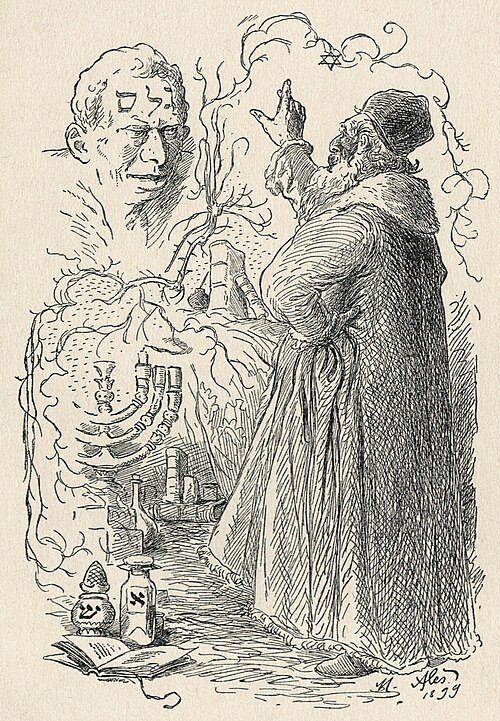 In her debut novel, Odessa, author Gabrielle Sher reimagines the legend of the golem to explore historical persecution of Jews, as well as notions of power and control. In traditional Jewish folklore, a golem is a being formed of earth or clay, given life by its creator using ritualistic incantations and scripture.
The word "golem" comes from ancient Hebrew and usually translates as "unfinished," "shapeless," or "embryo," reflecting both its creation from an inanimate substance and its status as not quite human, despite its humanoid appearance. There are many variations of the golem story throughout Jewish history, but most versions depict the creature as a protector of the Jews, following its creator's orders and using its superhuman strength to defend vulnerable communities from attack.
It is thought by some that wise Rabbis could call upon language set out in the Sefer Yetzirah, or Book of Creation, a work of Jewish mysticism, to bring a golem to life. The most widely known version of the golem story takes place in Prague in the 16th century. The city was under the rule of the Roman Empire, with Jewish communities facing persecution. Seeking to protect his people, Rabbi Judah Loew gathered clay from the Vltava River and formed it into the shape of a man. He then carved three Hebrew letters into the creature's forehead: aleph, mem, and tav. Some versions have him inscribe the letters on a small tablet that he placed in the creature's mouth instead, but in either instance, it is these letters—which together form the Hebrew word emet, meaning truth—that bring the golem to life to stop the attacks.
The golem's role is more nuanced than mere protector, however. In many versions of the tale, the creature becomes increasingly strong and unruly, making it unreliable and difficult to keep under control. In some examples, it begins to develop human emotions, lashing out violently when it faces rejection. In most cases, it either fails to carry out orders, or interprets them so literally that it leads to disaster, ultimately forcing its creator to destroy it. In this way, many see the golem story primarily as a cautionary tale, warning people against the dangers of playing God, or misusing their power over others.
If a golem's creator erased the first letter of the inscription on its head, it was left with the Hebrew word met, meaning death. This would return it to a lifeless mound of clay. One legend has it that after Rabbi Loew turned that famous golem back into clay, he hid its remains in the attic of the Altneuschul synagogue in Prague, ready to be reanimated should the Jewish people ever require its protection once more.
Rabbi Loew creating the golem
Image courtesy of the Czech Digital Library
Filed under Places, Cultures & Identities
 This article relates to Odessa.
It first ran in the June 10, 2026
issue of BookBrowse Recommends.
This article relates to Odessa.
It first ran in the June 10, 2026
issue of BookBrowse Recommends.
Theo of Golden by Allen Levi
One spring morning, a stranger arrives in the small southern city of Golden. No one knows where he has come from…or why…





Your guide toexceptional books
BookBrowse seeks out and recommends the best in contemporary fiction and nonfiction—books that not only engage and entertain but also deepen our understanding of ourselves and the world around us.

