
-
Your next favorite book
is waiting.
Summary | Excerpt | Reviews | Beyond the Book | Read-Alikes | Genres & Themes | Author Bio

In Search of the Disappearing Darkness
by Megan Eaves-Egenes Book Reviewed by:
This article relates to Nightfaring

While Megan Eaves-Egenes travels the world in search of the night sky in Nightfaring, the encroaching threat of light pollution looms over the proceedings. It's hard for it not to: as she explains in the first chapter, the light from LEDs can travel "30 to 40 kilometers (about 20 to 25 miles)," while "the cumulative skyglow from a big city…can sometimes be seen 200 kilometers (125 miles) away." But when you're talking about something like an omnipresent skyglow, it can be useful to know exactly what it is you're dealing with. Luckily, we have the Bortle scale to help us determine precise levels of light pollution. Astronomers use the scale to measure sky brightness, set realistic expectations for what can be seen at a given site, and communicate sky quality clearly across different observing locations.
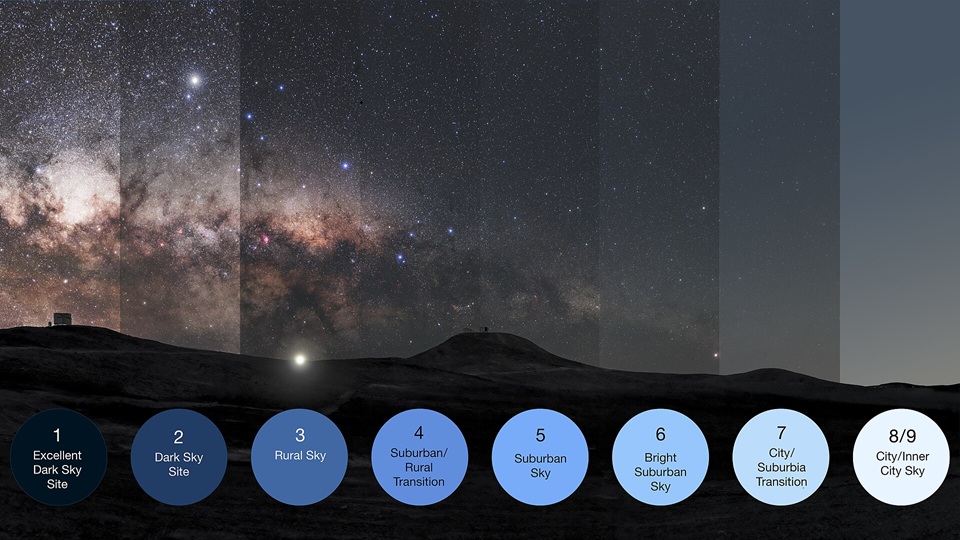
The Bortle scale was developed by an amateur astronomer by the name of John E. Bortle, and was first published in 2001 by Sky & Telescope magazine. The scale measures light pollution, ranging from 1 (least polluted) to 9 (most polluted); although Bortle's focus as an astronomer was generally on comets, it's become widely used across the amateur astronomy community (as well as by anyone who appreciates the night sky) to communicate sky conditions.
The top of the scale, Class 9, is used to denote the skies one might see in the inner city: most of the constellations are blocked out by skyglow, with only a few large, close objects (the moon and some of the planets) truly visible without aid. Going down the scale, visibility gradually improves. In a bright suburban sky (Class 6), traces of the Milky Way are visible, if only at the zenith (or the very top of the sky); in the rural/suburban transition zone (Class 4), the zodiacal light, or diffused sunlight, is visible, if weakened.
Eventually, you get all the way down to glorious Class 1, which you'll find only in very rural areas. This is where the full beauty of the night sky is apparent, furthest away from the light pollution of civilization. The spiral Triangulum galaxy, or M33, is readily visible; you may see the sky glow with zodiacal light, and the stars glimmer and twinkle before you.
Illustration of the Bortle scale by the European Southern Observatory (ESO), via Wikimedia Commons CC BY 4.0
Filed under Medicine, Science and Tech
 This article relates to Nightfaring.
It first ran in the May 20, 2026
issue of BookBrowse Recommends.
This article relates to Nightfaring.
It first ran in the May 20, 2026
issue of BookBrowse Recommends.





We have to abandon the idea that schooling is something restricted to youth...
Click Here to find out who said this, as well as discovering other famous literary quotes!

Can you name the title?
Test your book knowledge with our daily trivia challenge!
Your guide toexceptional books
BookBrowse seeks out and recommends the best in contemporary fiction and nonfiction—books that not only engage and entertain but also deepen our understanding of ourselves and the world around us.

_(flipped_left-right).jpg)