
-
Your next favorite book
is waiting.
Summary | Excerpt | Reviews | Beyond the Book | Read-Alikes | Genres & Themes | Author Bio

A Novel
by Julia Langbein Book Reviewed by:
This article relates to Dear Monica Lewinsky

In Dear Monica Lewinsky, a fictionalized, supernaturally powerful version of Lewinsky helps a woman experiencing shame and confusion about a past sexual experience with a much older man. In real life, Lewinsky is an activist committed to fighting the shaming of women—and this career path is the direct result of her own trauma.
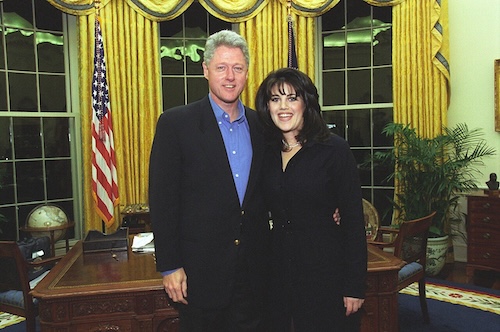 Lewinsky was a young intern at the White House in 1995 when she became sexually involved with then-president Bill Clinton. Reflecting on it years later in an essay for Vanity Fair, she wrote: "At the time—at least from my point of view—it was an authentic connection, with emotional intimacy, frequent visits, plans made, phone calls and gifts exchanged. In my early 20s, I was too young to understand the real life consequences."
Lewinsky was transferred to the Pentagon in 1996, where she told Linda Tripp, a coworker with whom she had become close, about the affair. Unbeknownst to Lewinsky, Tripp was recording their phone calls, and she turned the tapes over to independent counsel Kenneth Starr in January 1998.
Early online news site The Drudge Report was the first to break the news of the relationship later that month, and Lewinsky became the target of derision. Jay Leno made her the butt of his jokes more than 450 times during his time as a late-night host, researchers at George Mason University found, making her one of his top political targets. The news media didn't treat her much better. An article in the New York Times referred to Lewinsky as "a ditzy, predatory White House intern."
Months after the story broke, Starr argued that Clinton had committed perjury by denying the affair under oath, and the House approved two articles of impeachment. Clinton was acquitted by the Senate in 1999.
While Clinton's reputation was somewhat tarnished, the less powerful Lewinsky had a rockier path. Her attempt to launch a handbag line (she was far too controversial to be hired for another government job) was a widely mocked failure. Her pursuit of a masters degree from the London School of Economics (which she later successfully obtained) became national news.
In 2014, Lewinsky was back in the spotlight with a viral Vanity Fair essay about shame and cyberbullying. This time, she was met with a more welcome reception. Decades into the internet age, people were more ready to accept the damaging effects of so much negative attention, and that making a twenty-something intern, rather than the president, the target of blame was unfair.
In that essay, Lewinsky asserted, "Sure, my boss took advantage of me, but I will always remain firm on this point: it was a consensual relationship." But a few years later, the #MeToo movement began to highlight the exploitation inherent in relationships with large power imbalances. And Lewinsky's next viral essay, in 2018, reexamined the affair from that standpoint. She remained confident that she had consented, but noted that it was "a gross abuse of power" on Clinton's part. "The road that led there was littered with inappropriate abuse of authority, station, and privilege."
The degree of public shaming that Lewinsky, a young woman with very little power, faced may be unthinkable to some now in the post-#MeToo era. But young, attractive women continue to be the targets of cruel tabloids and forums, and many women who've been sexually exploited blame themselves. Lewinsky is using her unwanted fame to advocate for them—and this time people are listening to her.
President Bill Clinton and Monica Lewinsky photographed in the Oval Office of the White House in 1997, courtesy of White House Photograph Office and the Clinton Presidential Library
Filed under People, Eras & Events
 This article relates to Dear Monica Lewinsky.
It first ran in the April 22, 2026
issue of BookBrowse Recommends.
This article relates to Dear Monica Lewinsky.
It first ran in the April 22, 2026
issue of BookBrowse Recommends.

L.A. Women by Ella Berman
Two ambitious writers in 1960s LA face betrayal when one writes a novel based on the other's life.






Your guide toexceptional books
BookBrowse seeks out and recommends the best in contemporary fiction and nonfiction—books that not only engage and entertain but also deepen our understanding of ourselves and the world around us.

