
-
Your next favorite book
is waiting.
Summary | Excerpt | Reading Guide | Reviews | Beyond the Book | Read-Alikes | Genres & Themes | Author Bio

A Novel
by Kiran Millwood Hargrave Book Reviewed by:
This article relates to Almost Life

Born in Paris in 1840, Claude Monet grew up in the town of Le Havre in Normandy. He was interested in art from a young age, studying at a Le Havre arts school under masters Jacques-François Ochard and Eugène Boudin, the latter of whom became his mentor and introduced him to "en plein air," or outdoor painting techniques. After relocating back to Paris as a young man, Monet fell into a social circle of fellow artists, including Édouard Manet, alongside whom he painted and developed his style, before fleeing to England in 1870 after the outbreak of the Franco-Prussian War. It was here that he studied the works of John Constable and Joseph Mallord William Turner, whose innovative landscapes would come to influence Monet's signature style.
After returning to France, Monet painted Impression, Sunrise, which depicted a Le Havre landscape. A critic derisively referred to its style as "Impressionism," a term which Monet and his circle embraced. Characterized by its short brushstrokes, vibrant colors, and distinctive depiction of natural elements like sunlight and water, Impressionism is a style that attempts to capture the visual impression of a fleeting moment, in opposition to more realistic, naturalistic styles.
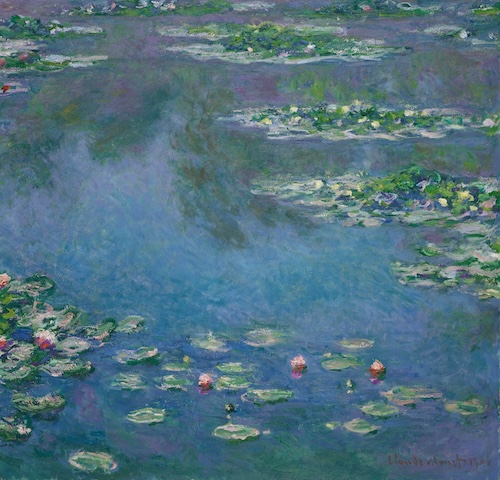 After the death of his first wife in 1879, Monet remarried and relocated to Giverny, where he began work on his Nymphéas, or Water Lilies series. Nymphéas refers both to the scientific name for water lilies, and to the story from Greek mythology in which nymphs lured Hercules' companion Hylas into a lily pond to drown. Monet worked on his Water Lilies series, depicting the water garden he had installed at his Giverny estate, for nearly thirty years, from the 1880s to his death at 86 in 1926. This series comprises nearly 300 paintings, and includes two types of compositions: one that depicts the edge of the pond and its vegetation, and one that depicts only the surface of the water with its lilies.
On the day following the Armistice of November 11, 1918, Monet offered several decorative panels of his Water Lilies series to the State of France as a symbol of peace, but ever the perfectionist, Monet was never satisfied enough with them to complete the donation before his death in 1926. The following year, in 1927, eight Water Lilies panels were installed in the Musée de l'Orangerie in Paris. Installed in a circle all along the curved walls of the room that was built specifically for this exhibition, the panels take up a total of 2,153 square feet and echo the layout of the building: the placement of sunrise scenes are positioned to the east, and sunset scenes to the west. One of the panels was damaged during the Paris bombings of 1944, but was later restored. The museum was renovated in the 1960s, and the result obstructed the natural light of the room, until it was renovated again in 2006. In 1952, French artist André Masson referred to this room as "the Sistine Chapel of Impressionism."
The Musée de l'Orangerie is where Erica and Laure gaze upon Monet's Nymphéas in Kiran Millwood Hargrave's romantic literary novel Almost Life. It is in this room that Erica first realizes the extent of her romantic feelings toward Laure, and as their relationship evolves and takes on different forms in the decades to come, the meditative quality of the Nymphéas is what tethers the two women to the simplicity of their young love for one another.
Water Lilies (1906), by Claude Monet, courtesy of Art Institute of Chicago
Filed under Music and the Arts
 This article relates to Almost Life.
It first ran in the April 22, 2026
issue of BookBrowse Recommends.
This article relates to Almost Life.
It first ran in the April 22, 2026
issue of BookBrowse Recommends.

L.A. Women by Ella Berman
Two ambitious writers in 1960s LA face betrayal when one writes a novel based on the other's life.






Your guide toexceptional books
BookBrowse seeks out and recommends the best in contemporary fiction and nonfiction—books that not only engage and entertain but also deepen our understanding of ourselves and the world around us.

