
-
Your next favorite book
is waiting.
Summary | Excerpt | Reading Guide | Reviews | Beyond the Book | Read-Alikes | Genres & Themes | Author Bio

A Novel
by Francis Spufford Book Reviewed by:
This article relates to Nonesuch

 When Nonesuch begins, just before the invasion of Poland by the Nazis in the late summer of 1939, Geoffrey Hale is a technical wizard working for the BBC in the young medium of television. Although by this point residents of the United Kingdom only have about 20,000 TV sets all told, Geoff rhapsodizes about its capabilities. "It makes you feel like you're there," he says, "and not just in one place, either. It's a flow…a pack [of images] shuffled by television itself." Soon enough, Geoff has to leave the cozy confines of the BBC for Dunkirk, but it's a reminder to the reader of the progress and innovation that waits on the other side of the war.
The history of television actually began a century before the events of the novel. That was when inventors like Samuel Morse and Alexander Graham Bell began to transmit sounds and messages through wires. It was understood that transmitting images this way was theoretically possible, but it took the work of many people, including physicist Karl Braun and engineer Paul Nipkow (both German), to lay the foundation for this new invention over the course of several decades.
Although there isn't one single inventor of the television, John Logie Baird is one of the two people generally cite. A Scottish inventor who battled poor health and scant resources, he built upon the work of Braun, Nipkow, and others to create a device in 1926 that used a spinning disc with holes punched in it to transmit images. At first, it was just a novelty demonstrated to customers at the famous department store Selfridges; two years later, experimental stations began the first regular broadcasts.
Meanwhile, across the pond, a patent battle was taking place between RCA, who claimed that their Vladimir Zworykin invented a form of television back in 1923, and Philo Farnsworth, a Utah man who devised his own device and patented it in 1927. After a lengthy legal battle, Farnsworth won, and he is now generally seen as the father of the modern television in the United States.
And, while the war did halt the rapid progress of television in the UK, it began to flourish when peace was restored—just in time to broadcast the coronation of Queen Elizabeth II.
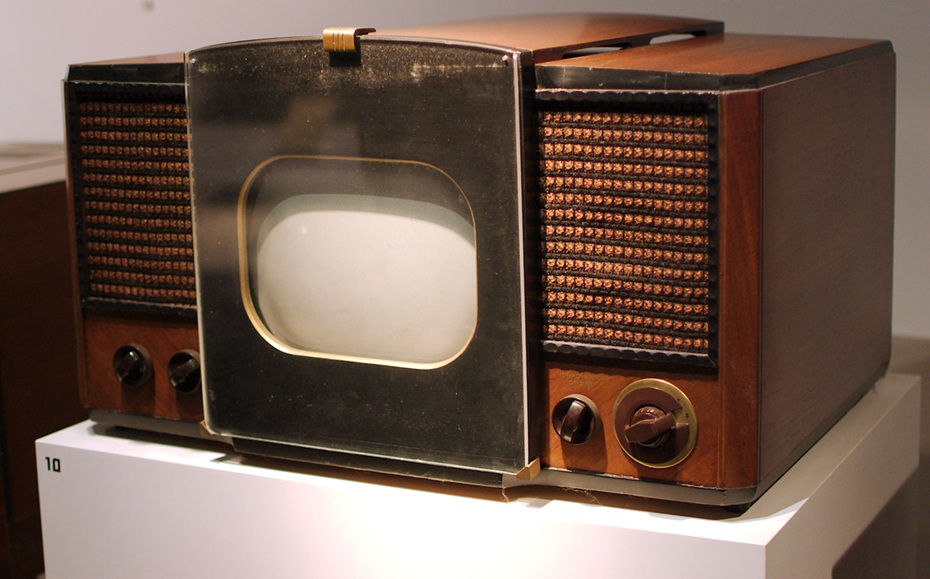
RCA Model 630-TS television set from the 1940s, photo by Fletcher6, courtesy of Wikimedia Commons CC BY-SA 3.0
Filed under Cultural Curiosities
 This article relates to Nonesuch.
It first ran in the April 8, 2026
issue of BookBrowse Recommends.
This article relates to Nonesuch.
It first ran in the April 8, 2026
issue of BookBrowse Recommends.

L.A. Women by Ella Berman
Two ambitious writers in 1960s LA face betrayal when one writes a novel based on the other's life.






Your guide toexceptional books
BookBrowse seeks out and recommends the best in contemporary fiction and nonfiction—books that not only engage and entertain but also deepen our understanding of ourselves and the world around us.


