
-
Your next favorite book
is waiting.
Summary | Excerpt | Reading Guide | Reviews | Beyond the Book | Read-Alikes | Genres & Themes | Author Bio

A Novel
by T Kira Madden Book Reviewed by:
This article relates to Whidbey

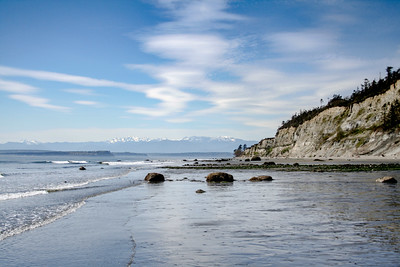 Whidbey Island, approximately 45 miles long with a total land area of 168.7 square miles, is situated in the Pacific Northwest, off the coast of Washington and nestled in the waters of Puget Sound. Its original, ancestral name is Tscha-kole-chy, used by the Native tribes that first inhabited it, including the Lower Skagit, Swinomish, Suquamish, and Snohomish. The first known European sighting of Whidbey was in 1790 during a Spanish expedition, but Whidbey was not explored by European settlers until 1792, in an expedition by Captain George Vancouver. Two Royal Navy officers and members of Vancouver's expedition, Joseph Whidbey and Peter Puget, thoroughly mapped the area which would become known as Puget Sound. Vancouver christened the island Whidbey Island after Whidbey circumnavigated it in June 1792.
While Vancouver claimed the island and surrounding areas for Britain, it was not occupied by British settlers. The first known non-Native occupant of Whidbey was a Catholic missionary, Father Francis N. Blanchet, who was invited to the island in 1840 by the leader Chief Tslalakum. He remained for a year, baptizing over 200 inhabitants.
The first white settler on Whidbey was farmer Thomas W. Glasgow in 1848. Glasgow married a woman he called Julia Pat-ke-nim, the daughter of a Snohomish chief, and left after a year under pressure from the Native inhabitants and at his wife's suggestion.
In 1850, Colonel Isaac N. Ebey became the first permanent white settler on Whidbey. He farmed potatoes and wheat and also worked as the postmaster in Port Townsend, Washington, rowing a boat daily across the inlet to work on the mainland. In 1857, at 39 years old, Ebey was murdered by North Coast Natives in retaliation for the killing of tribal members by the US military in 1856. In 1942, Fort Ebey was established in his honor. It was built by the Harbor Defense Command during World War II, to help protect military bases around Puget Sound.
Even after the death of Ebey, white settlers continued to populate Whidbey Island, leading to the displacement of Native people from their land—currently, about 80% of inhabitants are white, and less than 1% are Native.
Today, around 70,000 people live on Whidbey Island. Its economy is divided along the two halves of the island: in the northern half, Whidbey Island Naval Air Station provides the largest number of jobs to residents. The southern half of the island runs on a tourist economy, with the main attractions being its state parks and nature reserves, art galleries, boutiques, wine tastings, museums, whale watching, kayaking, and kiteboarding (a wind-powered water sport that combines elements of wakeboarding, surfing, and sailing).
Whidbey is also home to numerous festivals throughout the year. Some of the most well-attended are Whidbey Island Fair, Island Shakespeare Festival, Whidbey Island Kite Festival, Penn Cove Mussel Festival, Whidbey Island Marathon, and Whidbey Island Highland Games. For one weekend in February, the town of Langley turns into the setting of a fictional murder mystery for Langley's Mystery Weekend.
It's generally recommended to visit Whidbey between spring and fall, when the weather is at its most temperate, but rain is common during the warmer seasons. The easiest way to access Whidbey is by ferry—there are several ferry routes from different departure points on the mainland. Ferry rides are generally half an hour or less.
The island of Whidbey provides the setting for T Kira Madden's debut novel, appropriately titled Whidbey, where a woman spends her summer on the island in an attempt to take refuge from the media storm that surrounds her.
Useless Bay, Whidbey Island
Photo by Cindy Shebley, CC BY 2.0
Filed under Places, Cultures & Identities
 This article relates to Whidbey.
It first ran in the March 25, 2026
issue of BookBrowse Recommends.
This article relates to Whidbey.
It first ran in the March 25, 2026
issue of BookBrowse Recommends.

L.A. Women by Ella Berman
Two ambitious writers in 1960s LA face betrayal when one writes a novel based on the other's life.






Your guide toexceptional books
BookBrowse seeks out and recommends the best in contemporary fiction and nonfiction—books that not only engage and entertain but also deepen our understanding of ourselves and the world around us.

