
-
Your next favorite book
is waiting.
Summary | Excerpt | Reviews | Beyond the Book | Read-Alikes | Genres & Themes | Author Bio

A Story of Siblinghood and Survival
by Trina Moyles Book Reviewed by:
This article relates to Black Bear

Many Indigenous people view themselves as stewards of the land and nature and, in North America, have special relationships with bears. Tribes such as the Chippewa, Creek, and Mi'kmaq have Bear clans, while others perform a traditional Bear Dance. The Haudenosaunee Bear Dance, performed as part of a midwinter ceremony, imitates a bear's movements and is intended to cure medical complaints. The Zuni also believe in bears' healing powers and wear carved bear talismans. Historically, Native leaders and warriors have worn bear claw necklaces as a symbol of strength.
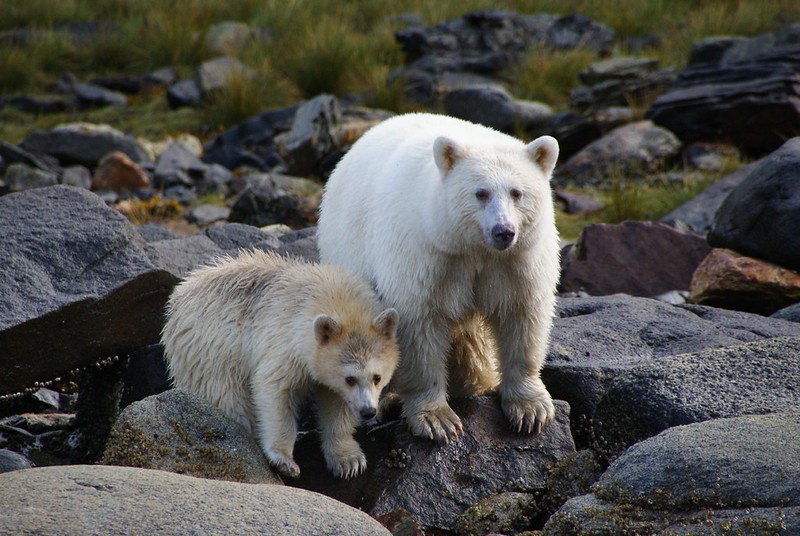
As Trina Moyles learned while writing Black Bear, understanding bear hierarchies allows First Nations to live in communion rather than conflict with bears. For instance, in salmon-fishing communities in the southwestern Yukon, Native peoples "intentionally tolerate the presence of older, dominant bears" because they keep younger bears in line. This means that, despite sharing a human food source, bears don't become a problem. Scholars have called for Indigenous-led management of grizzly bears in the Great Bear Rainforest of British Columbia. "Since the beginning of time, grizzly bears have been considered relatives, requiring respect and instilling an imperative of responsibility." In 2017, the Central Coast First Nations were successful in lobbying for a ban on the trophy hunting of grizzly bears. "Spirit bears" (or Kermode bears) are a rare white subspecies of the black bear found in British Columbia. A Kitasoo legend says that Raven, the creator, made the spirit bears as a reminder of the ice and snow that used to cover the earth during the Ice Age. In 2005, Spirit Bear Lodge, owned by the Kitasoo Xai'xais First Nation, opened to encourage eco-tourism, offering wildlife-watching and culture tours. Some Indigenous communities, such as the Champagne and Aishihik First Nations in southwestern Yukon, still engage in bear hunting, but show respect to the dead animal by addressing it as a family member and placing its skull high up in a tree.
Many Native peoples, including the Dene, Lakota, Ojibwe, and Ute, have legends about black bears or grizzly bears that emphasize the animals' kinship with people. One Pawnee story, "The Bear Man," has a man befriending a bear cub and asking it to look after his son in the future. When the son grows up and is killed in battle, the bear remembers the man's kindness and brings his son back to life. A Northern Cherokee Nation legend about the origin of bears and bear hunting tells how one clan went to live in the forest. Gradually, the people became covered with hair and grew unused to human food. They decided not to come back to their settlements. "Hereafter we shall be called yanu (bears), and when you yourselves are hungry come into the woods and call us and we shall come to give you our own flesh."
A well-known legend among Northwest Coast peoples is "The Woman Who Married a Bear." This has many variations, but the common storyline is this: a young woman initially shows disrespect for bears while out berry picking (by stepping over bear droppings, which women were forbidden to do), then meets a young man in the forest who takes her to his home. Only when she has become his wife does she realize that he is a shape-shifting bear. They live together in a den near her brothers' hunting ground and she leaves signs so they can find her. Her feelings for the bear-man alternate between fear and fondness. He has shamanic abilities and correctly prophesies that the brothers will kill him. When the woman and her twins fathered by the bear-man don bearskins, they, too, turn into bears. Moyles retells this story at one point in the book. Her solitude at the fire tower and her identification with her animal acquaintances was such that a friend texted her, "Just a gentle reminder. You are not a bear." However, the affinity she built with bears was real, and was inspired by the attitude modeled by Indigenous peoples: bears are not a nuisance or an enemy, but family.
Kermode bears at Spirit Bear Lodge, Klemtu, British Columbia (2014)
Photo by Maximilian Helm, CC BY 2.0
Filed under Places, Cultures & Identities
 This article relates to Black Bear.
It first ran in the February 11, 2026
issue of BookBrowse Recommends.
This article relates to Black Bear.
It first ran in the February 11, 2026
issue of BookBrowse Recommends.

L.A. Women by Ella Berman
Two ambitious writers in 1960s LA face betrayal when one writes a novel based on the other's life.







Your guide toexceptional books
BookBrowse seeks out and recommends the best in contemporary fiction and nonfiction—books that not only engage and entertain but also deepen our understanding of ourselves and the world around us.

