
-
Your next favorite book
is waiting.
Summary | Excerpt | Reading Guide | Reviews | Beyond the Book | Read-Alikes | Genres & Themes | Author Bio
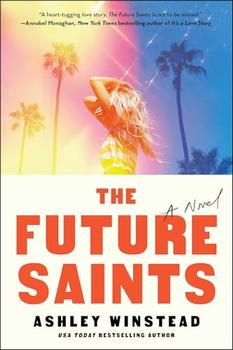
A Novel
by Ashley Winstead Book Reviewed by:
This article relates to The Future Saints

 In a bit of myth-making, it is often said that in 1969 Janis Joplin fell to her knees, tears in her eyes, on the final note of her Woodstock performance. There is no evidence that this happened, but the image persists because it captures something audiences believed to be true about Joplin: that she did not simply perform, but bled on stage. That same year, a journalist described her as follows: "Girl singers are supposed to be pretty, or sexy, or have warm and honey voices, but the girl from San Francisco by way of Texas has none of this. She is The Unpretty of pop music as she drops into an indelicate squat, pulls back the mic stand, and howls." And all this sounds exactly like Hannah Cortland the first time we meet her in The Future Saints.
Amy Winstead opens her novel with a blunt line—"The woman on the stage is haunted"—and goes on to describe a performance that ends with Hannah dropping to her knees as she performs a song about grief and self-destruction, the vulnerable moment that catapults the band to success.
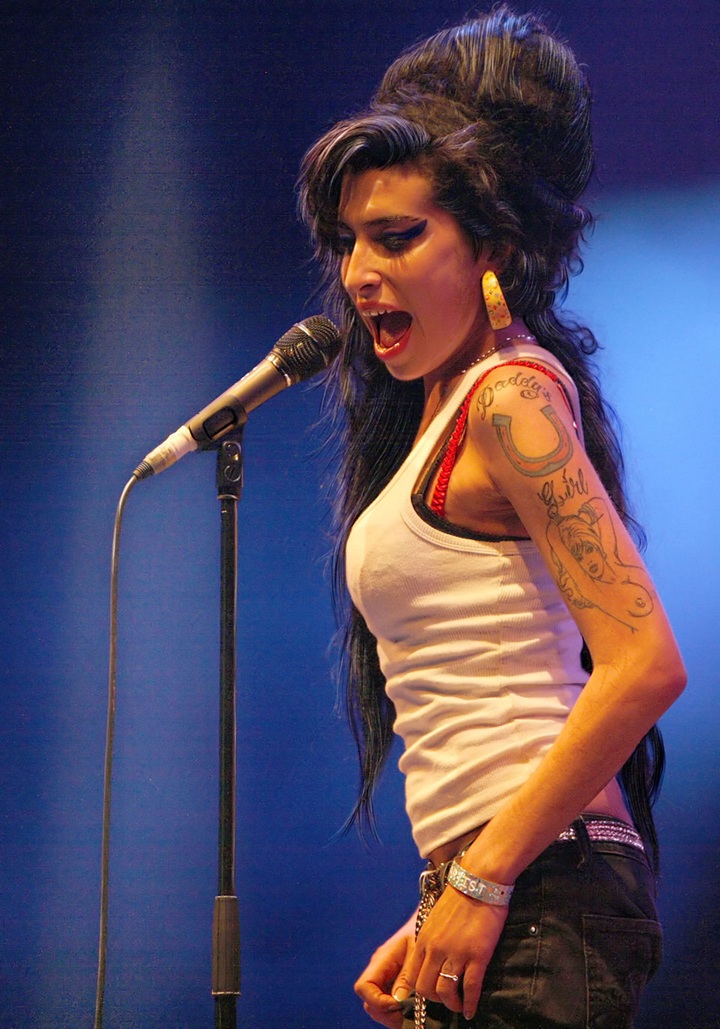
Throughout the novel, Hannah's pain is consumed, expected, monetized: Roger Braverman, the band's label's CEO, sends paparazzi to follow her to parties where she is visibly unravelling, as well as to visits to her sister's grave; teenagers cry on TikTok, claiming identification with her pain; fans beg for more songs about self-destruction; critics compare her to Amy Winehouse and Janis Joplin for her alcoholism, to Sinéad O'Connor for her refusal to conform to the music industry's expectations, and to Britney Spears for moments framed as public breakdowns. Winstead draws on all of these women to create Hannah, echoing through her a familiar pattern: an industry that demands women's visibility while denying their autonomy.
Winehouse and Joplin are often paired, united by extraordinary talent and early death. Both died at the age of twenty-seven from overdose, and it doesn't seem a coincidence that Hannah is barely twenty-eight in the novel. A character even states that he's "worried Hannah will go the way of Janis Joplin."
Their addictions are at the same time romanticized and weaponized. Comparisons to male artists like Kurt Cobain reveal the double standard. As one critic notes, Cobain remains "the voice of a generation," while Winehouse "was vilified, blamed, and mocked for her addiction" as well as a "paparazzi target whose struggles were portrayed as bigger than her trademark beehive and always overshadowed her talent." Like her, Hannah struggles with alcohol, is followed by paparazzi, and the world seems more interested in these struggles than in her music, despite her band's nomination for five Grammys (the same number Winehouse won in 2008). Her pain is made a spectacle, consumed, and then used to discredit her. The public, it would seem, loves to watch women break drown.
No moment illustrates this more clearly than Britney Spears's head-shaving incident in 2007. Framed as a meltdown, the image is now iconic. Yet years later, Spears described the act in these terms: "People thought that it was me going crazy and stuff ... But people shave their heads all the time ... It was me feeling a form of a little bit of a rebellion. Feeling free. Or shedding stuff that had happened."
Hannah shaves her head too, though not as an act of liberation. For her, it is an attempt to inhabit the reckless persona the world has already assigned her. A cover story asks: "Sinead or Britney? Is Hannah Cortland's Shaved Head an Act of Defiance or a Cry for Help?"
It's true Hannah's performances reveal pain, but they also carry a spirit of rebellion. We see it in small, comedic scale during a performance at her former high school, from which both she and her sister Ginny had been previously banned for life. There, in an act of defiance, she performs a sexually explicit song in front of the students, enraging the principal. Her rebellious streak reaches a pinnacle during her Grammy acceptance speech, which ends with her telling Roger, "fuck you, and fuck Manifest Records."
The moment recalls Sinéad O'Connor's refusal to attend the Grammys and accept the Best Alternative Music Performance award. The Irish singer, who shaved her head in opposition to imposed femininity standards, rejected an industry that was "concerned mainly with material success." She later added that these ceremonies "honor those who have achieved material success rather than people who have told the truth or who have done anything to pass information to people, or to inspire people, or to just be truthful."
Yet O'Connor was not only rebellion, just as Winehouse and Joplin were not only addiction, or Spears only breakdown. Hannah's full speech makes this clear: she also speaks of her sister, her ambition, her fans, and her renewed hope. In this way, The Future Saints refuses the false binary the industry imposes on women—breakdown or defiance—and demands that we see them instead as whole.
Amy Winehouse in 2010, courtesy of Rama via Wikimedia Commons CC BY-SA 2.0 FR
Filed under Music and the Arts
 This article relates to The Future Saints.
It first ran in the February 11, 2026
issue of BookBrowse Recommends.
This article relates to The Future Saints.
It first ran in the February 11, 2026
issue of BookBrowse Recommends.

L.A. Women by Ella Berman
Two ambitious writers in 1960s LA face betrayal when one writes a novel based on the other's life.






Your guide toexceptional books
BookBrowse seeks out and recommends the best in contemporary fiction and nonfiction—books that not only engage and entertain but also deepen our understanding of ourselves and the world around us.


