
-
Your next favorite book
is waiting.
Summary | Excerpt | Reviews | Beyond the Book | Read-Alikes | Genres & Themes | Author Bio

A Fable
by Jonathan Miles Book Reviewed by:
This article relates to Eradication

The premise of Jonathan Miles's darkly comic novel Eradication is fiendishly simple: a man is hired by a humanitarian foundation to sail to a desert island and, in the name of biodiversity, kill every goat he can find. To such an intriguing set-up, Miles attaches an equally intriguing subtitle: A Fable. It's a word that evokes myth and fairy tale—a signpost letting the reader know that they're no longer held by the bounds of reality. But what exactly is a fable, and how does Eradication fit into this millennia-old tradition?
Fables, in their most basic form, are short narratives usually featuring anthropomorphized animals. Above all, they convey a moral—that is, a pithy saying offering the audience a lesson on how best to live. The most famous fables have seeped deep into our cultural consciousness, and their morals have become, in the words of folklorist D. L. Ashliman, "embraced as among the essential truths about human beings and their ways." Indeed, all of us know the virtue of persistence and patience, because "slow and steady wins the race," just as all of us know that those who "cry wolf" will lose the trust of others when it really matters.
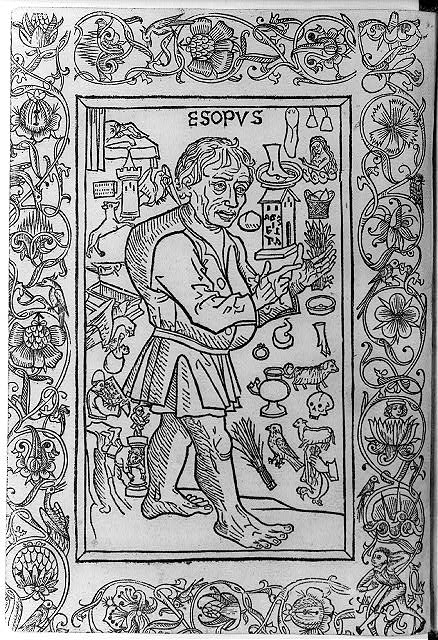 In Western literature, fables are most closely associated with Aesop, a freed Greek slave who lived sometime in the 7th century BCE. He is said to have authored hundreds of fables, with modern editions of his collected works including up to 600 of the short tales. In reality, however, Aesop is likely a legendary figure to whom other writers—from both the Classical Era and later, in the Middle Ages—attributed a myriad of stories and teachings that had been passed down over the centuries as part of the oral tradition. There is even evidence that the fable constitutes one of the earliest forms of human storytelling; "Aesopic" narratives can be found among the Sumerian literature of Mesopotamia, which flourished a whole millennium before the Greek fabulist allegedly began his career.
It is clear, at any rate, that the fable as a narrative form has a particularly enduring power—no doubt related to its seeming ability to distill the complexity of human life to its bare elements, and sum up a universal truth in the simplest of terms. Given the age at which most of us are introduced to fables (and their emphasis on how we should behave), we may have a tendency to conflate them with children's stories. But their simplicity conceals the importance of the social role they've played throughout the centuries. The indirect way in which fables examine human nature—via talking animals and fantastical situations—has often provided the politically powerless with the perfect vehicle to express otherwise inexpressible truths to their superiors. After all, it is perhaps no coincidence that Aesop, according to the legend, was born a slave.
That power of social commentary lives on to this day, and Jonathan Miles is certainly not alone among the writers to see a contemporary use for this ancient form. Some of the most celebrated authors from the 20thcentury—Italo Calvino (Italian Folktales and Marcovaldo), Jorge Luis Borges (The Aleph), George Orwell (Animal Farm)—have written modern fables to examine human nature and lay bare its follies. And in the 21st century—a time when the animal kingdom is bearing the brunt of those follies—it's no surprise that the fable has lost none of its significance, as evidenced not only by Eradication but also by works like George Saunders's Fox 8 and The Boy, the Mole, the Fox and the Horse by Charlie Mackesy. These days, however, it's harder to view the genre's simple world of foxes and wolves, rabbits and goats, as a stand-in for human society. As Eradication shows, more often than not it is our victim.
1481 woodcut depicting Aesop surrounded by images from his fables, courtesy of Library of Congress
Filed under Books and Authors
 This article relates to Eradication.
It first ran in the February 11, 2026
issue of BookBrowse Recommends.
This article relates to Eradication.
It first ran in the February 11, 2026
issue of BookBrowse Recommends.

L.A. Women by Ella Berman
Two ambitious writers in 1960s LA face betrayal when one writes a novel based on the other's life.




Your guide toexceptional books
BookBrowse seeks out and recommends the best in contemporary fiction and nonfiction—books that not only engage and entertain but also deepen our understanding of ourselves and the world around us.

