
-
Your next favorite book
is waiting.
Summary | Excerpt | Reviews | Beyond the Book | Read-Alikes | Genres & Themes | Author Bio

 Book Reviewed by:
This article relates to Small Things Like These

 Claire Keegan's slim novel, Small Things Like These, is in many ways about the things that people leave unsaid—the things they can't or won't say out of fear or, as it turns out, out of kindness.
In perhaps the most important example of this theme, towards the end of the novel, a passing comment from a neighbor about the resemblance between Bill and local farmhand Ned sparks a moment of realization: Ned is Bill's father. Ned was a constant, kindly presence throughout Bill's childhood, particularly following his mother's death. Ned's actions, "steadfastly watching over him through the years," imply he was aware of the truth all along. Why then, did he never say anything? The answer is a bittersweet revelation for Bill that speaks of Ned's selfless nature, and of how silence can sometimes be intended as a kindness: "hadn't it been an act of daily grace, on Ned's part, to make [Bill] believe that he had come from finer stock," Bill thinks. An unmarried, working-class laborer, Ned chose to forgo the full bond he may have had with his son so that Bill could hold on to the idealized imagined version of who his father may have been.
When Bill determines to help Sarah, a young girl who has suffered great abuse at the hands of the nuns in the local convent, he thinks back on his own childhood from a new perspective. His mother, an unmarried teenager shunned by her family, only avoided ending up at the very same convent because her employer, Mrs. Wilson, took her in; and when his mother died twelve years later, Mrs. Wilson continued to look after Bill. Though he failed to appreciate the gravity of these actions at the time, he can see now the "daily kindnesses" that Mrs. Wilson showed both him and his mother; "the small things she had said and done and had refused to do and say and what she must have known, the things which, when added up, amounted to a life." In this retrospective judgement, the things that Mrs. Wilson did not say are granted as much significance as the things she did—she "refused" to tell Bill about the ridicule that followed both him and his mother, or the judgement she no doubt received for associating with them, omissions that were a kindness to young Bill.
And of course, so much of the novel is about the complicit silence of the townspeople about the abuses of the powerful church—silence born out of fear, but which allows abuse to continue.
Keegan's formal choices skillfully highlight this very theme. Like her characters, she opts to hold back at key moments, omitting explicit explanations and trusting readers to interpret things on their own. And like her characters, we, as readers, are forced to think deeply about what a character's silence or omission might mean—and these moments of realization hit harder as a result.
For example, in a touching instance of Bill unknowingly following in his father's footsteps, he too allows his children to believe they come "from finer stock" by not telling them about his difficult upbringing. After musing internally on a particularly sad Christmas, on which the only two things he asked for—a jigsaw puzzle of a farm from Santa, and a chance to meet his father—failed to materialize, he instead tells his daughters that "Santy came, surely… He brought me a jigsaw of a farm one year." With a simple line, Keegan delivers a sucker punch to the reader, as we realize not only the motivation behind his lie, but how striking the parallel is to Ned's omission about Bill's own parentage.
In another scene in which Keegan allows the reader to interpret others' silence, Bill returns to the convent and rescues Sarah. As he guides her, weak and weary, through the icy streets towards his home, "Not one person they met addressed Sarah or asked where he was taking her." Some stare, some make awkward small talk with Bill before ducking away, some cross the street to avoid them altogether, but no one speaks to Sarah directly or offers to help. There is no shock at her disheveled appearance. There is no concern for her wellbeing. Instead, and without Keegan having to tell us, their collective silence to Sarah speaks volumes to the reader about the town as a whole: They have long known the truth about the convent, but chose to turn a blind eye so as not to invoke the wrath of the church. Sarah is a victim of institutionalized abuse, but she is also, in effect, a physical representation of the shameful truth her community has ignored.
While Small Things Like These may be slight, it is not necessarily the kind of novel you want to plow through. With such depth hiding in what Keegan and her characters hold back, it is a book that benefits from time and consideration, allowing the full impact of each interaction to reveal itself with greater poignancy.
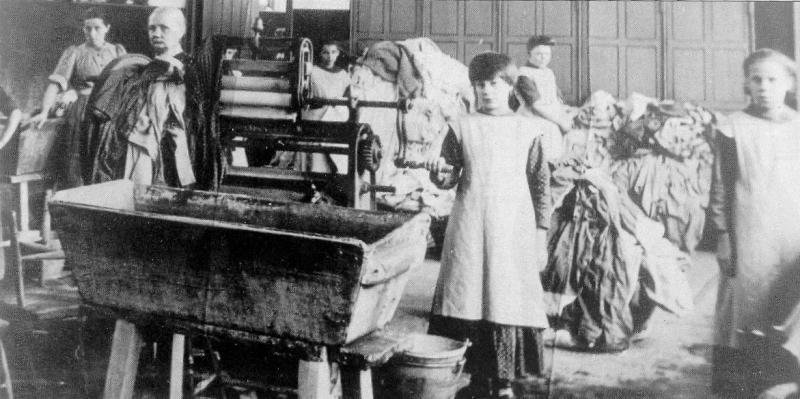
Image of a Magdalene laundry from Wikimedia Commons.
Filed under Books and Authors
 This article relates to Small Things Like These.
It first ran in the January 28, 2026
issue of BookBrowse Recommends.
This article relates to Small Things Like These.
It first ran in the January 28, 2026
issue of BookBrowse Recommends.

L.A. Women by Ella Berman
Two ambitious writers in 1960s LA face betrayal when one writes a novel based on the other's life.




Your guide toexceptional books
BookBrowse seeks out and recommends the best in contemporary fiction and nonfiction—books that not only engage and entertain but also deepen our understanding of ourselves and the world around us.


