
-
Your next favorite book
is waiting.
Summary | Excerpt | Reading Guide | Reviews | Beyond the Book | Read-Alikes | Genres & Themes | Author Bio

 Book Reviewed by:
This article relates to I Am You

The area known today as the Low Countries (Belgium, the Netherlands, Luxembourg) had by the sixteenth century been ruled for more than a hundred years by the Burgundy and Habsburg dynasties, before Holy Roman Emperor Charles V transferred power of the region to his son Philip II of Spain. In 1568, Dutch nobleman William of Orange led a revolt against Philip II, launching the Eighty Years' War, during which time several northern Dutch provinces joined forces to declare their independence from Spanish rule. These provinces united to form the Dutch Republic (roughly corresponding to the modern-day Netherlands), which was recognized as an independent country in 1648, while the Southern Netherlands (corresponding to modern-day Belgium, Luxembourg, and parts of northern Germany and France) remained under Spanish Catholic rule.
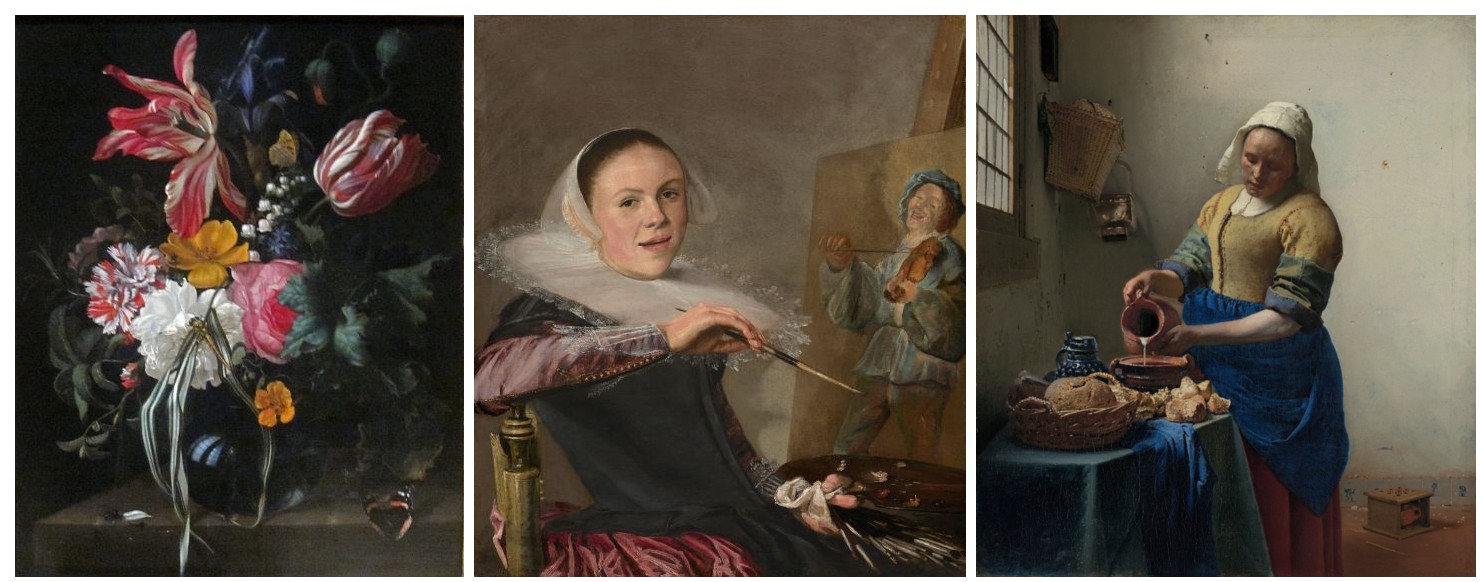
The Dutch Republic in the seventeenth century saw a surge in economic prosperity, with trade being the most lucrative industry. Many artists and craftsmen from the Catholic south fled north to enjoy newfound freedom, leading to a swell in artistic prominence for the region, which, free from Catholic rule and the artistic traditions it carried, began a largely secular reinvention. Five distinct genres of painting emerged: landscape painting, genre painting, history painting, portraiture, and still life.
Before the seventeenth century, landscapes had rarely been the focus of paintings, as they were often relegated to the background of religious scenes. Now, landscapes took on a life of their own. Dutch art was a source of national pride, and local patrons took great pleasure in their countryside being depicted with such beauty and realism. Jacob van Ruisdael, Aelbert Cuyp, and Hendrick Avercamp were some of the prominent names in landscape painting.
Some artists specialized in one type of painting, while others had multiple specialities.
Genre paintings, or scenes of everyday life, were another popular format for painters. These paintings depicted, among numerous other subjects: musicians, tavern scenes, peasant families, servants at work, and market scenes. One of the most famous genre paintings of the era was Gerrit van Honthorst's The Matchmaker, which displays a brothel scene; another is Vermeer's The Milkmaid, showing a domestic kitchen maid at work.
History painting refers not only to historical subjects, but also Biblical ones: not all art produced during this period was secular, but as churches were no longer commissioning paintings, the market for religious art dwindled. Still, some viewers craved familiar religious iconography, and a small contingent of religious art emerged. History paintings also included familiar literary, mythological, and allegorical scenes, as well as scenes from Dutch historical events. Rembrandt was one of the foremost historical painters, though he did not find much financial success in this niche; he was much more successful selling portraits.
Portraiture was perhaps the most financially lucrative genre for a painter during this time. In addition to Rembrandt, Frans Hals, Jan de Bray, Jan Steen, and others enjoyed success painting noblemen, merchants, guild members, militiamen, and family groups. One of the most famous portraits from the period is Self-Portrait by Judith Leyster—one of only two women to be admitted to her painters' guild. A subgenre of portraiture was the tronie—a close-up study of a person and their facial expression, in which the identity of the subject was not as important as the emotion being conveyed. The most notable example of a tronie is Vermeer's Girl with a Pearl Earring.
The final genre that thrived during the Dutch Golden Age is the still life, which required technical prowess in capturing minute details with realism. Subjects of still lifes ranged from food to tables and desks to flowers. As flowers were one of the few subjects deemed acceptable for female artists, a few women rose to prominence in this field: one of the two most notable names was Rachel Ruysch, and the other was Maria van Oosterwijck, the subject of Victoria Redel's historical fiction novel I Am You. Van Oosterwijck saw a great amount of success; her patrons included the Holy Roman Emperor Leopold I, Louis XIV of France, and William III of England. She also trained her maid, Gerta Pieters, to paint. Redel explores the relationship between these women at length, while brilliantly evoking the beautiful scenes they each painted.
Left to right:
Maria van Oosterwijck's Vase of Tulips, Rose, and Other Flowers with Insects, via Wikimedia Commons
Judith Leyster's Self-Portrait, via National Gallery of Art
Johannes Vermeer's The Milkmaid, via Google Arts & Culture
Filed under Music and the Arts
 This article relates to I Am You.
It first ran in the October 8, 2025
issue of BookBrowse Recommends.
This article relates to I Am You.
It first ran in the October 8, 2025
issue of BookBrowse Recommends.

L.A. Women by Ella Berman
Two ambitious writers in 1960s LA face betrayal when one writes a novel based on the other's life.






Your guide toexceptional books
BookBrowse seeks out and recommends the best in contemporary fiction and nonfiction—books that not only engage and entertain but also deepen our understanding of ourselves and the world around us.


