
-
Your next favorite book
is waiting.
Summary | Excerpt | Reviews | Beyond the Book | Read-Alikes | Genres & Themes | Author Bio

 Book Reviewed by:
This article relates to Cécé

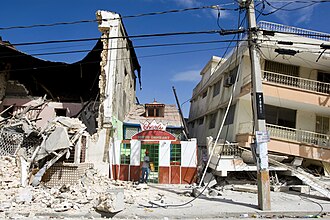 Emmelie Prophète's novel Cécé lays bare the hardship of day-to-day life in modern Haiti, as seen through the eyes of the titular heroine. Cécé bears witness to widespread poverty, rampant drug abuse, and deadly gang warfare. Despite how brutal this may sound, Cécé sees her life as "a very ordinary story," and indeed, this environment is very much the norm in modern Haiti, especially in the capital, Port-au-Prince. (Prophète, who was formerly Haiti's Justice Minister, presumably has a deep knowledge of Haiti's sociopolitical climate and the issues the country faces.)
Haiti is the poorest country in the Western hemisphere. Its modern history—as a colony whose economy was based on slavery that became, after the Haitian Revolution, a sovereign state soon plagued by political instability, debt, US occupation, and dictatorial rule—has resulted in a fractured society with vast disparities in wealth, infrastructure, health, politics, and opportunities. Recent events like fuel shortages, devastating earthquakes, and COVID-19 have exacerbated this situation.
Gang violence, which has long been a problem in Haiti, has escalated since the 2021 assassination of President Jovenel Moïse. With the country in a state of flux, lacking leadership and effective law enforcement, armed gangs seized the opportunity to tighten their grip on Port-au-Prince, a city that is now 85% controlled by gangs. In the resulting chaos, 1.3 million Haitians have been displaced. Between October 2024 and June 2025, at least 4,864 people in Haiti were killed by gang violence, many of them civilians, and hundreds more were injured, kidnapped, raped, or sold into human trafficking.
Concern has grown in 2025 among international human rights organizations, as violence between rival gangs is expanding into new areas of the country and attacks in regions beyond Port-au-Prince are becoming more common. It appears that gangs are branching out from central Haiti towards the border with the Dominican Republic, striving to control crucial routes of illegal weapons, and trafficking and facilitating easier access to these weapons, the number of which is already vast.
Haiti's UN special representative, María Isabel Salvador, has expressed concern that the country is fast approaching a "point of no return" into "total chaos." One UN initiative mobilized around 1,000 police officers from six countries to provide on-the-ground back-up to the Haitian National Police. This fell short, however, of the mission's target of 2,500 officers, and it failed to make any lasting impact.
Frustrated by these seeming inadequacies and fearful for their country's future, Haitians have been establishing their own self-defense groups to oppose the gangs. But not only does this vigilante approach put civilians at even greater risk, reports suggest some of these groups are themselves guilty of human rights violations, including lynching suspected gang members; human rights abuses have also been carried out by official Haitian security forces. In the words of Haiti's ambassador to the UN, Ericq Pierre, "The Republic of Haiti is slowly dying under the combined action of armed gangs, drug traffickers and arms dealers" and the UN must "help rid the country of the gangs that are terrorizing the population."
Image of the 2010 earthquake's destruction by Marco Dormino/The United Nations, CC BY-2.0.
Filed under Society and Politics
 This article relates to Cécé.
It first ran in the October 8, 2025
issue of BookBrowse Recommends.
This article relates to Cécé.
It first ran in the October 8, 2025
issue of BookBrowse Recommends.

L.A. Women by Ella Berman
Two ambitious writers in 1960s LA face betrayal when one writes a novel based on the other's life.






Your guide toexceptional books
BookBrowse seeks out and recommends the best in contemporary fiction and nonfiction—books that not only engage and entertain but also deepen our understanding of ourselves and the world around us.


