
-
Your next favorite book
is waiting.
Summary | Excerpt | Reading Guide | Reviews | Beyond the Book | Read-Alikes | Genres & Themes | Author Bio

A Novel
by Dan Chaon Book Reviewed by:
This article relates to One of Us

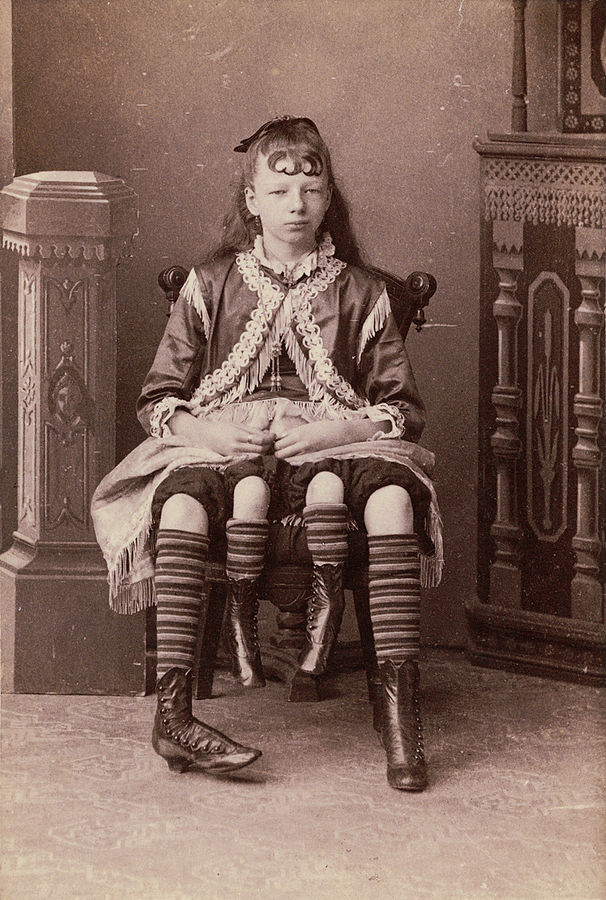 In the early 20th century, traveling circuses were common, and so were the sideshows that often accompanied them. While no one can definitively say which was the first, we know that P.T. Barnum was an early innovator. In 1842, he opened a museum to display his collection of oddities and human attractions. After the museum burned down, Barnum took his show out on the road. It featured a lot of the performers (or "freaks") that we most associate with sideshows today. Siamese twins Cheng and Eng Bucker were on the tour, as was General Tom Thumb, who was 3'4" owing to his dwarfism. Sideshow performers often married each other, as was the case with the Alligator Boy and the Monkey Girl. I make special mention of Myrtle Corbin, the four-legged girl, whose iconic photo still turns up often. And, if you ask me, the photo of the Three-Legged Man using two stools should be much better known.
Freak shows have always been controversial. Some argue that they were ableist and exploitative. Others counter with how well they paid people who would otherwise not be employable. I have a quadriplegic friend who loves freak show history because it highlights atypical bodies. Furthermore, the historical record of these sideshows reveals what audiences wanted and, therefore, what values were dominant at the time. Given the rich history and critical lore on the subject, you're invited to research and form your own opinion. An interesting angle to the debate is that sideshows, including Barnum's, would often display those who were born with bodily differences separately from "made freaks" who altered their own appearances through heavy tattooing or some other means. A ten-in-one show would have several different attractions (usually 10), while a "single O" would focus on one big draw. Working shows had performers demonstrate fire eating, sword swallowing, and the usual carnival tricks. Another popular event was the "girl show," whose contents you can probably imagine.
Over the years, attitudes and laws related to disability have changed. By the 1940s, freak shows had largely been phased out. With the 1966 founding of the International Independent Showmen's Association in Gibsonton, FL, money became available to help sideshow performers enter retirement. In fact, Gibsonton became a safe haven and community for many.
In One of Us, we get a snapshot of a moment in American history, illustrating what the freak show was like 20 years before it was mostly gone. While the novel's characters aren't real, there are plenty of amazing archives of photos and memorabilia of the historical sideshow performers, including this one from the International Independent Showman's Association, and this one from Ringling. The midway is calling.
Sideshow star Myrtle Corbin in 1882, photographed by Charles Eisenmann and courtesy of Wikimedia Commons
Filed under Cultural Curiosities
 This article relates to One of Us.
It first ran in the September 24, 2025
issue of BookBrowse Recommends.
This article relates to One of Us.
It first ran in the September 24, 2025
issue of BookBrowse Recommends.

L.A. Women by Ella Berman
Two ambitious writers in 1960s LA face betrayal when one writes a novel based on the other's life.




Your guide toexceptional books
BookBrowse seeks out and recommends the best in contemporary fiction and nonfiction—books that not only engage and entertain but also deepen our understanding of ourselves and the world around us.


