
-
Your next favorite book
is waiting.
Summary | Excerpt | Reviews | Beyond the Book | Read-Alikes | Genres & Themes | Author Bio

A Novel
by Patricia Lockwood Book Reviewed by:
This article relates to Will There Ever Be Another You

 In one chapter of Patricia Lockwood's Will There Ever Be Another You, the protagonist narrates her experience giving unofficial lessons in literature to her teenage niece, Angel, who has ambitions of becoming a writer one day herself. Lockwood explains, "Mostly this meant we would read a few pages of whatever I was reading and talk about it...Today, insanely, we were doing Walter Benjamin's 'Hashish in Marseilles.'"
Walter Benjamin (1892–1940) was a German Jewish philosopher and critic, and a master of what we think of today as the personal essay. According to a bio by the editorial staff at Harvard University Press, Benjamin, along with his friend Siegfried Kracauer, "virtually invent[ed] popular culture as an object of serious study," writing in-depth essays about food, gambling, children's literature and toys, and many other topics, including drugs. Benjamin was a contemporary and friend of Hannah Arendt and Bertolt Brecht, and worked as a translator in addition to writing. He is believed to have been inspired to write about hashish in part by translating the hallucinatory work of Charles Baudelaire. Benjamin died by suicide in 1940 whilst fleeing the Nazis.
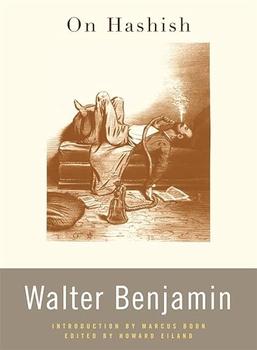 "Hashish in Marseilles" is a fragmentary piece containing Benjamin's reflections on the evening of July 29, 1928, during which he took hashish (a highly potent form of cannabis usually ingested orally in Benjamin's time) and wandered the titular city, stopping in at various nightspots. It is one piece among many in which Benjamin writes about his experiences with drugs—all of which are collected in the volume On Hashish, published for the first time in English by Harvard University Press in 2006. Benjamin had planned to publish a "truly exceptional book about hashish" during his lifetime but this work was not collected until after his death.
The essay features banal observations that together form a concrete picture of the effects of hashish ("My walking stick begins to give me a special pleasure. One becomes so tender, fears that a shadow falling on the paper might hurt it"). Narrating the act of choosing a table at a restaurant, Benjamin writes:
"As I was sitting down, however, the disproportion of seating myself at so large a table caused me such shame that I walked across the entire floor to the opposite end to sit at a smaller table that became visible to me only as I reached it."
Lockwood twists Benjamin's observation into a teaching lesson, asking her niece if she has ever felt "shame at the thought of sitting at a table too large for you." The lesson continues, amusingly:
"'Do you know what hashish is?' I asked her. 'Have you ever been given something that made you feel weird—cough syrup, Benadryl, laughing gas?' My niece confessed that once she had been given ear medicine. I slammed my fist down on the desk. 'Write, then, of wandering through a city at night on your Ear Medicine!'"
She also draws a connection between Benjamin's drug musings and her own experiences with caffeine ("I would have a Coca-Cola Classic...and exit my body") but more significantly these reflections on "Hashish in Marseilles" are at home amongst the author's narration of the neurological issues she developed after a Covid-19 infection, which lean toward the synesthetic and anthropomorphic. Like Benjamin, Lockwood offers a compelling investigation of altered perceptions.
Walter Benjamin in 1928
Source: Akademie der Künste, Berlin - Walter Benjamin Archiv, modified version via Wikimedia Commons
Filed under Books and Authors
 This article relates to Will There Ever Be Another You.
It first ran in the September 24, 2025
issue of BookBrowse Recommends.
This article relates to Will There Ever Be Another You.
It first ran in the September 24, 2025
issue of BookBrowse Recommends.
L.A. Women by Ella Berman
Two ambitious writers in 1960s LA face betrayal when one writes a novel based on the other's life.






Your guide toexceptional books
BookBrowse seeks out and recommends the best in contemporary fiction and nonfiction—books that not only engage and entertain but also deepen our understanding of ourselves and the world around us.


