
-
Your next favorite book
is waiting.
Summary | Excerpt | Reviews | Beyond the Book | Read-Alikes | Genres & Themes | Author Bio

A Novel
by Addie E. Citchens Book Reviewed by:
This article relates to Dominion

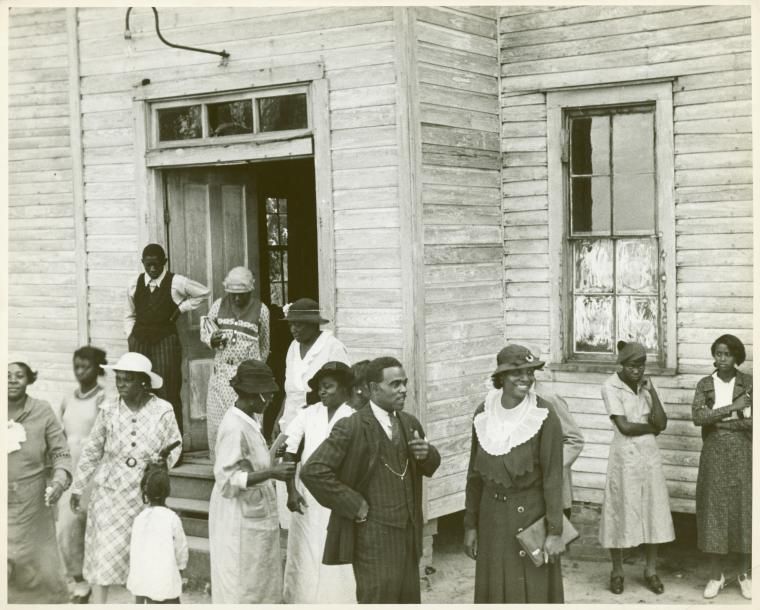 In Dominion by Addie E. Citchens, religion strongly influences both a family and the entire town of Dominion, Mississippi. The focus is on the Winfreys, whose patriarch is the reverend of the Seven Seals Baptist Church. Because of how important and widespread Christianity is in the South, this position brings power and high status to him and his family. Throughout the novel, townspeople talk about their faith and feelings toward the church, illustrating how deeply religion is part of their town and Southern US culture. While faiths of various kinds are important to millions of people all around the world, religion in the American South significantly shapes daily life, actions, and social hierarchies more than in many other places. In 2011, a Gallup survey found that Mississippi had the highest percentage of "very religious" Americans, with 59% identifying as such. By contrast, in several states in the Northeast, including New York, Rhode Island, Massachusetts, Vermont, Maine, and New Hampshire, 32% or less of residents reported being "very religious." But why is religion so prevalent in the South?
Christianity has profoundly shaped the land of the Bible Belt, a roughly defined region in the Southern US where religious traditions significantly influence daily life, particularly in Alabama and Mississippi. Christianity's impact is deeply rooted in Southern life, tracing back to the early European settlers who carried their faith across the Atlantic. As they built colonies and communities, churches became not just places of worship but also hubs of social activity and community bonding. During the 17th and 18th centuries, what is now known as the Bible Belt was the heart of Anglican beliefs, with Baptist denominations gaining prominence in the late 18th century. The evangelical movement sparked by the Second Great Awakening—led by Baptists, Methodists, and Presbyterians—ignited a religious revival that spread throughout the South. By the Civil War era, most Southerners with religious affiliations were either Baptist or Methodist.
Black churches played a significant role in the post-Civil War era, becoming centers for building Black political power, and are credited with fostering racial consciousness across Southern regions (and elsewhere) at this time. Reverend George Freeman Bragg, a Black Episcopal priest and journalist, also noted the value of biracial political collaboration in the Episcopal Church and the Readjuster movement (a Virginia political party that sought to appeal to both Black and white people). The participation of Black Baptists and Episcopalians in coalitions during key political moments transformed the nation after emancipation, steering the country toward a democracy that included Black political influence. Today, Mississippi has the largest Black population of any state, and among all major racial or ethnic groups in America, the Black community is the most religious.
Overall, America is widely regarded as a religious nation, with over two-thirds of the population identifying as moderately or very religious. Yet regional and cultural differences matter. As noted historically and in Citchens' book, Southern Black churches have a significant impact on their members and communities. In Dominion, we see how the church functions as a space for weddings, classrooms, counseling, and a music studio. As an institution, it acquires property for low-income housing, supplies buses for transportation, and runs a restaurant with a mission "to provide nutritious, delicious Delta delicacies and to create meaningful work opportunities for the indigent and poor." Aside from the Mormon regions of the Rocky Mountain West, no other area in the US exhibits this kind of widespread dominance of religious belief and practice. The extent to which the church is integrated into the daily lives and livelihood of Dominion's community reinforces its presence, and creates a culture where religion is central politically, economically, and socially.
Sunday in Little Rock, Ark., 1935. by Ben Shahn
From The New York Public Library
Filed under Places, Cultures & Identities
 This article relates to Dominion.
It first ran in the September 24, 2025
issue of BookBrowse Recommends.
This article relates to Dominion.
It first ran in the September 24, 2025
issue of BookBrowse Recommends.

Theo of Golden by Allen Levi
One spring morning, a stranger arrives in the small southern city of Golden. No one knows where he has come from…or why…






Your guide toexceptional books
BookBrowse seeks out and recommends the best in contemporary fiction and nonfiction—books that not only engage and entertain but also deepen our understanding of ourselves and the world around us.

