
-
Your next favorite book
is waiting.
Summary | Excerpt | Reviews | Beyond the Book | Read-Alikes | Genres & Themes | Author Bio
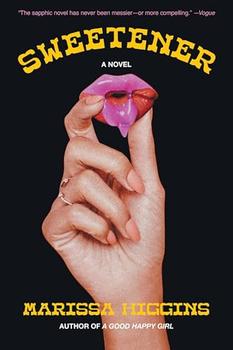
A Novel
by Marissa Higgins Book Reviewed by:
This article relates to Sweetener

 In Sweetener, Charlotte and Olivia go to the Smithsonian to view an exhibit of dioramas created by forensic scientist Frances Glessner Lee to further the training and work of law enforcement in solving crimes involving a suspicious death. One piece they look at closely features a woman lying on the floor, surrounded by the ordinary debris of life—magazines, canned goods, a pie in the oven. The point of examining the tiny room, according to Charlotte, is not to determine what happened to the woman: "[T]here's no right answer...The dioramas are exercises in detail, both for the creator and the observer." This is particularly true for Charlotte, who is a claymation artist struggling with her career and purpose in life and drawing inspiration from Lee's dioramas.
Frances Glessner Lee is often referred to as the "mother of forensic science." Born in Chicago in 1879, the daughter of a wealthy agricultural industrialist, Lee developed an interest in science when she was in her forties. A Harvard classmate of Lee's brother named George Magrath, a forensic pathologist, mentioned to Lee that there was a dearth of skills and knowledge when it came to solving crimes using science. Partly as a result of this discussion with Magrath, Lee helped found Harvard's Department of Legal Medicine in 1931 with a massive cash endowment ($3.3 million adjusted for inflation) and the dedication of a whole library's worth of books. In 1943, due to her advocacy and understanding of forensics, she was appointed (honorary) captain of the New Hampshire State Police, becoming the first female police captain in US history.
The series that Charlotte and Olivia see, called Nutshell Studies of Unexplained Death (or just Nutshells), consists of 20 murder/death scenes Lee created from 1944–1948, initially intended for study at Harvard seminars on criminal investigation. She was assisted in the woodworking by a carpenter at her family's New Hampshire summer home but handcrafted all of the interior details of the rooms herself. These details were based on real-life death scenes and students in the seminars would be given ninety minutes to review the diorama and determine the most likely cause of death. But as Charlotte says, the answer was not really the point; it was the examination itself that was deemed most valuable for students.
After their use at Harvard, the Nutshells dioramas were moved to the Office of the Chief Medical Examiner in Baltimore where they continued to be used as educational tools for law enforcement. In 2017 they came to the Smithsonian in Washington, DC for exhibition. The museum says in its description of the exhibit viewed by Charlotte and Olivia in Sweetener: "Every element of the dioramas—from the angle of miniscule bullet holes, the placement of latches on widows, the patterns of blood splatters, and the discoloration of painstakingly painted miniature corpses—challenges trainees' powers of observation and deduction." The detailed dioramas are incredibly captivating, both as practical learning tools and works of art. According to documentation from the exhibit, Lee was particularly interested in the pursuit of justice for victims of crime who were impoverished, women, or who were otherwise marginalized, as she understood that bias could hinder an investigation.
Images and video of the dioramas can be viewed on the Smithsonian's website. Fans of historical fiction intrigued by Lee's work may enjoy Katie Tietjen's novel Death in the Details, a mystery inspired by her life.
Nutshell Studies of Unexplained Death, kitchen diorama
Photo by Lorie Shaull, CC BY 2.0
Filed under Cultural Curiosities
 This article relates to Sweetener.
It first ran in the August 27, 2025
issue of BookBrowse Recommends.
This article relates to Sweetener.
It first ran in the August 27, 2025
issue of BookBrowse Recommends.
L.A. Women by Ella Berman
Two ambitious writers in 1960s LA face betrayal when one writes a novel based on the other's life.






Your guide toexceptional books
BookBrowse seeks out and recommends the best in contemporary fiction and nonfiction—books that not only engage and entertain but also deepen our understanding of ourselves and the world around us.

