
-
Your next favorite book
is waiting.
Summary | Excerpt | Reviews | Beyond the Book | Read-Alikes | Genres & Themes | Author Bio

 Book Reviewed by:
This article relates to Verity Vox and the Curse of Foxfire

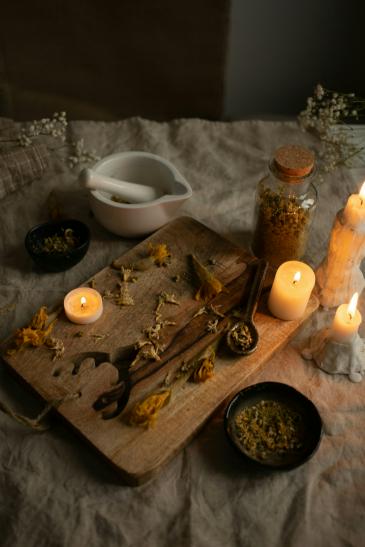 Verity Vox and the Curse of Foxfire is about a witch who saves an Appalachian town called Foxfire from a curse. The Appalachian mountain region has its own tradition of using native plants to perform magic and healing, which is also referred to as root work, granny magic, granny witchcraft, kitchen witchery, or Braucherei.
Appalachian folk magic is borne of a melting pot of different cultures. The Cherokee and the Choctaw were the first to combine the region's nature with spiritual ritual. When European settlers came in the 18th century, they brought traditional folk healing practices from Western Europe, which they later combined with Native knowledge about flowers, berries, roots, and leaves in Appalachia. And they incorporated the knowledge brought to the mountains by people escaping slavery in the south.
The resulting combination of all these practices and beliefs was a faith tradition mostly practiced by women; older women, or "grannies," served as midwives, healers, and stewards of ancestral knowledge to treat isolated communities that did not trust doctors. They used the regenerative properties of native plants to remedy bladder and stomach problems, tended to burns and warts, and provided herbal abortifacients and contraceptives; for example, catnip tea was used for hive prevention and sulfur was put in shoes to relieve the flu. While today witchcraft is associated with femininity, historically the term "witch" has been used by all genders. (Also, the term was applied to people deviating from religious and social expectations, which likely included people who did not conform to gender and sexual norms.)
Another dimension of folk magic has historically been Christianity: often, practitioners were Christian and considered their magic to be a part of their religion. Nikki Chester, who practices granny magic today, recalled that the women in her family "used the book of Psalms like a spell book, combined with an intimate knowledge of the land." Witches may have thought of their powers as a God-given gift or a vessel for God; their healing was the work of the Lord.
Today, many granny witches do not have traditional Christian beliefs and consider their folk magic to be separate from the Christian faith, but others still do. "Our people don't always call this magic," says Sara Amis, a southern writer and practicing pagan. "And they don't always call it witchcraft. It's just what you do. If you grow up in the South, it is everywhere. But people don't always name it, not even among themselves."
Image of wax candles and crushed flowers courtesy of Monstera Production.
Filed under Places, Cultures & Identities
 This article relates to Verity Vox and the Curse of Foxfire.
It first ran in the August 27, 2025
issue of BookBrowse Recommends.
This article relates to Verity Vox and the Curse of Foxfire.
It first ran in the August 27, 2025
issue of BookBrowse Recommends.

L.A. Women by Ella Berman
Two ambitious writers in 1960s LA face betrayal when one writes a novel based on the other's life.






Your guide toexceptional books
BookBrowse seeks out and recommends the best in contemporary fiction and nonfiction—books that not only engage and entertain but also deepen our understanding of ourselves and the world around us.

