
-
Your next favorite book
is waiting.
Summary | Excerpt | Reviews | Beyond the Book | Read-Alikes | Genres & Themes | Author Bio

A Novel
by Ruben Reyes Book Reviewed by:
This article relates to Archive of Unknown Universes

.jpg "Monument for victims of the Salvadoran Civil War") Ruben Reyes Jr.'s Archive of Unknown Universes explores the impact of the Salvadoran Civil War by contrasting one alternative timeline that shows a decisive victory by the government with another that shows the war ending with revolutionaries overthrowing the government. In reality, the Salvadoran Civil War lasted 13 years, from 1979 to 1992, and ended with peace talks facilitated by the United Nations. It was seen as a response to a brutal regime.
Ruben Reyes Jr.'s Archive of Unknown Universes explores the impact of the Salvadoran Civil War by contrasting one alternative timeline that shows a decisive victory by the government with another that shows the war ending with revolutionaries overthrowing the government. In reality, the Salvadoran Civil War lasted 13 years, from 1979 to 1992, and ended with peace talks facilitated by the United Nations. It was seen as a response to a brutal regime.
"It's simple," an organizer tells the character Neto in Reyes's novel, "We want more political space in this country. We want to be able to vote for candidates who actually represent the masses. We're asking for basic promises a government should offer its people: a political voice, less repression, literacy, health care. That's the basis of it, but a revolution looks like the only way to achieve those goals."
El Salvador came under various dictatorships from 1930 through the 1970s. During this period, the Farabundo Martí National Liberation Front (FMLN), a leftist group of guerrilla factions, was formed.
The United States supported the Revolutionary Government Junta (JRG), the Salvadoran military government that took power in 1979, due to economic ties and concerns that the leftist movement might overthrow the government and establish an anti-US communist regime. Over time, US aid increased, including funds for weapons and training for Salvadoran troops, despite ongoing human rights abuses by the JRG. The US provided the JRG with a total of $4 billion in aid to counteract the support the FMLN received from Cuba and the Soviet Union.
"The United States is trying to make El Salvador into another Puerto Rico. The Salvadoran government no longer works for us. They speak of those who dare organize as puppets controlled by the Soviets, but don't look at the fish-wire moving their own limbs," says Anabel, one of the leaders of the activist group fighting the Salvadoran government in the novel.
The conflict continued without significant developments on either side throughout the 1980s. In 1991, the United Nations intervened to facilitate peace talks between the FMLN guerrillas and the government. On January 16, 1992, the Chapultepec Peace Accords were signed in Mexico, officially ending the war. The peace agreement called for a major reduction of armed forces, the dissolution and disarmament of guerrilla groups, a new civilian police force (Policía Nacional Civil, PNC), and a commission to investigate human rights abuses committed by the Salvadoran Armed Forces and the FMLN during the war. The FMLN later became a political party. During the conflict, over a million Salvadorans were displaced, many fleeing to the United States seeking asylum. Since then, violence and political oppression in El Salvador have continued. Recent years have seen a decline in violent crime under the authoritarian government of President Nayib Bukele, a former FMLN member who was expelled from the party, but also a decline in civil rights and due process.
In Archive of Unknown Universes, we see the characters impacted by the war as some face displacement, violence, and trauma that gets passed through generations. The story sheds light on an essential part of El Salvador's history, highlighting how, in war, it is innocent civilians who suffer the most.
Monumento a la Memoria y la Verdad (Monument to Memory and Truth), a black marble monument containing the names of thousands of victims of the war in El Salvador
Photo by Olivia Isabel Flores, CC BY-SA 3.0
Filed under People, Eras & Events
 This article relates to Archive of Unknown Universes.
It first ran in the July 30, 2025
issue of BookBrowse Recommends.
This article relates to Archive of Unknown Universes.
It first ran in the July 30, 2025
issue of BookBrowse Recommends.
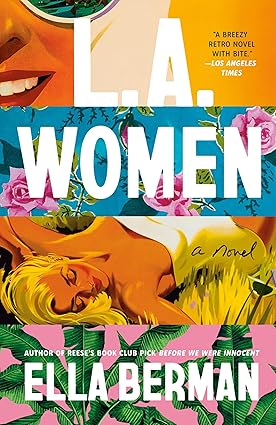
L.A. Women by Ella Berman
Two ambitious writers in 1960s LA face betrayal when one writes a novel based on the other's life.

Your guide toexceptional books
BookBrowse seeks out and recommends the best in contemporary fiction and nonfiction—books that not only engage and entertain but also deepen our understanding of ourselves and the world around us.


