
-
Your next favorite book
is waiting.
Summary | Excerpt | Reviews | Beyond the Book | Read-Alikes | Genres & Themes | Author Bio
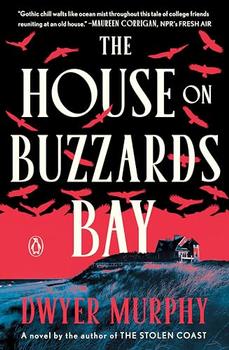
A Novel
by Dwyer Murphy Book Reviewed by:
This article relates to The House on Buzzards Bay

In The House on Buzzards Bay, Dwyer Murphy's gothic thriller, a group of former college roommates reunite for their summer vacation in a beachfront mansion. The house, owned equally by all six friends, was built by the local Spiritualist community in the nineteenth century as a home for the many people coming to join the sect. As Camille, an expert in communal movements, points out to the novel's narrator, the Spiritualists were just one example of "what was going on in America in those days, especially in the Northeast. Small, hopeful offshoots, everywhere you looked." Indeed, with the industrial revolution changing the fabric of society and opening the door to new ways of living, nineteenth-century America was a breeding ground for communal movements rooted in utopian ideals. Murphy's novel—which touches on ideas of communal ownership and polyamory—takes inspiration from two of the period's most famous examples, Brook Farm and the Oneida Community.
Brook Farm
 The community at Brook Farm outside of Boston was founded in 1841 by George and Sophia Ripley, transcendentalists who counted Ralph Waldo Emerson and Margaret Fuller among their friends. Conceived as a pastoral idyll in which labor was divided and carried out for the common good, it was to be, in George Ripley's words, the "city of God, anew." As an escape from the disorder of a rapidly industrializing Boston, the project was quick to attract the attention of New Englanders with an interest in social reform; although Emerson and Fuller declined an invitation to join full-time, the novelist Nathaniel Hawthorne was a founding member alongside the Ripleys.
For all the project's grand visions, however, the idea of middle-class intellectuals laying down the pen and taking up the plow was greeted more as a curiosity than a serious invitation to change the world. A short daytrip from Boston, Brook Farm became something of a tourist destination: in 1844, its guestbook registered 4,000 visitors as the settlement itself struggled to push its permanent population above 90. Many initial members quickly became disillusioned with the project—including Hawthorne, who left not long after the founding with a demand to be reimbursed for his initial investment. Such instability made it hard to maintain a self-sufficient community, and Brook Farm eventually ran into debt. When the uninsured community center burnt down in 1846, it proved financially ruinous, and the project was abandoned the following year. Yet the idea of Brook Farm lived on, and Murphy's dark novel captures what might be its most enduring legacy: the promise of paradise, and the knowing cynicism which holds that every shot to reach it is bound to end in disaster.
Oneida Community
 Shortly after the collapse of the Brook Farm project, a preacher named John Humphrey Noyes launched a different utopian scheme that would prove both more radical and longer lasting. The Oneida Community, located outside the small city of Oneida in upstate New York, was established in 1848 on the basis of the idea that the second coming of Christ had already occurred and that humanity could therefore start bringing about heaven on Earth. To achieve this, Noyes advocated a radical communalism—what he referred to explicitly as "Bible communism"—according to which everything was to be shared: money, possessions, even sexual partners.
"Complex marriage," as Noyes termed it, was the community's most scandalous practice in the eyes of genteel nineteenth-century society. Each member of the Oneida clan was considered married to every other (with all the freedoms that entailed), but men and women were actively discouraged from what the community sometimes referred to as "sticky bonds": strong attachments that came dangerously close to more traditional monogamous relationships. As Camille notes in The House on Buzzards Bay, "Every utopian experiment ever devised collapsed, ultimately, under the pressures of sex." Nevertheless, the Oneida community proved surprisingly resilient—lasting over 30 years, in total—and over the centuries its "free love" ideals have woven themselves into the American cultural consciousness. More than once in Dwyer's new novel, for example, do the friends toy with practicing their very own form of "complex marriage."
Communal utopias in American history weren't limited to the ones above. Various expressions of the idea, such as in the form of Black utopias, arose from different needs and existed both in and past the nineteenth century. But it is undeniable that many modern attempts to achieve a perfect life together—including more recent counter-culture communes and those embarked upon by the group of friends in The House on Buzzards Bay—owe a debt to these "small, hopeful offshoots."
Wood engraving of George Ripley, originally printed in Harper's Weekly, 1880, courtesy of Library of Congress Prints and Photographs Division
Stereoscopic image of the Oneida Community, 1860–1880, courtesy of Library of Congress Prints and Photographs Division
Filed under Places, Cultures & Identities
 This article relates to The House on Buzzards Bay.
It first ran in the July 2, 2025
issue of BookBrowse Recommends.
This article relates to The House on Buzzards Bay.
It first ran in the July 2, 2025
issue of BookBrowse Recommends.
L.A. Women by Ella Berman
Two ambitious writers in 1960s LA face betrayal when one writes a novel based on the other's life.






Your guide toexceptional books
BookBrowse seeks out and recommends the best in contemporary fiction and nonfiction—books that not only engage and entertain but also deepen our understanding of ourselves and the world around us.

