
-
Your next favorite book
is waiting.
Summary | Excerpt | Reviews | Beyond the Book | Read-Alikes | Genres & Themes | Author Bio

 Book Reviewed by:
This article relates to Icarus

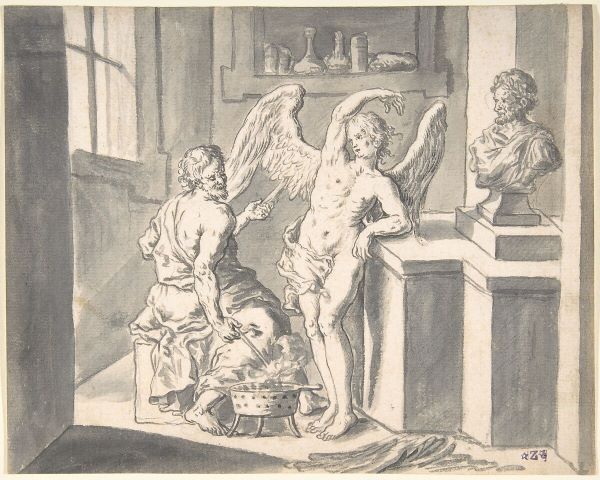 The titular protagonist of K. Ancrum's young adult novel Icarus denies that his name is an allusion to the famous character from Greek mythology and reveals that his mother christened him after the scientific name of a beloved fern, Icarus filiformis. Nonetheless, Icarus's denial of this reference only draws more attention to the resonance of his mythological namesake throughout the book.
In the original myth and Ancrum's retelling, Icarus's story is inseparable from his father's. Like the art restorationist Angus in Ancrum's book, Icarus's father in the myth, Daedalus, is an artist. According to Socrates in one Platonic dialogue, Daedalus's sculptures had to be tied down because they so captured the essence of life that they ultimately became alive themselves. Additionally, Daedalus is remembered as a genius inventor, with the ancient Greeks believing, for example, that he created the practice of carpentry. Therefore, like Angus toiling over art materials, frames, paintings, and sculptures in his studio, Daedalus is a master of handiwork and craft. However, his otherworldly inventiveness does not exclude him from the violent jealousies of human nature. Upon taking on the tutelage of his nephew, Talos, and realizing the boy's intelligence will eventually overshadow his own, Daedalus throws him off the Acropolis. Talos is miraculously transformed into a bird and saved, and Daedalus is banished from Athens, finding refuge in Crete under King Minos, where he becomes involved in the creation of the Minotaur, a creature that is half-man and half-bull.
Eventually, Minos imprisons Daedalus, who is determined to return to Athens with his son, in order to keep the inventor in Crete. But in both Ancrum's retelling and the mythology, the father-son pairs refuse to be confined by architecture. While Angus and Ancrum's Icarus are agile climbers who covertly gain criminal entrance through high-up windows, mythology's Daedalus observes the flight of birds and draws upon his ingenuity. With feathers, beeswax, and thread, he constructs wings for himself and Icarus. Before they take flight together to escape, Daedalus sternly warns Icarus not to fly too close to the sun. But Icarus does not heed his father's words and flies too high. The sun melts his wax wings, and he meets his demise falling into the sea. As Daedalus mourns over Icarus after burying him on the nearest island, Talos, the nephew he earlier attempted to murder, flies over to gloat. Unheeded words from a father also feature in Ancrum's Icarus, evolved into the uncommunicative silence between Angus and Icarus.
"Icarus" is not the only name in Ancrum's novel with mythological roots. Icarus's unlikely friend and love interest, Helios, is also a character from Greek myth — a Titan god personifying the sun. He drives a famed golden four-horse chariot. One day, Phaethon, one of Helios's sons (one of Apollo's sons, in some variations) begs his father to allow him to drive this sun chariot. Though reluctant, Helios acquiesces and hands Phaethon the reins. This has tragic consequences, as Phaethon's inexperience causes him to lose control of the horses. As the immortal steeds run wild, the earth is set on fire, and Zeus, to stop Phaethon, strikes him down with a thunderbolt into the River Eridanos. Thus, Helios, like Icarus, is associated with an ancient tale of father-son tragedy, which Ancrum retells through the fraught relationship between her Helios and his father, Mr. Black, running parallel to Icarus and Angus.
The myths involving Icarus and Daedalus, Helios and Phaethon are traditionally interpreted as cautionary tales to young, ambitious, and reckless men warning that they should not overreach and surpass their fathers; otherwise, they are fated to violent falls. Icarus, through reappropriating these classical figures, also plays with the notion of overreach – without moralizing condemnation, Ancrum's Icarus and Helios reach out to each other for intimacy and warmth against their antagonistic fathers' wishes, though the consequences of this reaching out, should it be discovered, remain dire, as in the Greek myths.
Daedalus Forming the Wings of Icarus out of Wax by Franz Xaver Wagenschön (18th century), courtesy of The Metropolitan Museum of Art
Filed under Places, Cultures & Identities
 This "beyond the book article" relates to Icarus. It originally ran in May 2024 and has been updated for the
March 2025 paperback edition.
Go to magazine.
This "beyond the book article" relates to Icarus. It originally ran in May 2024 and has been updated for the
March 2025 paperback edition.
Go to magazine.
Theo of Golden by Allen Levi
One spring morning, a stranger arrives in the small southern city of Golden. No one knows where he has come from…or why…






Your guide toexceptional books
BookBrowse seeks out and recommends the best in contemporary fiction and nonfiction—books that not only engage and entertain but also deepen our understanding of ourselves and the world around us.

