
-
Your next favorite book
is waiting.
Summary | Excerpt | Reviews | Beyond the Book | Read-Alikes | Genres & Themes | Author Bio
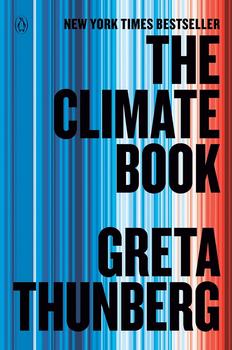
The Facts and the Solutions
by Greta Thunberg Book Reviewed by:
This article relates to The Climate Book

 Most of us are familiar with the mantra "reduce, reuse, recycle," and the effectiveness of this slogan inspired a generation of Americans to put plastics of all kinds into recycling bins rather than their trash. The problem is that, as contributor Nina Schrank points out in The Climate Book, "this narrative is perhaps the greatest example of greenwashing on the planet today." Despite shipping the problem out of sight and claiming that new technologies will continue producing plastics without creating waste, the fact remains that the vast majority of plastics can't be and aren't recycled.
Worldwide, only 9% of plastic waste is recycled, and in the U.S. that number drops to 5%, according to recent studies. The reasons for this are numerous, but the leading factor is the nature of plastics themselves. There are thousands of different types of plastics, and they can't be recycled together because of their varied chemical compositions, "making it impossible to sort the trillions of pieces of plastics into separate types for processing," as The Atlantic recently explained.
Many plastics also contain toxic substances, so cleaning them or melting them down to be re-formed as new products simply isn't safe. Those plastics that are recycled today are processed via mechanical recycling, i.e., grinding up plastic and melting it into new forms. This allows only for "downcycling," or making the plastic feedstock into traffic cones, doormats and similar products, as Schrank explains. After a few cycles, though, the material's "chemical make-up makes it impossible to continue and it too meets its final resting place in landfills, incinerators or dumped in the environment."
Because of these ongoing problems, plus the prohibitive cost of making new plastics via mechanical methods, the petrochemical industry is touting "advanced" or "chemical recycling" as a viable alternative. This process relies on pyrolysis, which is super-heating plastic waste in the absence of oxygen to make a liquid oil that can then be used to form new plastics.
But this solution has run into the same issues as mechanical recycling—namely, that different types of plastics can't be recycled together—and multiple efforts at large-scale pyrolysis have failed to get off the ground.
For example, advanced recycling startup Renewlogy designed a recycling program for the city of Boise, Idaho, and shuttered it about a year later because it couldn't process plastic films. Boise residents' plastic waste now goes to an incinerator, as Reuters explained. Shell, Unilever and Virgin Group also invested in advanced recycling projects in recent years only to abandon them because of technological snafus and cost overruns.
Even if advanced recycling could be managed on a large scale, there are concerns about the emissions of the pyrolysis process itself. "How do you heat that pyrolysis vessel to the 900 to 1,500° F you need? You heat it by incinerating the gas that comes off of it," says Jan Dell, founder of Last Beach Cleanup, an NGO.
All of this gets to a central feature of plastics—carbon emissions. Whether it's pumping oil to make virgin plastic or super-heating existing plastics to melt them down, it's impossible to separate emissions from plastic products. Combined with the environmental harm of polluting oceans and waterways, and open dumping in developing countries, it's clear that plastics are generating "a vast human and environmental tragedy," Schrank notes.
The solution, however, is contained in the same catchy saying that inspired recycling—it's the reduce and reuse parts. Changing our behavior to reduce consumption and reuse products at scale will take a paradigm shift in the Global North, which is no easy feat but a task that becomes ever more necessary. As The Climate Book summarizes, "The transition from a throw-away society to one that, where possible, eliminates packaging or adopts reusable packaging has never been more urgent than it is now."
Filed under Nature and the Environment
 This "beyond the book article" relates to The Climate Book. It originally ran in February 2023 and has been updated for the
February 2024 paperback edition.
Go to magazine.
This "beyond the book article" relates to The Climate Book. It originally ran in February 2023 and has been updated for the
February 2024 paperback edition.
Go to magazine.

L.A. Women by Ella Berman
Two ambitious writers in 1960s LA face betrayal when one writes a novel based on the other's life.






Your guide toexceptional books
BookBrowse seeks out and recommends the best in contemporary fiction and nonfiction—books that not only engage and entertain but also deepen our understanding of ourselves and the world around us.

