
-
Your next favorite book
is waiting.
Summary | Excerpt | Reading Guide | Reviews | Beyond the Book | Read-Alikes | Genres & Themes | Author Bio
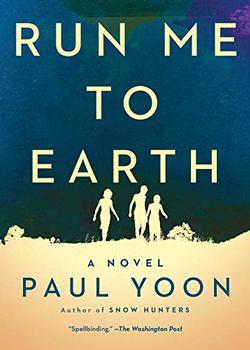
 Book Reviewed by:
This article relates to Run Me to Earth

 Author Paul Yoon's novel Run Me to Earth describes Laos as a beautiful landscape marked forever with unexploded ordnance (UXO) left in the wake of war from 1964 to 1973. Concealed explosives impact every character in the novel. The legacy of landmines and other unexploded munitions endures in the 21st century, not just in Laos but worldwide. Victims injured or killed by these weapons are often children at play or civilians and farmers living in rural areas that have not been cleared. It's estimated that 30% of the 250,000 cluster bombs dropped in Laos haven't yet exploded, and it's been almost 50 years since war ended there.
UXO affects more than 50 countries including Laos, Cambodia, Vietnam, El Salvador, Colombia, Myanmar, Bosnia, Ukraine, Nigeria, Sri Lanka, Somalia, Iran, Iraq, Afghanistan, Sudan, Lebanon, Sierra Leone, Angola and others. UXOs, such as cluster bombs dropped by aircraft, can embed in the earth, and aren't always visible dangers. A curious child or a farmer tilling soil can detonate a device, which can have an impact radius of up to or more than 30 meters. If victims survive, they're often disabled for life. The Mines Advisory Group (MAG)—a humanitarian NGO headquartered in the UK—calculates that, on average, 19 people are killed or injured daily by these devices. Experts estimate that at least 60 million people on Earth are in some way affected by this consequence of war—for example, in where they can safely live, work, farm, herd, play or attend school. In many regions impacted by war, people rely on subsistence agriculture. Injuries and deaths from UXO can not only put a burden on medical facilities, but also diminish a family's ability to sustain a livelihood after a family member is permanently disabled or killed. The presence of unexploded ordnance also affects potential residential development, wildlife habitats, access to water and other natural resources, and cultural sites.
Efforts to clean up impacted territory is complicated by often-rugged terrain, costs and the special training required. Armored vehicles and mechanical devices are used in these efforts, along with bomb-sniffing canines. Public education about risks, especially for war refugees who want to repopulate their homelands, can augment localized de-mining training and land clearing. Since 1989, MAG has led efforts to remove UXOs worldwide. In 1997, the International Campaign to Ban Landmines (of which MAG is a part) was awarded the Nobel Peace Prize along with Jody Williams, an American peace activist. Williams, who is considered an expert in the field of disarmament, has been credited with efforts to ban landmines that led directly to a major international treaty known as the Ottawa Treaty, or Mine Ban Treaty, in 1997.
The Ottawa Treaty (or the Convention on the Prohibition of the Use, Stockpiling, Production and Transfer of Anti-Personnel Mines and on their Destruction) has been signed by 164 nations. Key non-signatories include China, Russia and the United States (a majority of the permanent members of the United Nations Security Council). The Mine Ban Treaty bans new mines, and includes provisions to clear other unexploded munitions. Several humanitarian groups, including the HALO Trust and the Mine Action Review, monitor cleanup efforts and track destruction of weapons stockpiles. Peacemaking groups continue (as of 2020) to pressure the U.S. Congress to sign the treaty. In the meantime, global proliferation poses a threat to millions of civilians.
 The Plain of Jars, an archaeological landscape in Laos, was designated a UNESCO World Heritage Site in 2019. Key to this prestigious citation—which opens up the area for tourism, preservation and archaeological research—was the elimination of the many UXOs that contaminated the area. The Plain of Jars is one of the main settings of Run Me to Earth, an example of how literature can raise awareness about essential political and humanitarian issues.
A landmine found by U.S. Marines in Iraq
The Plain of Jars in Laos
Filed under Society and Politics
 This "beyond the book article" relates to Run Me to Earth. It originally ran in March 2020 and has been updated for the
January 2021 paperback edition.
Go to magazine.
This "beyond the book article" relates to Run Me to Earth. It originally ran in March 2020 and has been updated for the
January 2021 paperback edition.
Go to magazine.




The thing that cowardice fears most is decision
Click Here to find out who said this, as well as discovering other famous literary quotes!

Can you name the title?
Test your book knowledge with our daily trivia challenge!
Your guide toexceptional books
BookBrowse seeks out and recommends the best in contemporary fiction and nonfiction—books that not only engage and entertain but also deepen our understanding of ourselves and the world around us.
