
-
Your next favorite book
is waiting.
Summary | Excerpt | Reviews | Beyond the Book | Read-Alikes | Genres & Themes | Author Bio
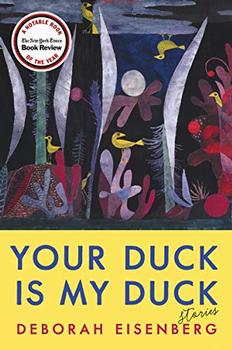
Stories
by Deborah Eisenberg Book Reviewed by:
This article relates to Your Duck Is My Duck

While staying at an island resort, the protagonist of the title story of Deborah Eisenberg's Your Duck is My Duck meets another artist, a puppeteer who is crafting a performance about their benefactors' mistreatment of the island's farmers. Eisenberg is drawing from a long history of puppetry as a political tool wielded by artists and activists to criticize the upper/ruling class.
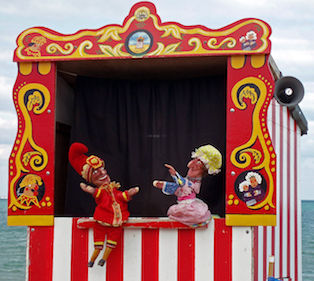 The transition from a rural/farming economy to the beginning of industrial capitalism in England coincided with the English Civil War and the rule of Oliver Cromwell, who served as Lord Protector after the execution of King Charles I. Cromwell, a Puritan, shut down the theaters in 1642, believing them to be dens of vice. He was also fully aware that plays frequently contained politically subversive messages. The theater ban, however, did not apply to puppetry, and consequently roving bands of puppet troupes were one of the few forms of popular entertainment for the eleven years of the Interregnum, which ended with Charles I's son being invited to return to England to become King Charles II. The first appearance of the puppet "Punch" (of later "Punch and Judy" fame) can be traced to this time. Punch was a "common man" hero that the audience could identify with, and he criticized authority and law enforcement figures (like police, judges, and government officials, including the king).
In the early 20th century, radical puppetry was revived by artists of the absurdist Dada movement as commentary on the inanity of war. In 1919, the German artists George Grosz, Oskar Kokoschka, and John Heartfield enacted politically-tinged puppet shows in their basement. These performances were ultimately shut down by German political officials bent on censoring free expression and criticism of the government.
Puppetry was widely embraced by the communist/worker's rights movements in Europe in the 20th century as well. In Russia, also in the early 20th century, the "Blue Blouse" and "Red Petrouchka Collective" theater troupes were very popular, and the latter introduced an anarchic character called Petrouchka who was essentially the Russian version of "Punch." This character's more radical characteristics were suppressed by the Soviet state, which then created its own, less controversial version of Petrouchka.
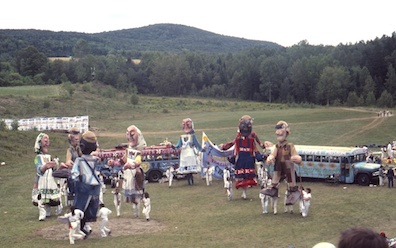 In America, the 1936 May Day celebration in New York City turned into an anti-fascist demonstration when a group of artists, including painter Jackson Pollack, crafted floats and giant puppets for the parade, including "a giant skeleton backpack puppet representing Nazi Germany." Perhaps the most famous example of political puppetry in America, however, is the Bread & Puppet Theater, founded in 1962 by the artist Peter Schumann. This troupe gained attention for their eye-catching performances with giant paper-mache puppets that criticized the Vietnam War. In the 1990s, the troupe's annual festival attracted tens of thousands of attendees. They have since held protests against the proliferation of nuclear power, the war in Afghanistan among many others, and even protested at the 2000 Republican National Convention in Philadelphia.
Punch and Judy show in Dorset England, 2006.
Bread and Puppet show in Glover, Vermont, mid 1980s.
Filed under Music and the Arts
 This "beyond the book article" relates to Your Duck Is My Duck. It originally ran in October 2018 and has been updated for the
June 2019 paperback edition.
Go to magazine.
This "beyond the book article" relates to Your Duck Is My Duck. It originally ran in October 2018 and has been updated for the
June 2019 paperback edition.
Go to magazine.
L.A. Women by Ella Berman
Two ambitious writers in 1960s LA face betrayal when one writes a novel based on the other's life.






Your guide toexceptional books
BookBrowse seeks out and recommends the best in contemporary fiction and nonfiction—books that not only engage and entertain but also deepen our understanding of ourselves and the world around us.


