
-
Your next favorite book
is waiting.
Summary | Excerpt | Reviews | Beyond the Book | Read-Alikes | Genres & Themes | Author Bio
 Book Reviewed by:
This article relates to Darius the Great Is Not Okay

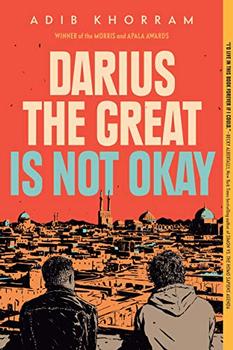
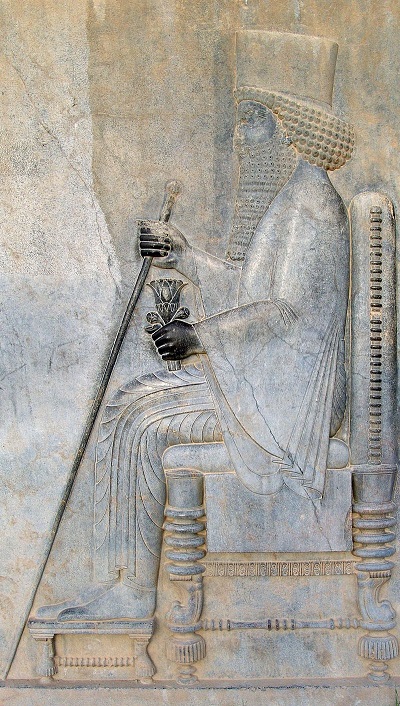 In Darius the Great Is Not Okay, Darius has two main concerns about his name: it starts with "D" (which provides ample opportunity for bullies to give him horrible nicknames), and it has connotations of an unattainable legacy. His namesake is Darius the Great, king of Persia from 522-486 BCE.
Darius I was born circa 550 BCE to a provincial governor. How he became king is historically controversial. The kinder version of the story says that Darius was serving the heir to the Persian throne, Cambyses, in Egypt when word arrived that Cambyses' younger brother Bardiya had stolen the throne from their father. However, Cambyses had secretly assassinated Bardiya months before, and the usurper was a pretender, a man named Gaumata. Cambyses set out for Persia, but died of either an accident or suicide, leaving no rightful heir to the throne. Darius, a distant cousin to the royal family, decided to claim the throne himself.
In the darker version, Cambyses died under mysterious circumstances, after which Darius returned to Persia and killed Bardiya, who had usurped the throne from his father, Cyrus the Great. Later, Darius justified the murder by claiming that the man he killed was not Bardiya at all, but an impostor. There is continuing historical debate about the truth, as many of the primary sources were written by Darius himself. Regardless of how Darius took the throne, he was able to quash the revolts that followed with his newly acquired army.
After securing internal peace, Darius began a military campaign, capturing the Indus Valley, and the Greek islands of Lemnos and Imbros. His conquests allowed Persia to control the Black Sea grain trade, which was essential to feed the Greek city of Athens. Through the grain trade, Persia exercised control of the Greek economy. Persia also controlled access to roads leading to Greece and invaded the country repeatedly, but was repelled each time.
Darius' reputation and legacy largely stem from his administrative successes rather than his military expansion. In order to improve the imperial economy, Darius standardized units of measure for currency, and weights, and established land and sea trade routes. He repaired and utilized a 7th century BCE canal from the Nile River leading to the Red Sea, and he divided the empire into satrapies (provinces) with fixed taxes.
Unlike other rulers of his dynasty, Darius respected the native religions throughout his empire. He allowed the Jews to rebuild the Temple at Jerusalem, built a temple to the god Amon in Egypt, and is largely credited with the introduction of Zoroastrianism as the state religion of Persia. Darius established a relatively progressive legal system for the time, which remained in place for centuries after his death.
Darius' legacy also includes the development of the Achaemenid architectural style (named for his dynasty). His largest architectural contributions were the great palace cities of Susa and Persepolis, and the Achaemenid style remained popular until the fall of the Persian Empire to Alexander the Great in 331 BCE. Darius' audience chamber is still visible as 13 stone columns at the UNESCO World Heritage site of Persepolis. The protagonist in Darius the Great Is Not Okay visits this site, and learns more about his heritage alongside his family. The region's esteem for architecture explains the excitement several Iranian characters express when learning that this is Darius' father's field of expertise. Thus architecture serves as a parallel connecting these two figures, one fictional and one real, across the centuries.
Filed under People, Eras & Events
 This "beyond the book article" relates to Darius the Great Is Not Okay. It originally ran in September 2018 and has been updated for the
August 2019 paperback edition.
Go to magazine.
This "beyond the book article" relates to Darius the Great Is Not Okay. It originally ran in September 2018 and has been updated for the
August 2019 paperback edition.
Go to magazine.

L.A. Women by Ella Berman
Two ambitious writers in 1960s LA face betrayal when one writes a novel based on the other's life.






Your guide toexceptional books
BookBrowse seeks out and recommends the best in contemporary fiction and nonfiction—books that not only engage and entertain but also deepen our understanding of ourselves and the world around us.

