
-
Your next favorite book
is waiting.
Summary | Excerpt | Reading Guide | Reviews | Beyond the Book | Read-Alikes | Genres & Themes | Author Bio

 Book Reviewed by:
This article relates to Barkskins

Annie Proulx's historical novel, Barkskins, covers 320 years from 1693 to 2013. While it focuses more on the social and ecological impact on the lives it follows, the story wouldn't exist without the context of the political situation that brought these Frenchmen onto North American soil.
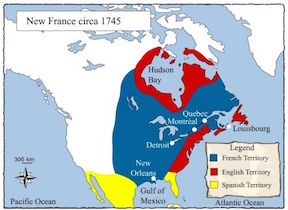 French interest in the New World began with King Francis I of France, who in 1524 sponsored Giovanni da Verrazzano (an Italian explorer in his service) to navigate the region between Florida and Newfoundland with the intention of finding a route to the Pacific Ocean.
Subsequently, the French explorer Jacques Cartier claimed the territory, planting a cross in the name of King Francis I in 1534. Financed by the King to search for sources of gold, spices and silks, he made three voyages, extending the French claims further each time - right into what is now central and eastern Canada and into large swaths of what is now central and southern United States.
The territory was named Nouvelle France (New France); but the King lost interest when no minerals of value were found and left expansion of the resource-rich forest lands, fur trading routes and coastal fishing areas to chartered companies such the French Trading and Colonization Company of New France. The companies thrived but it was not until around 1663, when the Crown began to send settlers, support and resources to the colony, that significant communities began to develop.
At its height, New France extended from Newfoundland to the Rocky Mountains, and from Hudson Bay to the Gulf of Mexico, including all the Great Lakes of North America. There were four colonies or administrative centers: Canada, Acadia, Newfoundland (Plaisance), and Louisiana.
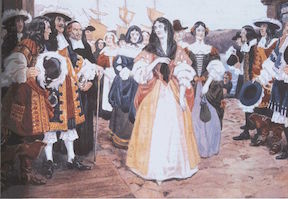 In Proulx's Barkskins, Charles Duquet arrives as an indentured servant to the seigneur, the overseer of a feudal land distribution system. The seigneurial system was central to France's colonization policy of their new territories and played a significant role in establishing and maintaining a social hierarchy. Two hundred-twenty seigneuries were granted during the French regime, covering virtually all the inhabited areas.
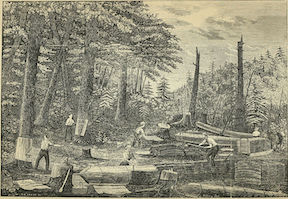
The character Duquet is impatient to make his fortune and establish his own family name. Under the seigneurial system he would have had to work for the seigneur for years before he could obtain land rights, so he escapes. He wonders, then, "What resource existed in this new world that was limitless, that had value, that could build a fortune?" and after rejecting living creatures, he comes to the conclusion that there is one everlasting commodity that Europe lacked – the forest. Forestry (which lead to much deforestation), as well as the fur trade and fisheries, were critical economic activities in New France.
 France was a colonial power in North America from the 16th century until 1763, when it ceded what remained of its New France territories (except the islands of Saint Pierre and Miquelon) to Great Britain and Spain at the Treaty of Paris, which ended the Seven Years' War (the French and Indian War). Britain received Canada, Acadia, and the parts of French Louisiana, which lay east of the Mississippi River – except for the Île d'Orléans, which was granted to Spain, along with the territory to the west – the larger portion of Louisiana.
In the United States, the legacy of New France includes numerous place names and a few French-speaking communities. In Canada, French and English are both official languages with around 20% of the population speaking French as their mother tongue.
Map of New France.
King's Daughters arriving in Quebec, 1667, painting by Charles William Jefferys.
Image of peeling hemlock bark for tanning, circa 1850.
Filed under People, Eras & Events
 This "beyond the book article" relates to Barkskins. It originally ran in July 2016 and has been updated for the
April 2017 paperback edition.
Go to magazine.
This "beyond the book article" relates to Barkskins. It originally ran in July 2016 and has been updated for the
April 2017 paperback edition.
Go to magazine.
L.A. Women by Ella Berman
Two ambitious writers in 1960s LA face betrayal when one writes a novel based on the other's life.






Your guide toexceptional books
BookBrowse seeks out and recommends the best in contemporary fiction and nonfiction—books that not only engage and entertain but also deepen our understanding of ourselves and the world around us.


