
-
Your next favorite book
is waiting.
Summary | Excerpt | Reviews | Beyond the Book | Read-Alikes | Genres & Themes | Author Bio
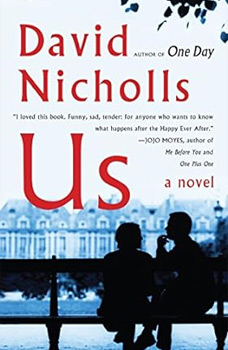
A Novel
by David Nicholls Book Reviewed by:
This article relates to Us

In David Nicholls' novel, Us, a couple sets out to show their son Europe as a parting gift before he heads to college. It's to be a Grand Tour, the mother tells her son, "to prepare you for the adult world, like in the eighteenth century." She explains that it was "traditional for young men of a certain class and age to embark on a cultural pilgrimage to the continent...taking in certain ancient sites and works of art before returning to Britain as sophisticated, civilized men of experience. In practice the culture was largely an excuse for drinking and whoring and getting ripped off." The son is skeptical about this project. "So why don't I just go to Ibiza?" he asks.
The idea of "The Grand Tour" is at least as old as the seventeenth century, and the prescribed tour stops were the seats of both ancient and Renaissance culture – an extended Western Civilization field trip. For some, the tour was an intellectual finishing school, and for others, an artist's apprenticeship. Some young noblemen used the Tour as an opportunity to snatch up classy décor for their stately homes, while others reveled in the discovery of a loose moral world (rife with brothels and card sharks) far from the family eye back home. Seeing Europe could serve to leaven the provincialism of life in the British Isles, or it could reinforce that provincialism by giving only a superficial glimpse of other cultures and peoples. In this way the dynamics of being a "tourist" were then much as they are now. The travelling itself could be character building, especially in the pre-railroad era when moving from Paris to the Alps to Italy was hard going and slow.
 By the nineteenth century, the traditional Grand Tour could still serve as an eye-opening inspiration for the young British artist or intellectual. John Ruskin's travels on the continent turned into his important and popular books, The Seven Lamps of Architecture and The Stones of Venice. His work influenced some of the most enduring art and literature of his time, from the Pre-Raphaelites to the Arts and Crafts movement. As transportation improved, more women followed the Grand Tour circuit, some seeking artistic enlightenment and some, social cachet. In the nineteenth century novel, a European tour was well entrenched as a literary device, a good way to separate unsuitable lovers or to give characters time to adjust to radically changed fortunes. (Dickens uses both of these devices in Little Dorrit, for instance.) Henry James and E.M. Forster exploited the Grand Tour idea to explore shifting class and gender nuances at the turn of the twentieth century, (The Wings of the Dove by James and A Room with a View by Forster), even as American newspaperman William Randolph Hearst was in real life buying up the medieval architectural treasures which would eventually furnish his California castle, San Simeon.
The modern-day Grand Tour is a more populist idea, bringing to mind a "gap year" of youth hostels and rail passes and likely to range farther afield – perhaps to India and Thailand – than the traditional Renaissance sights. In the contemporary Grand Tour there may be a shift of emphasis from studying the world to finding oneself – but the romantic possibilities of the Tour still beckon.
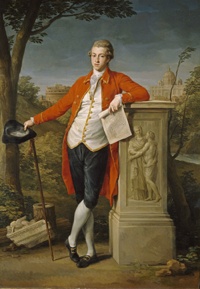
The picture of English Grand Tourist Francis Basset by painter Pompeo Batoni. The picture shows the future baron with the Castel Sant'Angelo and St. Peter's Basilica in the background. From Museo Nacional del Prado
Filed under People, Eras & Events
 This "beyond the book article" relates to Us. It originally ran in January 2015 and has been updated for the
June 2015 paperback edition.
Go to magazine.
This "beyond the book article" relates to Us. It originally ran in January 2015 and has been updated for the
June 2015 paperback edition.
Go to magazine.





The good writer, the great writer, has what I have called the three S's: The power to see, to sense, and to say. ...
Click Here to find out who said this, as well as discovering other famous literary quotes!

Can you name the title?
Test your book knowledge with our daily trivia challenge!
Your guide toexceptional books
BookBrowse seeks out and recommends the best in contemporary fiction and nonfiction—books that not only engage and entertain but also deepen our understanding of ourselves and the world around us.
