
-
Your next favorite book
is waiting.
(We'll also accept "Grab the Brass Ring" as a correct answer for this one.)
You’ll often hear someone at the start of an event say, “Let’s get the ball rolling,“ by which they mean let’s begin (the game/meeting/what-have-you).
Unsurprisingly, this phrase originally came from the sporting world and featured a literal ball. We have to go back to 17th-century France for the genesis, where a game called paille-maille was all the rage. Played on an alley of hard sand, a six-inch ball made of boxwood was struck with a curved mallet, the object being to propel it through a steel hoop at the other end of the alley. The winner was the individual who could drive the ball through the hoop in the fewest number of strokes (so kind of a cross between croquet and miniature golf). The game made it across the Channel to England, where it became known as pall-mall. (Interestingly, the sport was popular with King Charles II (1630-1685), and the famous street in London’s St. James area was named after the game.) As a result, as this activity became more fashionable (along with croquet and other sports that featured rolling spheres), the phrase “set the ball rolling” arose in the late 18th century in England to indicate the start of a match. By 1800, the saying was being used figuratively and appearing in print as “get the ball rolling.”
In 1840, the phrase became extremely popular in the United States as the result of a political campaign. Whig party candidate William Henry Harrison, used large rolling balls as props during rallies, along with log cabins and cider barrels. In addition, the image was mentioned in a campaign song, Tippecanoe and Tyler, Too, written by Ohio jeweler Alexander Coffman Ross with the lines:
What's the cause of this commotion, motion, motion,
Our country through?
It is the ball a-rolling on
For Tippecanoe and Tyler too.
The promotion was so popular that Benjamin Harrison, William Henry Harrison’s grandson, used the image in his own 1888 campaign with the slogan, “Keep the ball rolling.” He had an enormous steel-and-canvas-covered ball constructed with campaign slogans printed on it, and it was rolled 5,000 miles across the United States to promote him (and he did, indeed, beat incumbent president Grover Cleveland for the presidency that year).
The idiom “get the ball rolling” began appearing widely in print in 1840, morphing into its current meaning as a result of the ubiquity of the first Harrison’s slogan. It’s still in extensive use today in both Great Britain and the United States.
More expressions and their source
Challenge yourself with BookBrowse Wordplays
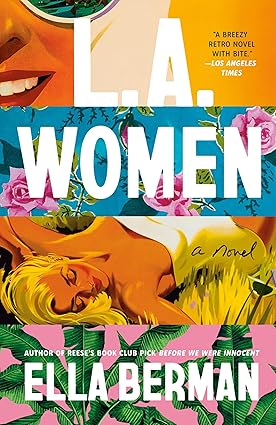
L.A. Women by Ella Berman
Two ambitious writers in 1960s LA face betrayal when one writes a novel based on the other's life.






Your guide toexceptional books
BookBrowse seeks out and recommends the best in contemporary fiction and nonfiction—books that not only engage and entertain but also deepen our understanding of ourselves and the world around us.

