
-
Your next favorite book
is waiting.
Summary | Excerpt | Reviews | Readalikes | Genres & Themes | Author Bio
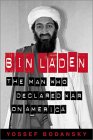
The Man Who Declared War on America
by Yossef Bodansky
On November 20, after a brief firefight to secure control of the Qaaba (the
center of the Grand Mosque complex, containing the holiest shrine of Islam),
Juhayman addressed the crowd of trapped pilgrims and asked for their support.
Sermons and discussions of corruption, wastefulness, and the pro-Western stance
of the Saudi royal family quickly gained the rebels widespread support among the
worshipers. Before long most of the 6,000 pilgrims taken hostage asked to be
issued arms so that they could join the revolt. Juhayman's sermons gained
sympathy even among the leftist and quasi-Marxist students. News of Juhayman's
sermons incited militant mobs throughout Saudi Arabia to storm local mosques and
government posts. Latent subversive elements came to life as almost
simultaneously with the seizure of the Qaaba a series of bombs exploded in
places sensitive to the royal family in Mecca, Medina, Jeddah, and Riyadh. Among
these targets were palaces, personal and official offices, and businesses.
Initially the White Guards reacted chaotically to the attack and suffered a
humiliating defeat. Moreover, growing discontent in the ranks of the Saudi elite
units led the royal family to fear that even they might rebel. The Saudi
security forces settled for a siege of the mosque that lasted about two weeks.
In the end the rebellion was only subdued by a special detachment of French
paramilitary special forces, antiterrorist experts who used stun grenades and
chemical weapons.
The uprising in Mecca shook the world of accepted norms in Saudi Arabia. The
grievances raised by Juhayman echoed throughout Saudi Arabia, being whispered
about in closed meetings. In intellectual circles his arguments made people stop
and think about Islam and the society they were living in. A thinking and
well-read individual, Osama bin Laden was influenced by the social issues
Juhayman raised. But although the crisis of November 1979 reinforced bin Laden's
conviction that only an Islamic government could shield Saudi Arabia and the
rest of the Muslim world from the evils of encroaching Westernization, he
remained a loyal subject of King Fahd and the House of al-Saud.
OSAMA BIN LADEN' S WORLD, like that of most Muslims worldwide, was jolted in the
last days of 1979, when the Soviet Union invaded Afghanistan. In the late 1970s
Afghanistan -- a desolate and backward landlocked country -- was ruled by a
Soviet-sponsored Communist government being challenged by Pakistani-sponsored
Islamist subversion. With the Communist regime increasingly unstable, the Soviet
armed forces marched into Afghanistan, occupied the country's strategic
infrastructure, assassinated the president, and replaced him with a docile
Soviet puppet. They also began a systematic campaign to suppress the Islamist
subversion.
The Soviet invasion was the first time since World War II that non-Muslim forces
had occupied a Muslim country -- and these were anti-Islamic Communists to boot.
Little wonder that the Soviet invasion of Afghanistan in the last days of 1979
shocked the entire Muslim world to its core. The occupation of a Muslim state by
Communist forces insulted the most basic sensitivities of Islam. But however
immense the shock and however great the condemnation by the Arab states, little
was actually done.
Immediately after the Soviet invasion, outrage ran throughout the Muslim world.
An extraordinary meeting of foreign ministers from thirty-five Islamic states
convened in Islamabad on January 27, 1980. Those assembled strongly condemned
"the Soviet military aggression against the Afghan people" and called
for the "immediate and unconditional withdrawal" of all Soviet troops
from Afghanistan. They also urged that no Muslim country recognize the
Democratic Republic of Afghanistan (DRA) -- the Soviet-installed government in
the capital, Kabul -- or negotiate with Kabul.
Excerpted from bin Laden by Yossef Bodansky Copyright 2001 by Yossef Bodansky. Excerpted by permission of Prima Lifestyles, a division of Random House, Inc. All rights reserved. No part of this excerpt may be reproduced or reprinted without permission in writing from the publisher.
Theo of Golden by Allen Levi
One spring morning, a stranger arrives in the small southern city of Golden. No one knows where he has come from…or why…






Your guide toexceptional books
BookBrowse seeks out and recommends the best in contemporary fiction and nonfiction—books that not only engage and entertain but also deepen our understanding of ourselves and the world around us.


