
-
Your next favorite book
is waiting.
Summary | Excerpt | Reviews | Readalikes | Genres & Themes | Author Bio
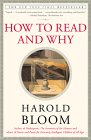

I turn to reading as a solitary praxis, rather than as an educational enterprise. The way we read now, when we are alone with ourselves, retains considerable continuity with the past, however it is performed in the academies. My ideal reader (and lifelong hero) is Dr. Samuel Johnson, who knew and expressed both the power and the limitation of incessant reading. Like every other activity of the mind, it must satisfy Johnson's prime concern, which is with "what comes near to ourself, what we can put to use." Sir Francis Bacon, who provided some of the ideas that Johnson put to use, famously gave the advice: "Read not to contradict and confute, nor to believe and take for granted, nor to find talk and discourse, but to weigh and consider." I add to Bacon and Johnson a third sage of reading, Emerson, fierce enemy of history and of all historicisms, who remarked that the best books "impress us with the conviction, that one nature wrote and the same reads." Let me fuse Bacon, Johnson, and Emerson into a formula of how to read: find what comes near to you that can be put to the use of weighing and considering, and that addresses you as though you share the one nature, free of time's tyranny. Pragmatically that means, first find Shakespeare, and let him find you. If King Lear is fully to find you, then weigh and consider the nature it shares with you; its closeness to yourself. I do not intend this as an idealism, but as a pragmatism. Putting the tragedy to use as a complaint against patriarchy is to forsake your own prime interests, particularly as a young woman, which sounds rather more ironical than it is. Shakespeare, more than Sophocles, is the inescapable authority upon intergenerational conflict, and more than anyone else, upon the differences between women and men. Be open to a full reading of King Lear, and you will understand better the origins of what you judge to be patriarchy.
Ultimately we read -- as Bacon, Johnson, and Emerson agree -- in order to strengthen the self, and to learn its authentic interests. We experience such augmentations as pleasure, which may be why aesthetic values have always been deprecated by social moralists, from Plato through our current campus Puritans. The pleasures of reading indeed are selfish rather than social. You cannot directly improve anyone else's life by reading better or more deeply. I remain skeptical of the traditional social hope that care for others may be stimulated by the growth of individual imagination, and I am wary of any arguments whatsoever that connect the pleasures of solitary reading to the public good.
The sorrow of professional reading is that you recapture only rarely the pleasure of reading you knew in youth, when books were a Hazlittian gusto. The way we read now partly depends upon our distance, inner or outer, from the universities, where reading is scarcely taught as a pleasure, in any of the deeper senses of the aesthetics of pleasure. Opening yourself to a direct confrontation with Shakespeare at his strongest, as in King Lear, is never an easy pleasure, whether in youth or in age, and yet not to read King Lear fully (which means without ideological expectations) is to be cognitively as well as aesthetically defrauded. A childhood largely spent watching television yields to an adolescence with a computer, and the university receives a student unlikely to welcome the suggestion that we must endure our going hence even as our going hither: ripeness is all. Reading falls apart, and much of the self scatters with it. All this is past lamenting, and will not be remedied by any vows or programs. What is to be done can only be performed by some version of elitism, and that is now unacceptable, for reasons both good and bad. There are still solitary readers, young and old, everywhere, even in the universities. If there is a function of criticism at the present time, it must be to address itself to the solitary reader, who reads for herself, and not for the interests that supposedly transcend the self.
Copyright © 2000 by Harold Bloom. All rights reserved. Reproduced by permission of the publisher, Simon & Schuster.
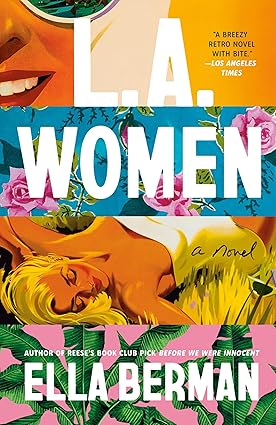
L.A. Women by Ella Berman
Two ambitious writers in 1960s LA face betrayal when one writes a novel based on the other's life.






Your guide toexceptional books
BookBrowse seeks out and recommends the best in contemporary fiction and nonfiction—books that not only engage and entertain but also deepen our understanding of ourselves and the world around us.


