
-
Your next favorite book
is waiting.
Summary | Excerpt | Reading Guide | Reviews | Readalikes | Genres & Themes | Author Bio
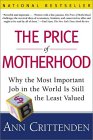
Why the Most Important Job in the World Is Still the Least Valued
by Ann Crittenden
A woman in Texas gave up a fifteen-year career in banking to raise two children. Her husband worked extremely long hours and spent much of his time on the road. She realized that only if she left her own demanding job would the child have the parental time and attention he needed. For almost two decades she worked part-time as a consultant from her home, and for several years she had little or no income. Recently the Social Security Administration sent her an estimate of her retirement income -- a statement that was full of zeroes for the years spent caregiving. Social Security confirmed that her decision to be the responsible, primary parent had reduced the government pension by hundreds of dollars a month in retirement income.
A mother in Maryland had a son who had been a problem child ever since kindergarten. At junior high, the boy was suspended several times; he was finally caught with a gun in his backpack and expelled. The boy's father sued for custody, and the mother countered with a request for more child support, to help pay the $10,000 tuition for a special private school. She also quit her full-time job to have more time for her family. At his new school, the boy showed dramatic improvement both in his academic work and in his behavior. When the case came to court, the father was denied custody, but the judge refused to require him to pay half the costs of the boy's rehabilitation, including therapy and tutoring, despite evidence that the father could afford to do so. A mother who did not work full-time was, in the judge's view, a luxury that "our world does not permit." So the mother was in effect penalized for having tried to be a more attentive mother, and the boy was forced to leave the only school in which he had enjoyed any success.
As these examples reveal the United States is a society at war with itself. The policies of American business, government, and the law do not reflect Americans' stated values. Across the board, individuals who assume the role of nurturer are punished and discouraged from performing the very tasks that everyone agrees are essential. We talk endlessly about the importance of family, yet the work it takes to make a family is utterly disregarded. This contradiction can be found in every corner of our society.
First, inflexible workplaces guarantee that many women will have to cut back on, if not quit, their employment once they have children. The result is a loss of income that produces a bigger wage gap between mothers and childless women than the wage gap between young men and women. This forgone income, the equivalent of a huge "mommy tax," is typically more than $1 million for a college-educated American woman.
Second, marriage is still not an equal financial partnership. Mothers in forty-seven of the fifty states -- California, Louisiana, and New Mexico are the exceptions -- do not have an unequivocal legal right to half of the family's assets. Nor does a mother's unpaid work entitle her to any ownership of the primary breadwinner's income -- either during marriage or after a divorce. Family income belongs solely to "he who earns it," in the phrase coined by legal scholar Joan Williams. A married mother is a "dependent," and a divorced mother is "given" what a judge decides she and the children "need" of the father's future income. As a result, the spouse who principally cares for the children -- and the children -- are almost invariably worse off financially after divorce than the spouse who devotes all his energies to a career.
Third, government social policies don't even define unpaid care of family dependents as work. A family's primary caregiver is not considered a full productive citizen, eligible in her own right for the major social insurance programs. Nannies earn Social Security credits; mothers at home do not. Unless she is otherwise "employed," the primary parent is not entitled to unemployment insurance or workman's compensation. The only safety net for a caregiver who loses her source of support is welfare, and even that is no longer assured.
Copyright © 2001 Ann Crittenden

L.A. Women by Ella Berman
Two ambitious writers in 1960s LA face betrayal when one writes a novel based on the other's life.






Your guide toexceptional books
BookBrowse seeks out and recommends the best in contemporary fiction and nonfiction—books that not only engage and entertain but also deepen our understanding of ourselves and the world around us.


