
-
Your next favorite book
is waiting.
Summary | Excerpt | Reviews | Readalikes | Genres & Themes | Author Bio
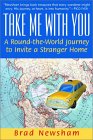
A Round-the-World Journey to Invite a Stranger Home
by Brad Newsham
As I walked through the Ermita district toward Manila’s focal point, Rizal Park, arms shot up from apparently lifeless bundles, palms outstretched. I gave a peso to a man with no legs, and thought: In San Francisco a few cents is an insult.
A young woman, wearing a short skirt and swinging a tiny black purse, caught my eye and slid her tongue across her lips. Even at this hour women in high heels, black net stockings, and frilly red teddies lounged in front of twenty-four-hour bars, and stretched their smooth, peanut butter-colored limbs. Winking at me they cooed, "Hi Joe," while young men leapt up to swing open the barroom doors. "Very nice, Joe. Very nice." Through the front door of one darkened place I saw a searchlight slicing through banks of cigarette smoke to highlight a tiny woman in a white Day-Glo bikini, prancing on a bar top.
In ten minutes I reached Rizal Park, a wide swath of green fronting on Manila Bay. On December 30, 1896, Dr. Jose Rizal–a poet, a genius who spoke more than thirty languages, and the spiritual leader of the Filipino struggle against the Spanish–was executed in the park that now bears his name. Photographs show Rizal standing with his back to the poised firing squad, and a formally dressed mob of thousands–Spaniards and Filipinos alike–crowding around to watch. Today the execution ground is a sprawling green lawn, punctuated by flowerbeds and fountains and statues, open-air amphitheaters, and a roller rink. A sea wall, a promenade, and a row of palms lined the water’s edge, and here, hunkered down on benches or spread out on the lawn, hundreds of Filipinos had gathered to watch the mid-morning sun heat up the bay.
I bought a Manila Bulletin from a small boy and found a shaded, empty bench. I had barely opened it when four men–each with a camera, a Rizal Park baseball hat, and a badge: official rizal park photographer–lined up in front of my bench.
"Pit-chur? Next to fountain. Only fifty pesos. Very cheap."
They stayed, pleading–"O.K., O.K. For you, forty pesos"–until I showed them my own small camera, and then they chased en masse after a French-speaking couple who had strolled by.
A front-page article described the uproar over Webster’s latest dictionary having used the phrase "domestic worker" to define the word "Filipina." Filipinas and Filipinos everywhere were enraged and insulted. The mayor of Ermita had banned the book’s sale. The dictionary people were holding firm.
Suddenly a small open hand imposed itself between my eyes and the newspaper. A girl–barefoot, with dirt-stained cheeks, no older than six–stood in front of me, a baby boy cradled in her arms.
"No mama," she croaked. "No papa."
I asked what had happened to them.
"No mama," she croaked. "No papa." The baby gaped at me with stunned brown eyes.
Was this her brother?
"No mama. No papa."
I gave her a peso, but she stared at it as though I’d squashed a turd into her palm. "No mama," she said. "No papa." She left after I forked over a five-peso coin, but immediately a dozen of her peers formed a bleating semicircle around me.
In American terms I was the classic financial dud –the-ne'er-do-well uncle or brother-in-law – but by these people’s standards I was a millionaire. My money belt was fat with cash and traveler’s checks, and a wad of pesos bulged in my shirt pocket. I passed out pesos, half-pesos, ten-centavo pieces, until all my change was gone, then retreated to a more distant bench and reopened my newspaper.
On the editorial page this caught my eye: "Deepening Poverty in The Philippines: Study confirms 60 to 80 percent of national wealth is controlled by only 2 percent of the population." The article spoke of slums, hunger, unemployment, needed reforms. The Rizal crowd–snoozing, strumming guitars, buying newspapers and bananas and small greasy pastries from barefooted vendors–were obviously from the bottom 98 percent. On this midweek morning no one was in a hurry to go anywhere, certainly not to jobs.
Copyright 2000. Brad Newsham. All rights reserved. No part of this book may be reproduced without written permission from the publisher, Travelers' Tales Inc
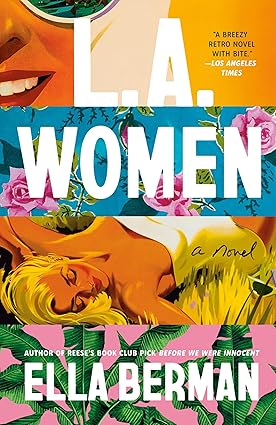
L.A. Women by Ella Berman
Two ambitious writers in 1960s LA face betrayal when one writes a novel based on the other's life.






Your guide toexceptional books
BookBrowse seeks out and recommends the best in contemporary fiction and nonfiction—books that not only engage and entertain but also deepen our understanding of ourselves and the world around us.


