
-
Your next favorite book
is waiting.
Summary | Excerpt | Reviews | Beyond the Book | Readalikes | Genres & Themes | Author Bio
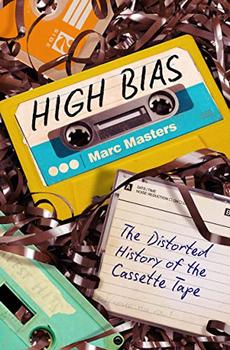
The Distorted History of the Cassette Tape
by Marc Masters Book Reviewed by:
The cassette tape has always been dangerous. Ever since it emerged in the early 1960s, it has been used to create, to invent, to individualize. In ways unlike any other audio format, the cassette tape offered freedom to artists, musicians, and fans—the kind of freedom that scared anyone used to dictating how music is made, sold, and heard.
Maybe you've heard the phrase "Home taping is killing music." Sounds pretty scary—but to the British Phonographic Industry, not scary enough. To get cassette tape users truly spooked, in the early 1980s the BPI created an advertising campaign that plastered this sensationalistic motto in bold block letters atop an ominous graphic. A cassette-shaped skull with its two holes serving as watchful eyes sat ready to pounce if you dared to tape music at home. Beneath were crossbones and another warning: AND IT'S ILLEGAL.
The horror suggested by this creepy cartoon must have been confusing. Could the cassette tape really murder an entire art form? As Newsweek put it in 1969, "One wouldn't think that the giant record industry had anything to fear from a revolutionary only four inches high." But now that people could copy music for just the price of a tape, record companies were definitely frightened—not only in Britain but around the globe. The industry tried everything—regulations, taxes, court battles, public shaming—to quash home taping, which it saw as taking money directly out of its pockets.
To those demonizing home taping, it wasn't just stealing. It represented a shift in the way music was controlled, an upending of the hierarchy between producers and consumers. "Tapes ... offer one distinct advantage that the record industry can't counter," wrote Richard Harrington in the Washington Post. "They are reusable, adaptable to the transient nature of music." In Harrington's piece, Lou Dennis of Warner Brothers Records added, "As long as all the tape machines in this country have a record button, how do you control that? You can't." Presaging the fears digital music would cause decades later, Irwin Tarr of RCA Records told Newsweek, "Young people now can start their music collections with tape and never have to buy a single record." "What is most frightening is that very soon it becomes a hobby," added Joe Cohen of the National Association of Recording Merchandisers. "And after it becomes a hobby, it becomes a habit."
"What the anti-piracy activists couldn't foresee was the intoxicating effect of assembling a mixtape or hearing yourself through your headphones," wrote essayist Hua Hsu decades later. "What the cassette introduced wasn't merely the impulse to copy and steal or to curate and create. The cassette inaugurated an era when it was possible to control one's private soundscape."
People could copy records and swap them with friends rather than having to buy everything they wanted to hear. They could tape albums off the radio, which sometimes played them in full without commercial interruption. They could compile favorite songs onto tapes, bypassing the way record companies delivered music and the way radio doled out hits. They could record their own creative work onto cassettes and release it on hand-dubbed tapes, eschewing conventional channels open only to a well-financed few. All these possibilities turned a simple physical object into the stuff of dreams.
Excerpted from High Bias by Marc Masters. Copyright © 2023 by Marc Masters. Excerpted by permission of The University of North Carolina Press. All rights reserved. No part of this excerpt may be reproduced or reprinted without permission in writing from the publisher.
Theo of Golden by Allen Levi
One spring morning, a stranger arrives in the small southern city of Golden. No one knows where he has come from…or why…






Your guide toexceptional books
BookBrowse seeks out and recommends the best in contemporary fiction and nonfiction—books that not only engage and entertain but also deepen our understanding of ourselves and the world around us.

