
-
Your next favorite book
is waiting.
Summary | Excerpt | Reading Guide | Reviews | Beyond the Book | Readalikes | Genres & Themes | Author Bio
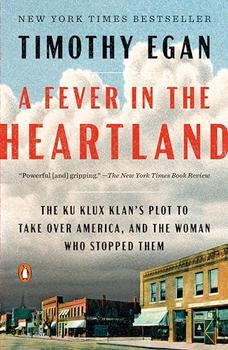
The Ku Klux Klan's Plot to Take Over America, and the Woman Who Stopped Them
by Timothy Egan Book Reviewed by:
Violence escalated: lynching, arson, beatings, a reign of orchestrated bloodshed for the last three years of Johnson's chaotic term. The exact number of deaths has never been fully established, but one military commander, General John Reynolds, reported from Texas that murders of Black citizens were "so common as to render it impossible to keep an accurate account of them." Sheriffs would not arrest their criminal neighbors. Witnesses were intimidated or murdered. "We can inform you that we are the law itself," was the message delivered from a Klan unit to one teacher in Mississippi.
We are the law itself—the same boast would be heard in Indiana, fifty years later, taking flight through the revelations of Madge Oberholtzer.
Johnson was impeached by the House, acquitted by a single vote in the Senate, then rendered powerless. When the Union general Ulysses S. Grant was elected in 1868, he carried most of the North and a handful of Southern states where large numbers of Black men had been able to vote, thanks to the protection of federal troops. A few months into his presidency, he got a letter from a widow, Sallie Adkins, of Georgia; her spouse, a state senator, had been assassinated on the open road by a Klansman. "I am only a poor woman whose husband has been murdered for his devotion to his country," she wrote the president. Grant promised to smash the Klan. There was nothing gallant or noble about these midnight marauders. The president saw them for what they were: killers in bedsheets who were "trying to reduce the colored people to a condition closely akin to that of slavery," he said.
In Lincoln's final days, he had sought to expand the Constitution. What followed was "a massive experiment in interracial democracy," the historian Eric Foner wrote. In the first lightning strike, the 13th Amendment, slavery was formally outlawed in 1865. In the second, passed after the president was killed, a citizen was defined in the 14th Amendment as anyone born or naturalized in the United States. The 15th Amendment, ratified in 1870, prevented states from denying voting rights based on color. Grant called the last of the three additions "the most important event that has occurred since the nation came to life."
The problem for the general who had won the war was that the Klan was not an organized army with a defined chain of command. Across the South, Klan units would not stand and fight against federal forces. They would not stand at all. They could not be chased across the land or forced to assemble in a defensive posture atop a hill. The enemy was "the most atrocious organization that the civilized part of the world has ever known," Grant's Justice Department declared. After Congress handed him the tools he needed, the president used the Ku Klux Klan Acts to hammer the hooded order. He sent federal authorities, backed by more federal troops, to prosecute what were now federal crimes. He declared martial law in places. He suspended habeas corpus. In the fall of 1869, nearly 2,000 Klansmen were arrested in South Carolina alone. By end of the next year, 3,000 were indicted across the South. A third of them were convicted and sent away with long prison terms. Acknowledging defeat, the Klan formally disbanded under an order from Forrest. He burned all records.
Frederick Douglass had seen the postwar carnage coming. As a manacled young man, he taught himself to read and write, breaking the law and risking the lash, a voracious student of classics, philosophy, and history. As an orator and essayist, he saw his words widely published; by the 1860s, he was the most prominent Black man in America. "The work does not end with the abolition of slavery," he said, not long after Lincoln was shot in the head, "but only begins." When Grant crushed the Klan in the South, Douglass wrote, "The scourging and slaughter of our people have so far ceased."
So far.
Excerpted from A Fever in the Heartland by Timothy Egan. Copyright © 2023 by Timothy Egan. All rights reserved. No part of this excerpt may be reproduced or reprinted without permission in writing from the publisher.

L.A. Women by Ella Berman
Two ambitious writers in 1960s LA face betrayal when one writes a novel based on the other's life.






Your guide toexceptional books
BookBrowse seeks out and recommends the best in contemporary fiction and nonfiction—books that not only engage and entertain but also deepen our understanding of ourselves and the world around us.


