
-
Your next favorite book
is waiting.
Summary | Excerpt | Reading Guide | Reviews | Beyond the Book | Readalikes | Genres & Themes | Author Bio
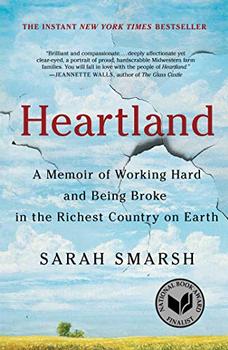
A Memoir of Working Hard and Being Broke in the Richest Country on Earth
by Sarah Smarsh Book Reviewed by:
In the evenings, Arnie returned from the shed with oil handprints on his jeans. Betty returned from her job at the Wichita courthouse wearing Kmart business suits. Dad returned from construction sites with sawdust in his beard. Mom returned from the Wichita airport, where she'd taken a job at an airline check-in counter, wearing a uniform skirt and a name pin with little wings on it.
All four bedrooms at the farm were upstairs. They had wood floors and the original, single-pane 1910 windows that smelled like dust and had ice on the inside of them. Dad and I would sit in bed eating cereal out of the box until the crumbs in the sheets made Mom mad. We all snuggled against the cold. I'd never been happier than I was sleeping on a full-size mattress between my parents, with my grandparents just beyond the wood-paneled wall.
In the spring of 1984, Dad and his friends finished our house. They put up sheetrock, laid shingles, poured cement in front of the attached garage. A hired man dug a pond with a dozer. Dad built a wooden dock before the big hole was filled with water. A family friend who raised catfish a couple miles down the road stocked the pond. Mom and Dad moved our few things from Betty and Arnie's farm, along the two-lane blacktop that curved around Cheney Lake.
Mom decorated the house with things that to our eyes looked nice and to anyone else's eyes were at least well arranged: a shiny black vinyl sofa next to antique chairs from an auction, satiny rose-colored wallpaper in the formal entry that faced the pond. In the family room, burgundy paint and a print of men wearing riding habits and hunting foxes with their hounds, as though Mom meant to redefine what sort of "country" people we were.
She had a knack for making it appear that we had more money than we did. There was about her an audacious dignity. She said people hung art too high on walls. It really bothered her, as though she'd never had a real problem. She was bothered, too, by dirtiness—a necessary awareness, as there would be no visit by a cleaning lady. Her attention to cleanliness might have been defensive, as well, to avoid giving credence to ideas that people like us might be dirty. This inherited concern ran deep in us as females. It's clean would be Grandma Betty's first report after approving a new burger joint or roadside motel.
As for deeper problems, I knew Jeannie's with the unparalleled expertise of any mother's child. One of them, it seemed clear, was that I existed. Though I wouldn't know for years that I'd been an accident, I felt the knowledge at an atomic level. I'd materialized over one word that either wasn't heard or wasn't heeded, that night she told Nick not to come inside her: don't.
Maybe that's why, as a kid, I heard nothing but don't—don't speak, don't breathe, don't laugh, don't cry. The price of my existence—the food, the air, the water, the space—was made known, and my actions either did or didn't justify it. My life's merit was met with the same suspicion as my mother's and that of countless people before us.
I was determined that you would never know that feeling. It reached for you from far back in time, well before I existed, before my parents or grandparents existed. We were centuries-old peasant stock.
Mom's lineage was a mix of Scandinavian, German, and Scots-Irish, best I can figure out. I knew that side of my family as single mothers who moved like the wind and called themselves gypsies.
Dad's Catholic bunch—me representing its fifth generation farming the windswept plains of Kansas—descended from foragers and farmers in what is now the German-Austrian border region, it appears. We ended up raising wheat and cattle, but our name, Smarsh, was for a much humbler food: mushrooms. In our ancestral homeland, I once read, poor people said mushrooms were holy fingers poking through the earth to nourish them.
Excerpted from Heartland by Sarah Smarsh. Copyright © 2018 by Sarah Smarsh. Excerpted by permission of Scribner. All rights reserved. No part of this excerpt may be reproduced or reprinted without permission in writing from the publisher.

L.A. Women by Ella Berman
Two ambitious writers in 1960s LA face betrayal when one writes a novel based on the other's life.






Your guide toexceptional books
BookBrowse seeks out and recommends the best in contemporary fiction and nonfiction—books that not only engage and entertain but also deepen our understanding of ourselves and the world around us.


