
-
Your next favorite book
is waiting.
Summary | Excerpt | Reviews | Beyond the Book | Readalikes | Genres & Themes | Author Bio
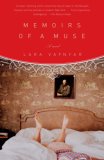
A Novel
by Lara Vapnyar Book Reviewed by:
"You should try it," my mother said to me. "You’re good with your hands."
My hand skills had only recently been discovered. Just a few weeks before that, I’d fallen victim to severe rainy-day boredom and pulled an old (probably left from my kindergarten days) box of white clay out of the closet. I sculpted a fat, curly sheep, hardened it in the oven, painted it off-white, sheep color, and presented it a week later to my uncle for his birthday.
"Oh, we have hands, don’t we?" my aunt Maya commented. Up until that moment it was thought that my mother and I were equally bad at all hands-involving activities: sewing, knitting, cooking, making sheep out of clay. I stood in front of Maya, staring at my hands as if they’d been slowly coming out of nonbeing. I had hands!
Having hands saddled me with new duties. I was to be the one to cut my grandmother’s hair.
I moved a chair to the edge of the bed, sat my grandmother up, and slowly dragged her from the bed and onto the chair’s seat, holding her under the arms. She looked weightless, but felt awfully heavy. After those months in bed she seemed to have lost all the substance that used to fill the space between her bones and her skin. I imagined she was completely empty in there, her bones rattling inside of the withered sack of her self, like my wooden building blocks in their canvas bag. I wrapped a sheet around her neck, untied her blue band and combed her hair, trying to avoid touching her scalp. Her skin, though warm, had a corpselike softness about it. I felt that if I pressed my finger hard enough, it would break her skin and fall into some deathly depths that reached further than the inside of my grandmother’s body.
I took the scissors—large stainless-steel shears, usually used for cutting fabric and trimming fish tails—and snapped with them a couple of times, then put them down and combed her hair some more. Her eyes, wet and alert, took in the scissors, the comb, my hands, and seemed to creep into my face.
"Sit still, Ba," I said, turning away from her stare. I called her a short and intimidating "Ba" instead of a long "Babushka." I loved to bully her. "Sit straight, Ba, you don’t want to spill your soup." "Here is your potty. You better do it now, because I have lots of homework and I’m not going to run in here every second." She never complained. She moved the way I told her to. She tried to eat as fast as possible and to go to the bathroom as neatly as she could. She praised the food I served. She sang to me. She told me stories. She met me with an eager smile. She tried to humor me.
Tough but efficient, I thought myself a perfect nurse.
"You wouldn’t believe what this girl of ten can do. I’ve been training my nurses for years and they are not half as accurate or reliable," my uncle said, introducing me to his doctor friends, who shook their heads in disbelief and smiled at me. I knew I was special! I’d always known! No other girl of my age could take blood pressure, run an ECG machine, or administer injections. Not even my uncle’s daughter, Dena. Dena, who was nine years older than me, a very good student, perfect in every way, and preparing to go to the U.S. There was no saying what I would be able to do when I got older!
It was only years later, when the doubts started gnawing at me, that I thought very few girls of ten were ever assigned to giving injections or running echocardiogram machines, and if they were, they might have done no worse than me.
And still later, a sickening suspicion suddenly crept in: my grandmother was so smiley and acquiescent not because I was a perfect nurse, but because she was afraid of me.
Before her stroke my grandmother had lived in her own apartment "a half of Moscow away from us," as my mother had said. We visited her once a month. To get to her part of Moscow we had to switch from a bus to a subway and then to another bus. The trip back and forth took us more than two hours. I thought that the hour spent at my grandmother’s place wasn’t worth it. She always served us cake that I hated—a stale, crumbly sponge smeared with sour cream and bitter wild strawberry jam, and she kept asking if I’d at last learned how to make my bed and spread my bread with butter. My grandmother’s apartment didn’t have any toys, or any fun or beautiful objects—only books, which lay everywhere with neat paper bookmarks stuck between the pages, and a few photographs: of my dead grandfather, my uncle, my mother, and myself at the age of two. I would rather she had a more recent photo. She talked about her health, the problems she encountered while paying her electricity bills or applying for her special war widow pension, the sidewalks covered with thin ice in the mornings. My grandmother often attempted to talk about my father, but seemed unsure if she should weep over his tragic, untimely death or condemn his behavior when he was alive, so she switched to my uncle’s wife, Maya, who was not dead and thus not protected from criticism.
Excerpted from Memoirs of a Muse by Lara Vapnyar Copyright © 2006 by Lara Vapnyar. Excerpted by permission of Pantheon, a division of Random House, Inc. All rights reserved. No part of this excerpt may be reproduced or reprinted without permission in writing from the publisher.
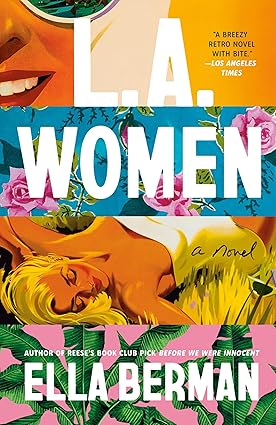
L.A. Women by Ella Berman
Two ambitious writers in 1960s LA face betrayal when one writes a novel based on the other's life.

Your guide toexceptional books
BookBrowse seeks out and recommends the best in contemporary fiction and nonfiction—books that not only engage and entertain but also deepen our understanding of ourselves and the world around us.


