
-
Your next favorite book
is waiting.
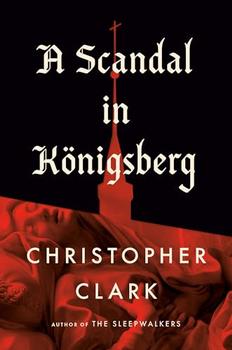
by Christopher Clark
As told by one of our greatest historians, the story of the scandal that took down two Lutheran preachers in the heart of nineteenth-century Prussia—a chamber piece of cultish esotericism, pseudoscience, and political resistance that conjures up Europe at the end of the age of reason and presages our current age of misinformation.
In 1835, Johannes Ebel and Georg Heinrich Diestel were tried for having started a cult. Worse: It was a cult that encouraged scandalous sexual behavior in women, including the daughters of prestigious Prussian families—causing the deaths of two young women from sexual exhaustion. The trial would absorb and polarize the city of Königsberg for half a decade and ruin the lives and careers of its defendants, despite their eventual legal exoneration. The historical moment it encapsulates—a Europe reeling from the triumph and horror of a new industrial, imperial era, struggling to decide which principles will reign in the aftermath of Enlightenment reason—is a fable for our present time of political, social, and existential disquiet.
The great Cambridge historian Christopher Clark—known for The Sleepwalkers, his monumental, defining study of the causes of the First World War—came across the files containing this story three decades ago; it has been swirling in his mind ever since. In gripping, narrative prose, Clark immerses us in a Königsberg scarred by the horrors of the Napoleonic Wars, where Immanuel Kant had recently inaugurated the theory of consciousness that completely reshaped humanity's understanding of itself—but where the distinction between reason and fanaticism was now up for grabs. A Scandal in Königsberg is a European history in exquisite miniature—and a peerless lesson in the theological and philosophical debates that animated the Western world at one of its great moments of transformation.
Rich and provocative, A Scandal in Königsberg articulates an unsettling antecedent for our most fiercely litigated contemporary questions of sexual identity, freedom of thought, and who gets to decide what constitutes the truth.
"A moral panic over a lurid sex scandal becomes culture war fodder for a polarized nation in this nuanced unearthing of a little-remembered episode in 1830s Prussia...Clark astutely notes that, much like with today's moral panics, concern about gender conformity seemed to be the panic's prime motivator...This meticulously researched history astonishes in its timeliness." —Publishers Weekly (starred review)
"[Clark's] studied focus on the specificity of the scandal in Königsberg allows each reader to consider how cults of personality, sensational accusations, performative outrage, and unyielding beliefs might undermine or endanger not only individual livelihoods, but also the deeply human pursuits of spiritual fulfillment, community, and power. An unexpectedly prescient cautionary tale." —Kirkus Reviews
"Clark provides a detailed and immersive view of these events...that feel more modern than their chronology would suggest...[A Scandal in Königsberg] maintains a well-paced narrative that makes it accessible to a broader audience. Ebel and other historical figures in the book are intriguing and multifaceted, enlivening an obscure story long overlooked by historians." —Library Journal
This information about A Scandal in Königsberg was first featured
in "The BookBrowse Review" - BookBrowse's membership magazine, and in our weekly "Publishing This Week" newsletter. Publication information is for the USA, and (unless stated otherwise) represents the first print edition. The reviews are necessarily limited to those that were available to us ahead of publication. If you are the publisher or author and feel that they do not properly reflect the range of media opinion now available, send us a message with the mainstream reviews that you would like to see added.
Any "Author Information" displayed below reflects the author's biography at the time this particular book was published.
Christopher Clark is a professor of modern European history and a fellow of St. Catharine's College at the University of Cambridge, UK. He is the author of Revolutionary Spring, The Sleepwalkers, Time and Power, Iron Kingdom, and other books.

If you liked A Scandal in Königsberg, try these:
Theo of Golden by Allen Levi
One spring morning, a stranger arrives in the small southern city of Golden. No one knows where he has come from…or why…






Your guide toexceptional books
BookBrowse seeks out and recommends the best in contemporary fiction and nonfiction—books that not only engage and entertain but also deepen our understanding of ourselves and the world around us.


