
-
Your next favorite book
is waiting.

An interview with Caro Claire Burke about her novel, Yesteryear
How did you become interested in the "tradwife" segment of social media?
In the winter of 2024, I was a very burnt-out writer who had been writing fiction for years and needed to take a break. On a whim, I downloaded TikTok. I ended up becoming involved in conversations about feminism and media literacy as they pertained to the tradwife discourse, which incidentally entered the zeitgeist the same month I downloaded my account. TikTok is a wonderfully democratic platform: if you share a video and enough people resonate with it, then you're in, so to speak. As a person who had spent years trying and failing to get a foot in the door at traditional cultural institutions (pitching culture essay ideas to magazines, for example), it was a shocking experience for me to find a side door. In short order, I grew a following and become a major player in a large cultural conversation which spanned weeks and one morning in that period, I woke up with the full synopsis for a novel in my head. I even had the title.
You co-host a culture podcast – Diabolical Lies – that, among other things, has covered tradwives. How did your work on one inform the other?
My work on Diabolical Lies is often jarringly interconnected with my work as a novelist, even though these are technically two extremely different projects: one exists firmly in the world we live in, requiring me to abide by facts and a basic understanding of reality, and the other allows me to dip into another world entirely, empowering me to diverge from the rigid structure of "fact" in the pursuit of another kind of truth. But both, at the end of the day, come from the same urge to better understand the world around me. Each job influences and fuels the other immensely. I'm lucky in that way.
You've talked about tradwives as a culture critic and have written about them as a debut author. What appealed to you about writing a novel vs. a nonfiction book on the subject? What drew you to making it a thriller, specifically?
I don't think any of these questions were ones I considered in any deliberate sense. I suppose I chose a novel because that's the field I trained in for years; I got my MFA in fiction, and have been writing fiction, both published and unpublished, for over a decade now. It wasn't a decision so much as a creative tic, one I'm sure another writer would recognize: once you have an idea for a story, you're a dog with a bone. It's not rational. It's instinct. As for the question of genre: when I was writing the first draft of the novel, I actually wasn't certain how the book would be marketed. It makes complete sense to me that people see it now as a thriller, but at the time I was focused on all kinds of things: how it operated as thriller, yes, but also how it operated as a black comedy of sorts, and a social satire, and in some ways a strange kind of coming of age.
What questions or feelings did you find yourself working through or exploring as you wrote Yesteryear?
Ha! How much time do you have? Let's just say I see myself in every character in this novel. At this point in my career, it's not clear to me if writing fiction about patriarchy, religious extremism, and structurally enforced misogyny works as a crucial form of emotional catharsis for me, or if I'm slowly marching my way to the nearest asylum by spending so much time immersed in these topics. TBD, I guess.
One of the most fascinating parts of the book was Natalie's relationship to a few core ideas. How would you describe Natalie's relationship to the very ideas of womanhood and motherhood?
Natalie has a very transactional relationship with motherhood, womanhood, and spirituality. This relationship is also quite childlike. She is constantly finding herself disappointed, shocked, and/or outraged by the nuanced way in which each of these realms of identities appears in her adult life. I think her perspective of other women's lives is equally limited. She has an almost pathological ability to misunderstand what another person is thinking or feeling, which means she ends up living in a world of absurdity. I didn't intend to write her this way, it just happened. Every scene that involves Natalie becomes hysterical, mysterious, or terrifying.
What about her relationship to patriarchy, both as a system and to individual men?
I often end up thinking about novels as houses, especially when I'm in the middle of a draft, and in Yesteryear, I view patriarchy as the scaffolding for Natalie as a character. She has built an entire worldview out of patriarchal assumptions, assuming these would hold steady for her entire life–but as everyone knows, scaffolding is a definitionally temporary support system, one you remove when the real work of building something that will last forever is completed. Unfortunately for Natalie, she leans on the flimsy thought structures of patriarchal thinking too hard, thinking they'll hold her. They don't.
The question of choice feels so central to this novel–how much of what happens is Natalie's choice, and how much isn't, for example. Another crucial element is the concept of performance, which is first verbalized by Natalie's mother as a coping mechanism she used to get through daily life while raising her kids. How do those concepts–choice and performance–intersect?
FREE WILL! Now I feel like we're talking on my podcast, where we joke that every conversation always ends up with me with my hands thrown up in the air, gesturing vaguely at the notion of free will. The question of performance is equally dizzying as the question of choice–once you start to think about it, you run the risk of overthinking every element of your life. It's true that we perform versions of ourselves online; that kind of performance is one people tend to feel the most comfortable admitting and discussing with others. But it's also true that we perform at work, and in fitness classes, and at home with the people we cherish most in the world. I'm not convinced anyone has a choice in any of it, but I tend to be a free will pessimist. This reminds me of a line Natalie thinks at one point, one that came to me early and was critical in unlocking the rest of the novel: "Motherhood is its own kind of curation. Which is to say: every woman I know lied to me about what it would be like, before I became one myself."
What role do you think non-supportive spectators (the social media followers Natalie calls the Angry Women) play in the perpetuation of tradwife performance and popularity?
Every performance demands an audience.
Yesteryear feels like it's written to be talked about. What are you hoping readers take away from that interplay?
I have no expectations or hopes for how readers react to this novel. On a personal note, there's nothing more interesting to me as a writer or a person than the grand performance of womanhood. I plan to talk about that for the rest of my life.
Unless otherwise stated, this interview was conducted at the time the book was first published, and is reproduced with permission of the publisher. This interview may not be reproduced or reprinted without permission in writing from the copyright holder.

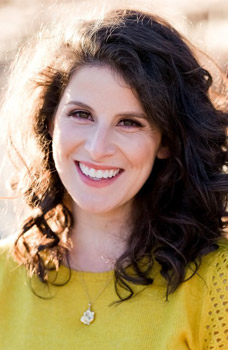
Megan Angelo grew up in Quakertown, Pennsylvania and graduated from Villanova University. Her writing has appeared in the New York Times, the Wall Street Journal, Glamour and Elle, among other publications. She lives in ... (more)
If you enjoyed:
Yesteryear
Try:
Followers
by Megan Angelo
Gillian Flynn was born in Kansas City, Missouri to two community-college professors—her mother taught reading; her father, film. Thus she spent an inordinate amount of her youth nosing through books and watching movies. ... (more)
If you enjoyed:
Yesteryear
Try:
Gone Girl
by Gillian Flynn
We recommend 4 similar authors
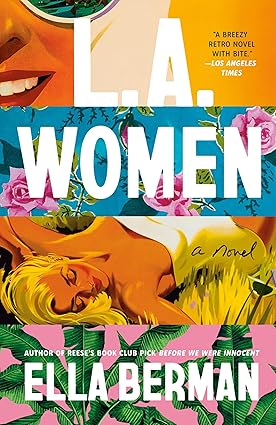
L.A. Women by Ella Berman
Two ambitious writers in 1960s LA face betrayal when one writes a novel based on the other's life.




Your guide toexceptional books
BookBrowse seeks out and recommends the best in contemporary fiction and nonfiction—books that not only engage and entertain but also deepen our understanding of ourselves and the world around us.

