
-
Your next favorite book
is waiting.

A Q&A with Bonnie Garmus on her novel, Lessons in Chemistry.
Elizabeth Zott is a character we would all love to know or even become; where did such a personality spring from?
Fury! I started Lessons in Chemistry about seven years ago. I'd just come out of a meeting, irritated by some garden variety sexism, and as I sat down to work, I suddenly realized someone else was sitting there, too. Her name was Elizabeth Zott. Like me, she wasn't in a very good mood. "You think you've had a bad day?" she said. "Well, get a load of this."
Now I should add that Elizabeth Zott wasn't new to me—she'd had a minor role in a different novel I'd started (and shelved) years before. But what was new to me was her certainty of who she was and what she had to say—about society, culture, racism, sexism, religion, and most of all, about change. How to do it and why
Was there a particular idea or story that inspired you to write Lessons in Chemistry?
Not really, although I remember feeling like I really needed a new role model— someone who stood up for what she believed in; someone with integrity. That feeling was directly influenced by current politics and a deep-seated feeling that irrationality is on the rise. So I wanted to create a character who represented common sense—who refused to buy into society's latest set of limitations.
Why did you pick the era of late 1950s and 1960s as the setting of your book?
I set the book during my mother's era because I wanted to salute a generation of overlooked women—those so-called average housewives. They were the ones who stayed at home, and, despite education and ability, did all the cooking, cleaning, sewing, baking, and ironing, while raising a herd of kids.
Obviously, theirs was a tough job, but it was made even tougher by restrictions of the time. For instance, back then a woman couldn't open a bank account without her husband's permission; she had no legal right to his salary; her name was usually absent from the deed to the house; she couldn't attend an Ivy League school; she couldn't apply for a credit card; she couldn't take birth control (it was illegal in some states and extremely difficult to get in most others); she couldn't serve on a jury; she couldn't practice law; and if she did work outside the home (a rarity) pregnancy was a fireable offense. Worse, all of her labor was trivialized.
Today, when I get frustrated because I think we still haven't made enough progress, I think back to my mother's era. It reminds me that significant change is possible. We've done it before; we can do it again
Six-Thirty is destined to capture people's hearts. Tell us about the dogs in your life.
I've had a few! My first dog was Charlie, a mutt, and he lived a very long time—nineteen years— thanks to (we believe) the bowl of ice cream he enjoyed every evening. As I child, I worshipped him and imagined he had great powers and heroic tendencies, although for a hero, he slept an awful lot.
Next came Astro and Barney, both mutts from the pound. They were our Best Dogs at our wedding and were great in the role—maybe a little too great—because a lot of our wedding photos feature only them—or them and the bottom half of our legs. We always referred to think they helped prepare us for parenthood.
Friday came next—she was yet another pound rescue who'd been so badly abused, her previous owner had been sent to jail. But despite her bad beginning, Friday was basically Gandhi. Incredibly calm, wise, and smart, she had a huge vocabulary—not as big as Six-Thirty's—but large, nonetheless. When we were transferred to Switzerland, she even picked up some German. Friday was the inspiration for Six-Thirty.
Now, we have 99, an eleven-year-old greyhound ex-racer. We live in a small flat in London—99's the biggest thing in it. Living with her is probably the closest we'll ever get to living with a fawn. Extremely sensitive, if she hears crying, she'll try to do something about it—usually by gently pressing herself up against the sad person. Which is nice unless the crier in question is someone with a fear of dogs. She's given a few people heart attacks.
Your book may inspire more young women to become scientists. Did you have similar aspirations when you were younger?
I never wanted to be a scientist—I always wanted to write novels! But I've always held scientists in high esteem. We all know brilliant minds have been routinely barred from science through systemic sexism, racism, and cultural barriers, and it's still happening today. Science is one field in which keeping women, people of color, people of all genders out is not only unacceptable but perverse given that science itself doesn't recognize intellectual limitations within these groups. So I do hope young women will continue to break through these barriers and flock to science—we need them! But I hope some of them will write novels, too.
You use the chemistry theme so creatively and make it so much fun. We could have sworn you had a scientific background! Where did the science in the book come from?
I needed to get the basics down, so I taught myself chemistry using an old textbook from the 1950s—had to be from the '50s so I wouldn't inadvertently mention breakthroughs that hadn't happened yet. I also used a children's chemistry book—The Golden Book of Chemistry Experiments—from the same era. I even conducted a few experiments in our London flat, some of which had iffy results—which is okay in science, but less so in a dense neighborhood. But now I can say for a fact that the London fire department's response time is excellent.
Elizabeth Zott refuses to conform to societal limits of her era – are there any particular women in history whom you admire?
I've got a long list! But I'll start with Rosalind Franklin, whose X-ray diffractions of DNA led directly to the discovery of the double helix— not that James Watson would ever admit to that. I'm also a big fan of Rosa Parks, the activist; Nellie Bly, the journalist; Jane Goodall, the animal behaviorist; Gloria Steinem, the feminist; and Gertrude Ederle, the first woman to swim the English Channel and in a time that beat every male who'd come before her.
Do you enjoy cooking yourself ? Who cooks the most in your house?
I'm a little embarrassed to admit I don't enjoy cooking! But I do admire those who do and that's why my favorite meal is the one someone else makes. I think cooking well is hard—it's both an art and a science. Luckily, my husband loves to cook and he's good at it. Nevertheless, we split cooking duties right down the middle. Which means we get a great meal every other day.
Which books have most influenced you as a writer?
I read a lot as a child and those books and authors—Harriet the Spy, anything by Roald Dahl, Dickens, Nancy Drew, etc., had a huge impact. But as I got older, I read broadly— especially the Russians and the French (Anna Karenina, Madam Bovary) before getting hooked on great storytellers like John Irving, Donna Tartt, and J.K. Rowling.
Can you tell us more about the sport of rowing and why you chose to make Calvin a rower?
That's easy: rowing was the one thing I didn't have to research! Because I'm a rower. But I also wanted to make Calvin a rower because the sport requires an incredible amount of cooperation, plus the ability to withstand pain and embrace endurance. Based on his upbringing, Calvin knew how to withstand pain and endure. But cooperate? That's where people stumble. And that's why I wanted rowing to serve as a thematic device in the book. The fastest boats aren't necessarily the boats with the biggest, strongest people, but rather the boats filled with people who cooperate and communicate well. People who pay attention to the tiny details rowing demands. Every race always starts the same way: with the word, "Attention." And it's those boats that pay attention—that row as one instead of as eight— that win.
Unless otherwise stated, this interview was conducted at the time the book was first published, and is reproduced with permission of the publisher. This interview may not be reproduced or reprinted without permission in writing from the copyright holder.


Ramona Ausubel is a graduate of the MFA program at the University of California, Irvine. She is the author of the novel No One Is Here Except All of Us and the short story collection A Guide to Being Born. Her work has been ... (more)
If you enjoyed:
Lessons in Chemistry
Try:
The Last Animal
by Ramona Ausubel
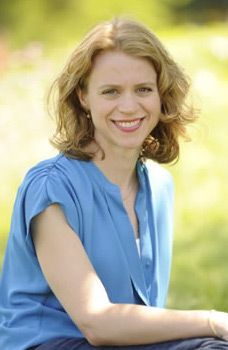
Kerri Maher is the USA Today bestselling author of The Paris Bookseller, The Girl in White Gloves, The Kennedy Debutante, and, under the name Kerri Majors, This Is Not a Writing Manual: Notes for the Young Writer in the Real... (more)
If you enjoyed:
Lessons in Chemistry
Try:
All You Have to Do Is Call
by Kerri Maher
We recommend 5 similar authors
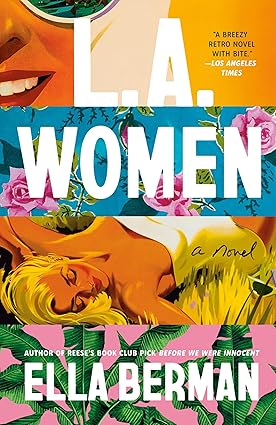
L.A. Women by Ella Berman
Two ambitious writers in 1960s LA face betrayal when one writes a novel based on the other's life.




Your guide toexceptional books
BookBrowse seeks out and recommends the best in contemporary fiction and nonfiction—books that not only engage and entertain but also deepen our understanding of ourselves and the world around us.

