
-
Your next favorite book
is waiting.

A Q&A with Wally Lamb on The River Is Waiting.
What inspired you to write The River Is Waiting? How much of Corby Ledbetter's journey came from real-life experiences versus pure imagination?
Starting a novel is always difficult for me. I usually begin by going back to ancient folktales and myths—the stories that have withstood the test of time because people need them to be told and retold. In 2018, I discovered a Mexican folktale called "The Weeping Woman." It's about a ghost who wanders near bodies of water, mourning the loss of her children whom she has drowned. The River Is Waiting goes far afield from that story but it, too, is about a parent who mourns a child for whose death he is responsible and who goes to the river to seek his truths.
As to real-life experiences, the writer Tom Drury said it best when he answered this perennial question: How much of you is there in your characters? Think of it this way, Drury said. A fiction writer takes a baseball bat to a stained-glass portrait of himself. Then he sits before the broken pieces and creates a whole different portrait. There are shards of me in Corby, but he and I are different people.
The book dives deep into incarceration and systemic injustice. How did you tackle writing about these tough topics, keeping in mind that some readers might be unfamiliar with aspects of the prison experience?
Almost all the novels I've written explore in some way how power is used and sometimes abused—personally, politically, judicially. Although it's not the central theme, The River Is Waiting comments, through Corby's growing awareness, on the racist white paternity's historical and contemporary abuses of power to the detriment of Black and Indigenous people.
From 1999 to 2019, I facilitated a writing program for incarcerated women at a maximum-security facility where inmates of color far outnumbered white inmates. Many of my students' autobiographical essays told me why. Crime and punishment is a complicated equation in which race, class, and economics are factors. Many of the women in our program gained self-awareness by examining in writing the "hows" and "whys" that led to their imprisonment. Other writers focused on the day-to-day details and challenges of prison life. Prison administrators and officers don't necessarily want the public to know everything that goes on in the institutions they maintain. Perhaps Corby's story lends some transparency to life behind the prison walls, particularly for those unfamiliar with the challenges of this existence.
Nature, especially the Wequonnoc River, is an important part of the story. How did you come up with the idea to use it as a metaphor and emotional anchor?
The Wequonnoc is a fictional river that shares characteristics with three rivers that conjoin in my hometown of Norwich, Connecticut. An East Coast native who lives about 45 minutes from the ocean, I've always been drawn to the sight, sound, and power of moving water. That fascination extends to rivers, streams, waterfalls, floods— and even to indoor plumbing! (I've gotten some of my best writing ideas in the shower.) There's something about the flow of water that unblocks me and carries me along, as a writer and a problem solver.
Corby goes to the river seeking clarity. Should he confess and take responsibility for the tragedy he caused or use the loophole his attorney has suggested? He makes his decision when he stares eye to eye with a great blue heron perched on a rock in the middle of the swiftly moving river.
Manny's journey is all about resilience and hope. What shaped his character, and what do you want readers to take away from his life after incarceration?
There's a lot of sadness in this novel. To some extent, Manny is a character who provides a measure of comic relief. But he functions in other ways as well. The Yates Prison chapters depict two opposing forces: evil and good. The forces of evil are embodied in Officers Piccardy and Anselmo and Corby's first cellmate, Pug. The forces of good include Mrs. Millman, Officer Cavagnero, Dr. Patel, and, despite the crimes he's committed, Manny Della Vecchia. I like to think Manny's compassion and humanity, as when he reaches out to Emily, will serve him well in his post-prison journey. That said, his employment opportunities are likely to be limited to low-paying service jobs like the one he has at the mall. I know from my formerly incarcerated students that employers are often reluctant to take a chance on someone who has a prison record.
Art plays a big role in Corby's story-it is both an escape and a legacy. Why did you decide to make Corby an artist, and what does his artistic expression mean in the story?
I imagine making one's living as a commercial artist is different than following one's artistic impulses irrespective of a salary. Corby's job provides him a living but does little to nurture his creative soul. Yet when his employer lets him go, it triggers his downward spiral toward addiction. Ironically, when he is tapped to create his mural, that confinement in prison frees him to follow his instincts, restoring his love of art for art's sake.
When I was a kid, I loved to draw. I wrote and illustrated my own comic books. Recognizing that I had some artistic talent, my elementary school teachers god rest their overworked souls-taped bedsheet-sized paper to the classroom walls and let me draw and paint full-size murals during recess. In high school I was voted "Class Artist" and entered college planning to major in art. Then I fell in love with literature and swerved in a different direction. In my twenties I had no idea I would become a novelist, but in retrospect it all makes sense. Drawing and fiction writing drink from the same well. I often see scenes play in my head like movies before I put them into words. All that drawing I did as a kid prepared me to become a storyteller.
Addiction and mental health are handled with so much care in the book. How did you approach writing about these themes in an authentic way?
The town where I grew up housed Connecticut's largest hospital for the mentally ill. Riding past that sprawling campus when I was a kid spooked and fascinated me. It wasn't until I was an adult that a family secret was divulged: my maternal grandfather had lived the last years of his life in that hospital's forensic building.
Many of my incarcerated students were doing time because of DUI fatalities and/or addictions that led them to criminal behavior. Their honest explorations of how they came to crave substances that were destroying their lives opened my eyes to the self-defeating power of addiction. Corby's problems start with his depression and subsequent anxiety, for which he is prescribed an addictive anti-anxiety drug. I wrote about his overreliance on alcohol based somewhat on personal experience. When I was in my fifties, my drinking went from enthusiastic to problematic, but I have been happily sober for fourteen years.
The multiple perspectives and time jumps in the book add significant dimension to the story. How did you decide on this structure and balance storylines to make the characters feel so real?
I began the story knowing that the tragedy would come near the beginning, but I didn't yet know much about who Corby and Emily were as a couple, so in chapters two and three, I took a hiatus from 2017 and began writing their backstory covering the years 2005 through 2013. Later, I wrote several flashback scenes to inform myself what Corby's childhood had been like with a difficult father and a mother who was checking out by smoking weed. I wasn't thinking about a readership during this process; I was writing for myself so that I could understand Corby on a deeper level. I don't outline or plot my stories ahead of time; I sit behind my laptop and discover them on a day-to-day basis.
I had a chunk of the novel written before I began working with my wise and perceptive editor, Marysue Rucci. Back then, the story swung back and forth between two points of view: Corby's and Emily's. Marysue urged me to tell the story from a single viewpoint, Corby's, and let us know Emily through his eyes. That went a long way toward focusing and improving what I had drafted. Throughout our work together, Marysue's feedback was rigorous and invaluable. She helped me to write a much better book.
How did you decide on the ending and what do you hope readers will take from it?
Titling my novels is always a big deal for me and, as many of my readers have observed, there's always a tie-in to music. That's because I play music while I'm writing and a snatch of song lyric or a refrain sometimes will point me in a direction that surprises me. Titling is my way of tipping my hat to musicians and songwriters. "The River Is Waiting" is a song I first heard sung by New Orleans's soul queen, Irma Thomas. I later learned it was written and recorded by John Fogerty. The song kept playing in my head until I realized on a conscious level that that would be the title of my then story in progress. That left me with two questions I needed to answer: who or what was the river waiting for and why?
In the book's final scene, Corby and Emily's surviving twin, Maisie, reaches up to touch the rendering of her lost brother Niko in Corby's mural. "Hello, boy," she says. That ending wasn't something I intellectualized about; it came to me full-blown and moved me to tears. For those brief few seconds, Maisie reconnects with her lost twin.
Including the Covid-19 pandemic added a contemporary dimension to the story. Why did you want to weave this into the narrative? How does it highlight issues facing incarcerated individuals?
I began writing this novel two years before the outbreak of Covid-19. Since Corby enters prison in August of 2017 with a three-year sentence, his release is scheduled for the summer of 2020, at which time the coronavirus was rampant. It would have been unrealistic to avoid this health crisis in a novel set in the real world at a specific place and time.
Because they live in close proximity to one another, prisoners were extremely vulnerable during the pandemic. Facilities had protocols to lessen the possibility of infection, but they were not always adhered to. Inmates were sequestered in their cells for weeks at a time, family visits were cancelled, and volunteer programs were shut down. Some incarcerated individuals still suffer from long Covid and the effect of long-term isolation.
What is one takeaway you hope readers will have after finishing The River Is Waiting?
What readers take away from the novel is up to them, not me. I only hope the story is useful and perhaps applicable to their own lives.
Unless otherwise stated, this interview was conducted at the time the book was first published, and is reproduced with permission of the publisher. This interview may not be reproduced or reprinted without permission in writing from the copyright holder.


Born in the U.K, Luke Allnutt is a writer and journalist based in the Czech Republic. He is married and has two young boys. (more)
If you enjoyed:
The River Is Waiting
Try:
We Own the Sky
by Luke Allnutt

Highly regarded as both a novelist and a short story writer, Ethan Canin has ranged in his career from the short stories of Emperor of the Air to the novellas of The Palace Thief, from the short novel Carry Me Across the ... (more)
If you enjoyed:
I Know This Much Is True
Try:
A Doubter's Almanac
by Ethan Canin
We recommend 10 similar authors
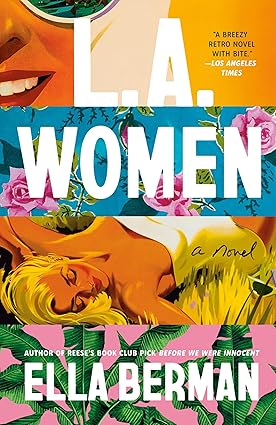
L.A. Women by Ella Berman
Two ambitious writers in 1960s LA face betrayal when one writes a novel based on the other's life.






Your guide toexceptional books
BookBrowse seeks out and recommends the best in contemporary fiction and nonfiction—books that not only engage and entertain but also deepen our understanding of ourselves and the world around us.

