
For Patrons of Onondaga County Public Library
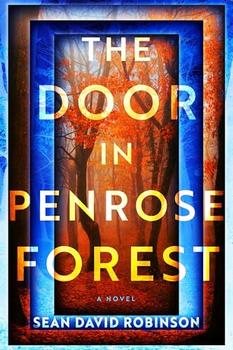


by Sean David Robinson
As a boy, Nico once accompanied his mother on a research trip to investigate a stalled migration of monarch butterflies. One night, upon hearing her sneak out of their rented cabin, he followed her to a clearing in the forest where a famed mansion once stood. Paralyzed with fear, he watched his mother climb a staircase and vanish, along with the stairs and the strange glowing door at its peak. No one believed his story, and as he grew older, he too stopped believing it was real.
As an adult, Nico returns to his hometown to care for his ailing father. But something strange is happening to the town. There are unexplained power fluctuations, people are going missing, and, reportedly, phantoms are roaming the woods. When Nico finds his mother's field journal from the week she disappeared, including her account of the vanishing staircase, he begins to pick apart the mystery.
All the tangled strings trail back to the same starting point: the Gilded Age family whose mansion burned down under mysterious circumstances in those very same woods where his mother vanished.
Equally a compelling mystery and a moving story of family and destiny, this speculative novel will spellbind readers of Emily St. John Mandel and Susanna Clarke.
In 1997, young Nico Calloway goes on an expedition with his lepidopterist mother to study the behavior of monarch butterflies in nearby Penrose Forest. In the middle of the night, she wakes up, walks towards a mysterious glowing door in a forest clearing surrounded by butterflies, and enters, never to return. Unsurprisingly, this has a profound effect on Nico, who grows up obsessed with puzzles, clearly attempting to bring order to a world where such an inexplicable, traumatizing event could occur. When his father's heart attack brings him back to Penrose Forest in the present day, it soon becomes clear that, to quote Twin Peaks, "it is happening again."
The debut novel of Sean David Robinson, The Door in Penrose Forest is the kind of mystery that lets you enjoy the journey as much as the destination. Some novels (and movies and TV shows) are too concerned with setting up chess pieces to flesh out characters, develop a setting, or establish a mood. That's not the case here, thankfully; it's great fun to let yourself be taken on the ride alongside Nico, whose attempts to wrap himself around the one puzzle that's been hanging over his head virtually his entire life result in mystery, peril, and, eventually, something like closure.
Robinson makes the smart structural choice of putting the eerie inciting incident, with its mystical door near the ruins of a Gilded Age mansion and a mysterious entity that Nico calls the Ribbon Man, right at the start of the story, then sinking us into Nico's more mundane reality as an adult. Not only does it provide necessary contrast (inexplicable disappearance giving way to boring air travel), it puts you on alert, making you look for clues to what's happening even in the quietest moment. And after the second chapter, Robinson shifts gears entirely into an in-universe contemporary narrative—a memoir describing the fall of the Penrose family, whose ruined mansion is near the site of Nico's mother's disappearance, from the point of view of an interloper. Curiouser and curiouser!
The Door in Penrose Forest is an impressively ambitious first novel, but there are some aspects that aren't quite as strong as they could be. Robinson's prose skews matter-of-fact; he has some strongly evocative images (the furious beating of countless butterfly wings is described as sounding like "a river in the sky"), and it's enough to make you wish he was more consistently evocative. As for the in-universe memoir, it's a little too self-consciously mannered, feeling very much like an inexpert approximation of interbellum wit.
But ultimately, these are nitpicks. I was intrigued from the word go, no developments along the way made me want to stop reading, and while I won't spoil where it all ended up, I can certainly say I was satisfied. If you like your mysteries a little less straightforward and a little more uncanny, you'll be drawn to Penrose Forest—and The Door in Penrose Forest—like a butterfly to a flame. (Wait, that's moths, not butterflies. Darn it.)
Book reviewed by Joe Hoeffner
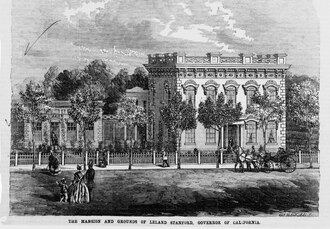 In The Door in Penrose Forest, the Penrose in question, lending his name to the forest, the city near it, and the ruined mansion at the heart of the intrigue, was Cornelius Penrose, a robber baron from the Gilded Age who used his vast fortune to enrich the area surrounding Penrose (then called Williamsville) before a massive flood devastated the area; not long thereafter, a mysterious fire reduced his palatial estate almost completely to ash. The reader eventually finds out what happened, parceled out in alternating chapters with Nico's story.
The Gilded Age was, of course, a time when mostly-unscrupulous men accumulated then-unimaginable amounts of wealth, which they used to build some things for the people (museums, libraries) but mostly for themselves (for example, their palatial mansions).
There are quite a few Gilded Age mansions in the United States, some of which still stand and some of which met a similar fate as Penrose Estate. The San Francisco mansion of Leland Stanford, an ultra-wealthy railroad magnate and governor of California, for instance, was destroyed in the 1906 earthquake, along with the mansions of the four other founders of the Central Pacific Railroad who lived on the same hill. (These four businessmen who lived on Nob Hill were known as the "Big Four.") Stanford had two other mansions: one in Palo Alto which was torn down in 1965 after serving as a children's hospital, another in Sacramento that now serves as a museum and a reception center for the California government.
One of the more notable Gilded Age mansions still standing is Sagamore Hill, which was built for President Theodore Roosevelt. While he was President, it served as the "Summer White House," and he lived in it from 1885 until his death. You can still visit it today to marvel at the gorgeous Queen Anne architecture and learn all about the 26th president. And not far away from Sagamore Hill sits Oheka Castle, an enormous Gilded Age mansion-turned-hotel built by the financier Otto Herrmann Kahn. This former mansion is perhaps most famous as the location where Taylor Swift filmed the music video for "Blank Space".
by Allie Rowbottom
Los Angeles, 1982. Jude is eighteen, newly out of reform school and hungry for more than her small-town past can offer. Searching for her best friend, Winnie, she instead falls under the spell of Laird, an older man with a motorcycle, a needle, and a taste for danger. What begins as escape soon unravels into motel rooms, stickups, and drug binges.
Then Jude finds Winnie, reinvented as Velvet at a Sunset Strip club. Together, the two girls imagine a future: bartending, dancing, writing the novels they dream of, building a home of their own. But the same world that promises glamour and freedom is poised to consume them, and survival demands that they navigate the men who offer love, power, and escape—always at a cost.
With Joan Didion's eye for California's allure and shadows, and told in a two-part structure reminiscent of Lauren Groff's Fates and Furies, Lovers XXX is a hypnotic novel of friendship and self-invention, of sexual identity beyond binaries, and of the costs of giving one's body to the performance of sex. Above all, it is a love story like no other—between two ardent, vulnerable, and revelatory women.
When eighteen-year-old Jude thinks back on the happiest days of her life, her mind always returns to the time she spent with her childhood best friend, Winnie. The two once imagined running away together from their small Pacific Northwest town, heading to the big city to become famous writers. But when, after a stint in reform school, Jude returns home, she discovers that Winnie has already made her escape. Determined to recapture the hopeful dreams the two girls once shared, Jude follows clues, tracing Winnie to Los Angeles—and into a different kind of fame.
Allie Rowbottom's second novel, Lovers XXX, is in many ways a series of variations on the theme of recapturing an idyllic kind of female friendship, one marked by mutual support and respect and by shared ambition. Life has a way of complicating dreams, and Jude and Winnie's road back to one another is full of unexpected and sometimes damaging turns. First, Jude is lured into small-time robbery by a charismatic drug dealer—and by his seductive wares. Once she narrowly escapes that path, Jude follows Winnie's trail from diners to topless bars to strip clubs, where she finally encounters Winnie somewhat listlessly dancing under the stage name Velvet Waters.
After Jude, with Winnie's help, kicks her heroin habit, she also takes up employment at Ladies of the Valley, and for a fleeting moment she and Winnie happily revive some of their youthful closeness. Winnie even starts writing again, and Jude has discovered her own talents. She's a magnetic performer, and she possesses both a voluptuous body and a keen appetite for sex, making her a natural on stage at the strip club, and soon—for the promise of ever-bigger paychecks—in the pages of pornographic magazines and, eventually, in adult films under the name Puss Boots.
Winnie follows along somewhat reluctantly on Jude's coattails, as unlike Jude she never really loves the work, and for a time, the two ride the last cresting wave of adult cinema's "golden age" in the early 1980s (see Beyond the Book). But soon a betrayal upends the life they've created—and threatens to end their friendship forever.
The novel's first half is told from Jude's point of view and ends with the threat of violence—the narrative then abruptly shifts perspective and time frame, switching to Winnie's perspective and fast-forwarding several decades, as Winnie, who has achieved some of her youthful ambitions, sets out to find Jude, who has been missing and presumed dead by most in the porn industry since shortly after the events narrated in the first half. The story, then, again takes up that quest narrative—from Winnie's side this time, and the novel's second half is both a mystery (what happened to Jude?) and, through skillfully interspersed flashbacks, a window into what was actually happening in Winnie's life while Jude's drama was unfolding on the page.
This technique effectively alters readers' perceptions of both Jude and Winnie, first, by showing readers Jude through the eyes of her friend, and second, by adding considerable depth to Winnie, a character who, in Jude's half of the book, often comes off as a somewhat passive background character when compared with Jude's main-character energy and her pursuit of stardom. Questions that were once unanswered become less so, and it's a testament to Rowbottom's skill that, even though some of the events in the two halves of the novel overlap, they maintain interest and intrigue, remaining fresh and surprising.
In addition to being a loving portrayal of a somewhat unconventional lifelong friendship between two women, Lovers XXX is also a masterful portrait of a specific time and place, one that rarely finds its way into the pages of literary fiction (though it has been memorialized in films like Boogie Nights). Though the novel contains a lot of sex, Rowbottom excels at making those scenes glaringly unsexy, thereby reinforcing the business aspects of the porn industry, a place where real power and wealth is held by a vanishingly small number of powerful men, not by women like Jude and Winnie. In this world, genuine affection, intimacy, and emotional connection are found not in staged bedroom scenes but in the female friendships that are forged along the way.
Book reviewed by Norah Piehl
.jpg "Theater in Amsterdam showing the movie Deep Throat, 1977") Allie Rowbottom's novel Lovers XXX is set in early 1980s Los Angeles against the backdrop of the adult film industry, during the waning days of what has since been called the "golden age" of adult cinema. For a brief time, from the early 1970s through the early 1980s, hardcore porn films achieved a kind of cachet, earning splashy red-carpet premieres, distribution to general movie theaters, bona fide celebrity actors, awards ceremonies, and coverage by mainstream film critics.
Allie Rowbottom's novel Lovers XXX is set in early 1980s Los Angeles against the backdrop of the adult film industry, during the waning days of what has since been called the "golden age" of adult cinema. For a brief time, from the early 1970s through the early 1980s, hardcore porn films achieved a kind of cachet, earning splashy red-carpet premieres, distribution to general movie theaters, bona fide celebrity actors, awards ceremonies, and coverage by mainstream film critics.
Many sources trace this era, dubbed "porno chic" in a 1973 New York Times article, to the 1969 release of Blue Movie, directed by Andy Warhol, which was the first theatrically released motion picture to depict actual sexual intercourse. The success and widespread acceptance of erotic and pornographic films like Blue Movie and, a few years later, Last Tango in Paris (1972) and Deep Throat (1972), cemented the realization that, with a relatively small investment in talent and production equipment, films depicting sex acts on screen could become hugely popular.
These films often featured full storylines and at least partially developed characters; as Casey Scott, the curator of a 2013 film festival screening masterpieces of this period, noted, "These movies seemed like Hollywood films that just happened to have sex in them." Many actors who were struggling to make it in "legitimate" film or theater were drawn to the higher paychecks and steady work of adult films to keep their careers afloat. As Deep Throat star Harry Reems said in a 2009 interview, "I could get $150 for a few hours in a sex film – compared to next to nothing for appearing for weeks in an off-off-Broadway play."
The milieu depicted in Lovers XXX is one of an industry on the verge of massive change, one that played out in the real-world history of adult cinema as well. What contributed to the end of porn's "golden age"? The novel touches on several factors, including the Meese Commission's obscenity crackdown during Ronald Reagan's administration, as well as "Women Against Pornography" activists such as Catharine MacKinnon and Andrea Dworkin, whose 1981 Pornography: Men Possessing Women positioned pornography as fundamentally misogynistic and anti-feminist. The AIDS crisis of the 1980s also took a toll on the free-wheeling 1970s adult film scene. But what most analysts point to as the death knell for the era was the rapid advancement of VHS technology, which changed the way adult films were both distributed and watched. Quickly, high artistic production values and theatrical releases on 16mm or 35mm film were supplanted by lower-budget straight-to-video approaches that prioritized cheap, widespread distribution to the home video market. Of course, in the forty years since then, the near-total transition to internet distribution and consumption has transformed the industry once more.
Theater in Amsterdam showing Deep Throat, 1977
Photo by Rob Croes / Anefo, via Wikimedia Commons
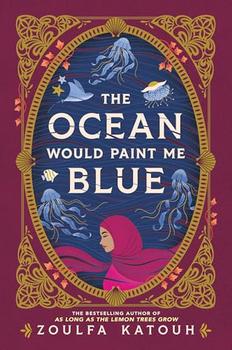
by Zoulfa Katouh
Seventeen-year-old Jihad Dabbagh has always seen life with a heightened sense for colors, one of many magical blessings the women in her family possess. But Jihad's gift changes depending on her mood. When depression sets in, the world is a colorless oasis, and in the wake of her mother's sudden death, the world has become a permanent shade of grey.
Broken by tragedy, Jihad's family doesn't believe her color loss. Her father sends her to the elite Braxton Academy to finish her senior year. There, Jihad's name and hijab put a target on her back. Her haven comes in the form of an old sketchbook carved from a tree in her hometown in Syria—a country she only knew through her mother's stories. Jihad hasn't picked up a brush in over a year, but finds herself channeling the colors of her hurt, pain, and grief as she paints the story of her mother's journey in Syria.
When graffiti of that same mural starts magically popping up all over New York, her art goes viral and the world takes notice, the threat of legal consequences is imminent. To reclaim her voice, Jihad will have to paint a new future for herself and Braxton, guided by the resilience of her mother's story.
The Ocean Would Paint Me Blue centers on Jihad, a Syrian-American Muslim teenager navigating everyday life at home and at her new school, where she experiences constant discrimination and harassment from her classmates due to her Muslim faith and identity, all while grappling with the devastating loss of her mother. When a mysterious sketchbook begins bringing her drawings to life, Jihad is forced to confront her grief and the memories she has buried since her mother's death. Blending magical realism with contemporary issues, Zoulfa Katouh examines, through Jihad's healing journey, what it means to find your voice and cling to hope when life truly seems unbearable.
I was drawn into the story almost immediately by Katouh's incredible poetic prose, which captures Jihad's grief and shows how much loss can impact every aspect of a person's life. Throughout the novel, grief is shown as something static that cannot be easily resolved. Jihad's character is easy to relate to because of her feelings of sadness, rage, and longing. The story's magical elements combine with the expression of her emotions through art, which allows her an alternative to words. The magical sketchbook and murals become symbols of healing and memory.
One of the parts of the novel I appreciated most was how Katouh portrays discrimination. As a Muslim woman who wears the hijab, I recognized many of the experiences Jihad faces. The assumptions people make, the feeling of standing out, and the pressure to repeatedly explain yourself are realities many Muslim readers will understand. Katouh handles these instances honestly, showing both obvious and subtle ways prejudice can affect someone's confidence and sense of belonging. "Our words, our meanings, my name, my meaning—all crushed under the boot of racism." What makes Jihad compelling is that she is not written as a fearless hero. She often struggles to stand up for herself and sometimes chooses silence over confrontation. While that may frustrate some readers, it felt realistic to me. It is easy to tell someone to be brave, but much harder to find courage when you feel alone or misunderstood. Watching Jihad slowly learn to trust herself and speak up makes her growth feel earned rather than rushed.
Jamie, a classmate Jihad befriends on her first day of school, plays an important role in the novel. Their relationship develops naturally, and Jamie becomes a source of comfort and support without overshadowing Jihad's journey. Their relationship was one of my favorite elements of the novel, and I wished the story had offered a glimpse of where they might be a few years down the road.
The ending is bittersweet, which is fitting for a story centered on grief. Not every question is answered, and not every wound is healed. While I had hoped for a little more closure, I appreciated that Katouh stayed true to the emotional reality of the situation. Healing is not an end goal but an ongoing process. Readers who enjoy character-driven stories, thoughtful explorations of identity, and emotionally rich coming-of-age novels will likely connect with this book. Heartbreaking yet hopeful, The Ocean Would Paint Me Blue is a moving reminder that even after loss, it is possible to find connection, purpose, and moments of beauty.
Book reviewed by Amani Altwam
 In The Ocean Would Paint Me Blue by Zoulfa Katouh, art becomes more than a creative outlet for Jihad. As she struggles with the death of her mother and the challenges of being a visibly Muslim teenager, art allows her to express emotions that often feel too overwhelming to say aloud. With elements of magical realism, Jihad's drawings begin to take on a life of their own, her artwork becoming a powerful reflection of her memories, fears, and hope. "Mama may be gone, but she will live in this art. She will survive outside the ghostly confines of this apartment. Her story will bring her to life." Katouh presents art not as a cure for grief, but as a way for Jihad to understand her pain and begin moving forward. This portrayal reflects the reality of a growing body of psychological research that suggests art can be a tool for healing.
Art therapy is a form of psychotherapy that uses creative expression to help people process difficult emotions. It is commonly used with individuals experiencing grief, trauma, anxiety, and depression. Researchers have found that creative activities can help people make meaning from loss, maintain healthy emotional connections with loved ones who have died, and express feelings that are difficult to communicate through words alone. In one paper that incorporated data from multiple studies, visual art interventions were associated with positive outcomes, such as "continuing bonds" with the deceased.
Grief affects everyone differently, which is one reason art can be so valuable in processing it. Unlike conversation, creating something does not require people to explain exactly how they feel. Instead, emotions can emerge through colors, images, or symbols. Researchers studying grief interventions have found that combining art with storytelling encourages reflection, helps participants process painful memories, and fosters resilience over time. Using art for healing does not require artistic talent. The goal is not to create a perfect painting or drawing, but to engage in the creative process itself. Whether someone sketches, keeps an art journal, paints, or creates a collage, the act of making something can provide a sense of control during an emotionally overwhelming period.
Katouh captures this idea beautifully through Jihad's journey. Her artwork cannot erase her grief or change what she has lost, but it gives shape to emotions that once felt impossible to understand. "I will tell the jellyfish there about Mama, and they'll pass her story all over the oceans and seas until it reaches the Mediterranean. Her story will reach her home." The Ocean Would Paint Me Blue reminds readers that healing is rarely about forgetting. Sometimes it begins by creating something that helps us carry our memories forward.
Person painting with watercolors
Photo by Rifqi Ali Ridho, via Unsplash
by David Sedaris
In The Land and Its People, Sedaris investigates what it means to be a traveler, a brother, a lifelong friend. Trying on the role of caretaker after his boyfriend Hugh's hip-replacement surgery, he both succeeds and fails. He covers ground with his friend Dawn and challenges her to eat a truck tire. A ambivalent Duolingo bot becomes his unlikely confidante as he attempts to describe his family in a foreign language. Ever adding to his list of "Countries I Have Been To," he rides a horse named Tequila in Guatemala, buys a bespoke priest's cassock in Vatican City, and goes on safari in Kenya without taking a single photo.
Time takes its toll: scrolling through his address book, he counts those he couldn't bear to outlive, and realizes how many are already gone. He is bitten by a dog and insulted by a wee train passenger. A woman on the street late at night either sexually harasses him or doesn't. It's easy to agree with the lady waving a sign that reads, "Enough Is Enough." And yet, life holds much to delight in: the massive testicles of a ram, a trip abroad with his sisters, a really excellent reptile video, a pair of well-made cotton underpants.
Throughout these essays—at once acerbic and tender, playful and profound—Sedaris shows how much there is to marvel at when you keep your head up and your eyes open, observing with warmth and curiosity our fascinating human species and the lands we inhabit.
There is a passage in David Sedaris' new book of essays where he is trying to engage his fourteen-year-old godson Tommy in a conversation. He remembers his own godfather Nick, and not fondly. Nick was "a complete dud. A deadbeat. No birthday gifts that I can remember. No Christmas checks. I saw him three times in my life." (Nick earned godfather status because of the relationship he had with Sedaris' father.) Remembering how little he mattered to Nick, Sedaris wanted to be a different kind of godfather, but Tommy is perfectly adolescent. Mumbling. Disinterested. Annoyed. It triggers an instinct in Sedaris to dig deeper and do more, beg more; he can win this tête-à-tête. It's such a relatable scene, particularly when he fails.
The vulnerability Sedaris exposes during a simple breakfast conversation is why his essays are beloved. He doesn't write about martyrs or perfection, just ordinary people and awkward encounters, like a godfather and his reluctant godson in a New Jersey restaurant eating pancakes.
The essay "The Godfather" is one of twenty-eight in Sedaris' newest book The Land and Its People. These richly drawn stories are conversational and witty, though I wish "Friends," about Sedaris' childhood best friend Dan Thompson, had a more prominent placement. It feels like burying the lede to put it near the end of the collection, as if what happened to Sedaris as a boy didn't infect and influence who he became as a man.
When Sedaris was fifteen, before he acknowledged he was gay, Dan seduced a girl Sedaris loved. "It would be years before anything hurt that deeply again." He never forgave Dan, never spoke to him again. Later in life Dan turned to drugs, was incarcerated, and they lost touch, though Sedaris heard through gossip that Dan's life was a struggle. A housepainter. Married. Divorced. But the teenage Dan was different. "We were best friends. He allowed me to feel that some part of myself was likable, and though we grew apart, I needed him in the world."
The title essay begins with Sedaris in Guatemala riding a horse up a volcano, thinking of the very real possibility that his horse, named Tequila, would throw him and then he'd be in a wheelchair. Sedaris describes Tequila as an animal "who looked smudged, like someone with a short attention span had gone at him with an eraser." Always imagining the worst, Sedaris' brain kept up a running monologue. What if a wasp were to land? Or a spark from a cigarette? Guatemala, Sedaris learned, was the shortest country in the world, with men just five foot four, in the range of his own height. "It was nice seeing people eye to eye and never having to look up."
Sedaris was traveling with Montana ranchers Clark and Yanira. He went with them to Fiji and learned to snorkel but, of course, hated it. "If I ever want to see fish like that again, I'll just stare into some dentist's aquarium."
The essays are a tour of all the things that make Sedaris self-conscious or uncomfortable. Like eating alone in a restaurant ("The Doctor Is In"). Meeting the Pope ("The Hem of His Garment"). Staying at someone's house ("A Long Way Home"). The humor is anticipated and welcomed by the reader, such as when Sedaris writes about the time he quit meth but not because he went to rehab. His dealer moved to Florida and no one took his place. Sedaris transitioned to pot, ecstasy, and mushrooms, then alcohol. He finally quit in 1999 when he'd had enough.
In "And Your Dog Too," after leaving a doughnut shop in Portland, he passes a group smoking fentanyl when, suddenly, their dog bites him. The group shrugs it off. A pharmacist later tells him to get a tetanus shot. "The people whose dog bit me…they thought that their day would proceed uninterrupted while mine would be spent in…a very sad and busy hospital. And so I returned to my hotel room, deciding I would rather die."
In "Little America," a train ride from Sussex to London becomes tense. Sedaris likes to police his environment: he hears music from someone's phone. "Aren't you supposed to be wearing headphones?" he demands of a twenty-something with red hair and pimples, who replies that he doesn't own headphones. Sedaris, beyond pissed, yells, "Then turn it off," as if he is the boy's father. As Sedaris goes back to his seat the boy mutters, "cunt." And then, "Mind your own bloody business."
A few minutes later, when the twenty-something's phone rings, it is apparent from his side of the conversation that he has just been released from rehab that day. To his credit, Sedaris is not "obnoxiously sober," lecturing and proselytizing, but he doesn't offer empathy either, just judgment. "You could see this kid's whole life laid out before him, and it was rotten." Then, a month later, on the same train, a woman approaches Sedaris, taps him on the shoulder, and asks, "Aren't you David Sedaris?" Because Sedaris thinks she is a fan, he smiles and glows until she says, "All of us can hear your music you're blasting on your laptop…I just hate jazz." It is his turn to be the recipient of someone else's rage.
In an earlier essay, "Punching Down," Sedaris levies scorn on contemporary parents who abhor slapping or spanking their children. He attempts to make the case that hitting children lacks long-term repercussions and plays the I-didn't die-from-being-knocked-around card, though he admits his parents could have solved conflicts without violence. He writes that the families of his childhood friends were "better than ours," children who went to private school and whose parents were doctors.
It's the one essay that is backward-facing. Sedaris punches down on only children, repeating the trope that they are more selfish and have huge egos, which is absurd. What gives children an outsized view of their importance is an absence of expectations and boundaries, which can occur in families with many or few children. "Punching Down" feels like it was written by someone sixty-seven years old who has never raised children, who conflates pain with discipline and pain with love, and presumes that parenting is simple and without a myriad of challenges.
Sedaris can be kind. Once, he and his husband Hugh offered a stranded woman at the airport a ride. She lived on the Upper East Side. Her name was Susan Du and that rainy night she helped drive. After a truck came very close, Sedaris thought, What if Susan Du and I lived and only Hugh died? He began imagining Hugh's funeral and the aftermath. This story is Sedaris at his best, finding wit in his anxiety and discomfort while sorting through the available options if the worst thing were to happen.
Sedaris' true talent is illustrating the absurd. His wit shapes his storytelling and leaves the impression that what is ordinary about him is ordinary about us. His charm is his literary voice laced with pessimism and cynicism and shards of hope. He isn't afraid of bold assumptions and it's a wonderful paradox, the casualness of his stories and their authorial depth, and this collection of essays is wonderful too.
Book reviewed by Valerie Morales
 In the early 1990s, when director Roger Allers went to Kenya, he heard the phrase "hakuna matata" from one of the safari guides. Upon his return, he told lyricist Tim Rice about the breeziness of the phrase and Rice anchored it in a quirky song for the movie The Lion King, as a turn in the plot from grief to humor. Audiences of The Lion King celebrated the idea that a carefree lifestyle is an antidote to the anxieties and stress of life. In the years since then, the phrase has been widely commercialized and criticized by those who perceive it as endorsing avoidance and irresponsibility.
The phrase "hakuna matata" originated in the coastal regions of East Africa, including Tanzania and Kenya. In Swahili, which is a Bantu language, "hakuna" means "there is/are not" and "matata" is a word for entanglements and troubles. It is interpreted not just literally but as a philosophy of living.
Swahili developed over centuries as a lingua franca in the multicultural atmosphere of trade between Arab and Persian speakers and Bantu-speaking Indigenous peoples on the East African coast, and it was in this environment, requiring cooperation and trust, that the phrase "hakuna matata" emerged. The tourism industry in the 1980s adopted it as a way to market Kenyan and Tanzanian culture to international visitors.
In East Africa today, "hakuna matata" can appear in a similar context to the Lion King film/play, as a kind of cultural etiquette to reassure friends, to water down the stressors of life, and to embrace empathy and understanding, though it is used primarily when communicating with tourists as a way of welcoming.
In his essay "Trophy Room," appearing in The Land and Its People, David Sedaris recalls visiting the Maasai Mara nature reserve in Kenya. "We saw every animal that was in The Lion King and then some. They were just there, like ants at a picnic, except they were elephants and giraffes." On his last day in Kenya, Sedaris and his husband Hugh saw eight elephants. Then they flew to Tanzania to stay on the resort island of Zanzibar. The local animals were lizards and snails. The beach was sugar-white, enveloped in palm trees. T-shirts for sale had the phrase "Hakuna Matata" splashed across the front, a phrase the hotel staff continually tossed out to guests. If you asked for coffee, "hakuna matata." If you mentioned you weren't feeling well, "hakuna matata." If you mentioned a large snail, "hakuna matata."
"It got to the point where you didn't dare say anything just because you didn't want to hear 'hakuna matata' again."
But there is a deeper meaning to the phrase in its original form, outside of its joyous leanings. It embraces emotional resilience in the face of uncontrollable events in the human experience. Being responsive instead of reactive is a healthier way of dealing with conflict and restoring harmony. As one article puts it, "Adopting a worry free attitude isn't about ignoring bills or deadlines; it is about tackling them with a calm, resilient energy rather than frantic worry…the best solution is simply to breathe and proceed at a human pace."
Beach on Zanzibar, Tanzania
Photo by Danai Tsoutreli, via Unsplash
Your guide toexceptional books
BookBrowse seeks out and recommends the best in contemporary fiction and nonfiction—books that not only engage and entertain but also deepen our understanding of ourselves and the world around us.

