
-
Your next favorite book
is waiting.
Summary | Excerpt | Reading Guide | Reviews | Beyond the Book | Readalikes | Genres & Themes | Author Bio
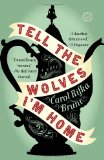
A Novel
by Carol Rifka Brunt Book Reviewed by:
"You wait, June," she said. "I'll hold this over you and Uncle Finn and then what'll you do?" She smiled at me, waiting.
I knew what she was thinking. I'd have to be unkind to Finn or risk catching AIDS, and she wanted to watch me decide. Greta knew the kind of friend Finn was to me. She knew that he took me to art galleries, that he taught me how to soften my drawings of faces just by rubbing a finger along the pencil lines. She knew that she wasn't part of any of that.
I shrugged. "He'll only kiss my cheek."
But even as I said it, I thought of how Finn's lips were always chapped to shreds now. How sometimes there would be little cracks where they'd started to bleed.
Greta leaned in, resting her arms on the back of her seat.
"Yeah, but how do you know that the germs from a kiss can't seep in through the skin of your cheek? How can you be sure they can't somehow swim into your blood right through your open pores?"
I didn't know. And I didn't want to die. I didn't want to turn gray.
I shrugged again. Greta turned around in her seat, but even from behind I could tell she was smiling.
It started to sleet, and the little nuggets of wet ice splatted against the window as we drove through the streets of the city. I tried to think of something good to say back to Greta, something to let her know that Finn would never put me in danger. I thought about all the things Greta didn't know about Finn. Like the way he'd let me know the portrait was just an excuse. How he'd seen the look on my face the very first time we'd gone down for the painting sessions. How he'd waited for my mother and Greta to go ahead into the living room, and in that moment, when it was only the two of us in the narrow hallway inside Finn's apartment door, he'd put his hand on my shoulder, leaned in, and whispered in my ear, "How else could I get all these Sundays with you, Crocodile?"
But that was something I would never tell Greta. Instead, when we were in the dim parking garage, climbing out of the van, I blurted out, "Anyway, skin's waterproof."
Greta pressed her door closed gently, then walked around the van to my side. She stood there for a few seconds, staring at me. At my big, clumsy body. She tugged the straps of her backpack tight against her little sparrow's shoulders and shook her head.
"Believe what you want," she said, turning away and heading for the stairs.
But that was impossible and Greta knew it. You could try to believe what you wanted, but it never worked. Your brain and your heart decided what you were going to believe and that was that. Whether you liked it or not.
My mother spent the hours at Uncle Finn's in his kitchen, making pots of tea for us in a magnificent Russian teapot Finn had that was colored gold and red and blue with little dancing bears etched around the sides. Finn said that pot was reserved for serving tea to his favorite people. It was always waiting for us when we came. From the living room we could hear my mother organizing Finn's cabinets, taking out jars and cans, plates and mugs, and loading them back in again. Every once in a while she'd come out to give us tea, which would usually go cold because Finn was busy painting and Greta and I weren't allowed to move. All those Sundays, my mother hardly looked at Finn. It was obvious that she was being broken up into pieces about her only brother dying. But sometimes I thought there was more. She also never looked at the painting. She'd come out and set the teapot down and walk right past the easel, craning her head away. Sometimes I thought it wasn't Finn at all. Sometimes it felt like it was the canvas and brushes and paint she was trying not to see.
That afternoon we sat for an hour and a half while Finn painted us. He had on Mozart's Requiem, which Finn and I both loved. Even though I don't believe in God, last year I convinced my mother to let me join the Catholic church choir in our town just so I could sing the Mozart Kyrie at Easter. I can't even really sing, but the thing is, if you close your eyes when you sing in Latin, and if you stand right at the back so you can keep one hand against the cold stone wall of the church, you can pretend you're in the Middle Ages. That's why I did it. That's what I was in it for.
Excerpted from Tell the Wolves I'm Home by Carol Rifka Brunt. Copyright © 2012 by Carol Rifka Brunt. Excerpted by permission of The Dial Press, a division of Random House, Inc. All rights reserved. No part of this excerpt may be reproduced or reprinted without permission in writing from the publisher.




Second hand books are wild books...
Click Here to find out who said this, as well as discovering other famous literary quotes!

Can you name the title?
Test your book knowledge with our daily trivia challenge!
Your guide toexceptional books
BookBrowse seeks out and recommends the best in contemporary fiction and nonfiction—books that not only engage and entertain but also deepen our understanding of ourselves and the world around us.


