return to home  
Join   |  Gift   |  Member Login   |  Library Login
BookBrowse Mobile
Follow Us: 
   Summary and Book Reviews

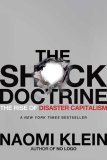
The Shock Doctrine: Summary and book reviews of The Shock Doctrine by Naomi Klein, plus links to an excerpt from The Shock Doctrine and a biography of Naomi Klein.

The Shock Doctrine

The Shock Doctrine
The Rise of Disaster Capitalism
by Naomi Klein
Hardcover: Sep 2007,
576 pages.
Paperback: Jun 2008,
576 pages.

Publication information
Author Information
Critics' Opinion:   
Readers' Rating:  
About BookBrowse Rankings
Share: 
Buy This Book

BOOK SUMMARY

award image
In her groundbreaking reporting over the past few years, Naomi Klein introduced the term “disaster capitalism.” Whether covering Baghdad after the U.S. occupation, Sri Lanka in the wake of the tsunami, or New Orleans post-Katrina, she witnessed something remarkably similar. People still reeling from catastrophe were being hit again, this time with economic “shock treatment,” losing their land and homes to rapid-fire corporate makeovers.

The Shock Doctrine retells the story of the most dominant ideology of our time, Milton Friedman’s free market economic revolution. In contrast to the popular myth of this movement’s peaceful global victory, Klein shows how it has exploited moments of shock and extreme violence in order to implement its economic policies in so many parts of the world from Latin America and Eastern Europe to South Africa, Russia, and Iraq.

At the core of disaster capitalism is the use of cataclysmic events to advance radical privatization combined with the privatization of the disaster response itself. Klein argues that by capitalizing on crises, created by nature or war, the disaster capitalism complex now exists as a booming new economy, and is the violent culmination of a radical economic project that has been incubating for fifty years.
BookBrowse

The Shock Doctrine is a highly polemical book which, like all polemical books, will energize those already inclined to agree with her and will be quite easy for opponents to dismiss as exaggerated or histrionic. Read this book if you’ve been demoralized by the news from Sri Lanka after the tsunami, Iraq after the invasion, and New Orleans after the hurricane. The Shock Doctrine will give you a surprisingly long historical perspective from which to view the corruption and exploitation that all three recent events have prompted. The criticisms launched against Klein center on her unbalanced, unremitting attack on capitalism as the scourge of the planet. What these critics miss is that Klein specifically aims her weaponry at corporatism, the strand of capitalism that erases the line between government and business by turning over public wealth to private companies, thus enriching a few and impoverishing the masses.  (Reviewed by Amy Reading).

Full Review Members Only (896 words).

Media Reviews

  Publishers Weekly
[A] powerful populist indictment of economic orthodoxy.

  The New York Times - Joseph E. Stiglitz
She paints a disturbing portrait of hubris, not only on the part of Friedman but also of those who adopted his doctrines, sometimes to pursue more corporatist objectives.

  Dow Jones Business News - Paul B. Farrell
Hot tip: Invest in "Disaster Capitalism." This new investment sector is the core of the emerging "new economy" that generates profits by feeding off other peoples' misery: Wars, terror attacks, natural catastrophes, poverty, trade sanctions, market crashes and all kinds of economic, financial and political disasters.

To more fully grasp this new economy, you must read what may be the most important book on economics in the 21st century, Naomi Klein's The Shock Doctrine: The Rise of Disaster Capitalism ....

  New York Times - Joseph E. Stiglitz
Klein is not an academic and cannot be judged as one. There are many places in her book where she oversimplifies. But Friedman and the other shock therapists were also guilty of oversimplification, basing their belief in the perfection of market economies on models that assumed perfect information, perfect competition, perfect risk markets. Indeed, the case against these policies is even stronger than the one Klein makes. They were never based on solid empirical and theoretical foundations, and even as many of these policies were being pushed, academic economists were explaining the limitations of markets — for instance, whenever information is imperfect, which is to say always.

  New Statesman - Johann Hari
How can Naomi Klein top No Logo, the most influential political polemic of the past 20 years? Her first book forensically studied the bloodstains that have splashed from the developing world's factories and "export processing zones" on to our cheap designer lives - and it spurred the creation of the anti-globalisation movement. Today, she has produced something even bolder: a major revisionist history of the world that Milton Friedman and the market fundamentalists have built. She takes the central myth of the right - that, since the fall of Soviet tyranny, free elections and free markets have skipped hand in hand together towards the shimmering sunset of history - and shown that it is, simply, a lie.

  Kirkus Reviews
Required reading for anyone trying to pierce the complexities of globalization.

  Booklist
Assiduously researched, energetically expressed, Klein's report bears an ideological perspective that won't leave readers neutral about her economic interpretations.

  The Observer - Will Hutton
Klein is so anxious to prove that all capitalism is bad, even, on occasion, relying on torture to get its way, that she never allows for the possibility that markets can deliver beneficial results. Or that the demand for markets comes from the bottom up, as it did in China between 1980 and 1983. Nor, in her account of the shock treatment of the former communist Eastern Europe, does she explain why some countries - the Baltic republics and the Czech Republic - have done so much better than others.

So The Shock Doctrine is a lost opportunity. It is hardly new that disasters and shocks are often triggers of change; her insight is to apply the thesis to turbo-capitalism and its ideologues. If Klein had been fairer, she would have had a smarter thesis that could genuinely have changed the intellectual climate. As it is, she will be dismissed by her critics as a confused ranter. We need critics of free-market fundamentalism to do better than that.

  Scotsman - Claire Black
The Shock Doctrine is hugely ambitious and eminently readable. Klein's thesis, drawing together disparate events, far-flung countries and competing ideologies, is cogent and clear, and although she stops short of answering the question as to whether violence is inherent to neoliberal ideology, or results from its implementation, she builds an utterly convincing case against the excesses and corruption of a system so exemplified by Bush, Cheney and Rumsfeld.

  The Telegraph - Nicholas Blincoe
Did the American-educated economists behind Pinochet's reforms sign up before the coup, as Klein claims, or after, as they aver? Could the massacre in Tiananmen Square really have been a softening-up operation for economic shock therapy? Klein does not always get away with her most tendentious readings, but she often does. In part, this is down to sheer verve and, in part, because she has the self-damning quotations: an endless stream of inane politicians spoiling for a fight, talking about "shock and awe" and even praising Iraqi looters for their jump-start on the privatisation programme.

  The Guardian - John Gray
There can be no doubt that fortunes have been reaped from the Iraq war as they have been from other experiments in disaster capitalism. Yet I remain unconvinced that the corporations Klein berates throughout the book understand, let alone control, the anarchic global capitalism that has been allowed to develop over the past couple of decades - any more than the neo-liberal ideologues who helped create it foresaw where it would lead. Rightly, Klein insists that free market ideology must bear responsibility for the crimes committed on its behalf - just as Marxist ideology must be held to account for the crimes of communism.

  The Independent - Julie Wheelwright
Among the most haunting chapters are those dealing with the dismantling of Iraq. While the Bush presidency now seems mired in scandals, Klein takes little comfort in the comeuppance of his closest allies. "I wrote the book because I think we need to be talking about systems rather than individuals," she says. "My worry is that the danger of the Bush years is that these guys are so outrageous that the focus has just been on the bad apples. You gun, gun, gun to get Rumsfeld to resign; you gun, gun, gun to get Cheney to resign, and then do we really think this is going to change things?'

Recent Reader Reviews

Rated 1 of 5 of 5 by mike smith
the shock doctrine
This is a great example of leftist thinking gone horribly wonky. This writer sees right-wing capitalist evil in every move of the lefts, by now, boring and non-existent demons. Where is her rage at 50 million murdered in the Chinese communist's...   Read More

  • Milton Friedman (1912-2006) was awarded the Nobel Prize in economics in 1976, greatly raising his international profile and paving the way for the adoption of his policies. The Nobel website publishes Friedman's autobiography and prize lecture. Friedman charmingly admits the incongruity of his receiving a prize established by the Central Bank of Sweden: "[M]y monetary studies have led me to the conclusion that central banks could profitably be replaced by computers geared to provide a steady rate of growth in the quantity of money. Fortunately for me personally, and for a select group of fellow economists, that conclusion has had no practical...

Continued...  Beyond the Book (members only)

Readalikes Full readalike results are for members only

If you liked The Shock Doctrine, try these:

Colossus
by Niall Ferguson

Niall Ferguson brings his renowned historical and economic depth of field to bear on a bold and sweeping reckoning with America's imperial status and its consequences.

Dangerous Games
by Margaret MacMillan

Margaret MacMillan, an acclaimed historian and “great storyteller” (The New York Review of Books), explores here the many ways in which history – its values and dangers – affects us all, including how it is used and abused.


These are 2 of the 8 readalike suggestions for The Shock Doctrine. Members have full access to all readalikes. If you are a member, please login. To find out more about membership, click here.


Become a Member
Click Here
Editor's Choice
  •  May 21 
  •  May 20 
  •  May 18 
Helga's Diary
Helga Weiss

Helga's Diary Jacket

The remarkable diary of a young girl who survived the Holocaust—appearing in English for the first time.
Fever
Mary Beth Keane

Fever Jacket

A bold, mesmerizing novel about the woman known as "Typhoid Mary," the first known healthy carrier of typhoid fever in the burgeoning metropolis of early twentieth century New York.
The Woman Upstairs
Claire Messud

The Woman Upstairs Jacket

The riveting confession of a woman awakened, transformed, and betrayed by passion and desire for a world beyond her own.
Click Here
   Most Recent Blog Entries
Movies Based on Books: Summer 2013 (May - August)
Jewish Young Adult Books That Are Not About The Holocaust
Books to Give This Mother's Day
rss  RSS   rss  subscribe
Recent Reader Reviews
Z: A Novel of Zelda Fitzgerald by Therese Fowler
Z, the novel about the life of Zelda Sayre Fitzgerald is at points charming and; like another reviewer, I kept thinking of the movie, "Midnight... read more
Flight Behavior by Barbara Kingsolver
Although heavy on the scientific details, which slowed down the story for me (OK, I admit, I was one of those liberal arts majors who skipped out on... read more
The House at the End of Hope Street by Menna van Praag
Loved this book. Magical, quirky, enchanting I could go on. All books do not have to be literary fiction, sometimes it is just so comforting to read... read more
RSS RSS feed More...  
Most Viewed This Week
1. Half the Sky
Nicholas D. Kristof, Sheryl WuDunn
2. A Child Called It
Dave Pelzer
3. And the Mountains Echoed
Khaled Hosseini
4. Defending Jacob
William Landay
5. Into The Wild
Jon Krakauer
More...
Book Club Recommendations
Why Be Happy When You Could Be Normal?
by Jeanette Winterson
Paperback (Mar/13)
Eleanor & Park
by Rainbow Rowell
Hardback (Feb/13)
The House Girl
by Tara Conklin
Paperback (Oct/13)
The Painted Girls
by Cathy Marie Buchanan
Hardback (Jan/13)
More...
First Impressions
Members read and review books often months before they're published. See what they think in First Impressions!
Golden Boy
by Abigail Tarttelin
4.5 Stars            (May/13)
The Last Girl
by Jane Casey
Four Stars            (May/13)
The Caretaker
by A .X. Ahmad
Four Stars            (May/13)
The Sisterhood
by Helen Bryan
Four Stars            (Apr/13)
More...
  Latest BookBrowse News
British Parliament asks Amazon to clarify why it pays $9 million in income tax on $23 billion of UK sales. (May 20 2013)
Amazon will be called back to give further evidence to members of the British Parliament "to clarify how its activities in the U.K. justify its low corporate... Full Story
rss RSS feed More...
 
BookBrowse Poll
Q: Which of these Summer movies based on books would you like to see? (Info on each movie here)
The Great Gatsby
Epic
Man of Steel
World War Z
The Lone Ranger
The Wolverine
R.I.P.D.
Percy Jackson
Paranoia
The Mortal Instruments
Select Any That Apply
Search: Title or Author
Free Newsletters
The Light Between Oceans

Online Book Club
More about
The Comfort of Lies
Join the discussion!


Win This Book!
On Sal Mal Lane


"Piercingly intelligent and shatter-your-heart profound."

Enter To Win Now!

wordplay
Solve this clue:
"I Y N P O T Solution, Y P O T P"

and be entered
to win....
frame top
New Author
Interviews
Menna van Praag
Erica Brown
Helga Weiss
Kate Morton
frame bottom
HOME Book Submissions | Advertising | Library Subscriptions | Reviewing for BookBrowse | Contact Us