Jasper Fforde
Three separate interviews in which Jasper Fforde discusses the Thursday Next series, his Nursery Crime novels and Shades of Grey, the first in a trilogy set in a future world recognizable as our own - but only just.
Abraham Verghese
An interview with Abraham Verghese about his life and writing and in particular about his extraordinary 2009 novel Cutting for Stone, set in 1960s and '70s Ethiopia and 1980s New York.
Martha A Sandweiss
An interview with Martha Sandweiss in which she discusses her book Passing Strange, a biography of Clarence King who lived a double lifeas the celebrated white explorer, geologist, and writer Clarence King and as a black Pullman porter named James Todd, married to Ada with whom he had five children.
Amy Greene
Amy Greene talks about her first novel, Bloodroot, which brings her native Appalachiaand the faith and fury of its peopleto rich and vivid life.
Caution! It is likely that the following questions will reveal, or at least allude to, key plot details. Therefore, if you haven’t yet read this book, but are planning on doing so, you may wish to proceed with caution to avoid spoiling your later enjoyment.
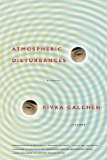
Introduction
Hailed as a virtuosa storyteller, garnering comparisons ranging from Borges to
Murakami, Rivka Galchen has received a level of ebullient acclaim rarely bestowed
on debut novelists. Exploring the nature of love, identity, truth, and reality itself,
Atmospheric Disturbances is equally funny and fantastical, yet grounded in colorful
details capturing the conflicts of daily life.
At the heart of these quandaries is Dr. Leo Liebenstein, his missing wife, Rema, and
his psychiatric patient Harvey. The only clue Rema has left behind is an illusion of
herself, a cunning simulacra that looks, talks, and behaves just like the real Rema
and has fooled everyone but Leo. Attempting to unravel the mystery of spousal
replacement, he embarks on an investigation that leads him to the inner sanctum of
the Royal Academy of Meteorology in their cosmic conflict with the 49 Quantum
Fathers, and the unwelcome conviction that somehow heor maybe his wife, or
maybe even Harveylies at the center of these unfathomable developments. From
Buenos Aires to Manhattan, with many cosmic sojourns in between, Leos erratic
quest yields both a suspenseful psychological thriller and a moving love story.
Inventive and provocative, Atmospheric Disturbances deftly explores the nature of
human relationships, and how we spend our lives trying to weather the storms of
our own making.
Questions for Discussion
Discuss the novels epigraphs. Does your own experience with love and friendship
match the observations of the French philosopher Gilles Deleuze? What is the effect
of reading a quote from the real Tzvi Gal-Chen, followed by scenes of a fictional
character who bears his name? How do Gal-Chens thoughts on prediction and
knowledge predict various outcomes in the novel?
How much did you trust Leo as a narrator? What did you initially think the
novels mysteries were? How did you interpret the various clues provided by the
characters?
What symptoms does Harvey have in common with his healers? How did Remas
scheme, coaching Leo through his impersonation, affect the mental health of the
other characters?
What makes meteorology an ideal metaphor for love and marriage?
On page 14, Leo describes the limits of reality testing for some patients. How do
the novels characters distinguish between reality and illusion? How do most of us
test realityin love, at work, in politics?
In what ways does Leos Dopplerganger effect (emphasized in Chapters 8 and
9) prove to be both true and absurd?
Consider Remas puppy. What role does it play in propelling the storyline?
How does the situation change when Leo meets Magda? What effect do she and
Anatole have on Rema? Ultimately, does anyone know Rema better than she knows
herself?
On page 157, Leo describes the significance of the interpretive leap. How did you
interpret the sign at the bottom of the page? How do the novels characters balance
their interpretive leaps with empirical laws?
In what way do the desaparecidos, the vanished victims of Argentinas dirty
war, form a meaningful part of Leos travels in South America?
What shifts occur when the setting changes to Buenos Aires? What keeps Leo
oriented in both New York and Argentina?
How was your reading affected by the photographs that appear on pages 26 and
147? Can photography capture fiction?
What criteria would your family and friends use if they were trying to determine
whether you were the real You or an impostor?
Rivka Galchen weaves many philosophical references into the novel, ranging
from the term simulacra itself to critical theorists of the Frankfurt School (such
as Theodor Adorno) to poststructuralist theory (such as Jacques Lacans mirror
stage). Yet she was also hailed by the novelist Francisco Goldman for producing a
novel that is as funny as any episode of The Simpsons. What techniques enable her
to achieve such a broad range of tones? Is this novel a spoof? A tragedy? A realistic
account of a fracturing mind? A fable? How does the genre affect your reading of
the story?
Chapter 22 is written almost entirely in the future tense. How does this affect
your reading of the closing scenes? What do you predict for the characters futures?
Unless otherwise stated, this discussion guide is reprinted with the permission of Picador.
Any page references refer to a USA edition of the book, usually the trade paperback version, and may vary in other editions.
Named for a flower whose blood-red sap possesses the power both to heal and poison, Bloodroot is a stunning fiction debut about the legaciesof magic and madness, faith and secrets, passion and lossthat haunt one family across the generations, from the Great Depression to today.
Samara Taylor used to believe in miracles. But her mother is in rehab, and her father seems more interested in his congregation than his family. And when a young girl in her small town is kidnapped, her already-worn thread of faith begins to unravel.
When she's not digging up bones or other ancient objects, quirky, tart-tongued archaeologist Ruth Galloway lives happily alone in Norfolk. But when a child's bones are found on a desolate beach nearby, and Detective Chief Inspector Harry Nelson calls Galloway for help, Ruth finds herself in...
Few works of literature are as universally beloved as Alices Adventures in Wonderland. Now, in this spellbinding historical novel, we meet the young girl whose bright spirit sent her on an unforgettable trip down the rabbit hole and the grown woman whose story is no less...
The Coral Thief, as riveting and beautifully rendered as Ghostwalk, Rebecca Stotts first novel, is a provocative and tantalizing mix of history, philosophy, and suspense. It conjures up vividly both the feats of Napoleon and the accomplishments of those working without fame or...
I rarely read anything before this. Years ago I picked this one up and couldn't put it down. It changed me into a book nut. It was a wonderful ...
read more
I can't believe I waited so long to read this book. Shame on me. This book was wonderful, lyrical, entertaining - all the makings of a wonderful ...
read more
The book held so much for the reader but in the end I felt robbed. The evolution of Trudy was disturbing and somewhat insulting. She came across as ...
read more
Justice Department still has issues with Google Settlement(Feb 05 2010) The Department of Justice dealt a serious blow Thursday evening to the chances that the Google Book Search settlement will gain court approval later this...
Full Story
Hachette formally adopts 'agency model'(Feb 05 2010) Hachette Book Group USA became the second major U.S. publisher to officially announce its intention to move to an agency model for the sale of e-books....
Full Story