
-
Your next favorite book
is waiting.
Summary | Excerpt | Reviews | Beyond the Book | Readalikes | Genres & Themes | Author Bio
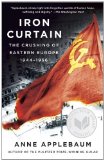
The Crushing of Eastern Europe, 1944-1956
by Anne Applebaum Book Reviewed by:
The speed with which this transformation took place was, in retrospect, nothing short of astonishing. In the Soviet Union itself, the evolution of a totalitarian state had taken two decades, and it had proceeded in fits and starts. The Bolsheviks did not begin with a blueprint. In the wake of the Russian Revolution, they pursued a zigzag course, sometimes harsher and sometimes more liberal, as one policy after another failed to deliver promised economic gains. The collectivist 'war communism' and 'red terror' policies of the Russian Civil War era were followed by Lenin's more liberal New Economic Policy, which permitted some private business and trade. The New Economic Policy was in turn abolished in 1928 and replaced by a Five Year Plan and a new set of policies which eventually became known as Stalinism: a push for faster industrialization, forced collectivization, centralized planning, draconian restrictions on speech, literature, the media and the arts, and the expansion of the Gulag, the system of mass forced labour camps. The phrases 'Stalinism' and 'totalitarianism' are often used interchangeably, and rightly so.
But by the late 1930s Stalinism was in crisis too. Standards of living were not improving as fast as the party had promised. Poorly planned investments were beginning to backfire. Mass starvation in Ukraine and southern Russia in the early 1930 s, while of some political utility to the regime, had created fear rather than admiration. In 1937 , the Soviet secret police launched a public campaign of arrests, imprisonments and executions, initially directed at the saboteurs, spies and 'wreckers' who were allegedly blocking society's progress, and eventually spreading to include the highest circles of the Soviet communist party. The Great Terror was neither the first wave of arrests in the Soviet Union nor the largest – earlier bouts of terror had been largely aimed at peasants and ethnic minorities, especially those living near the Soviet border. But it was the first to be directed at the highest party leadership, and it caused profound disquiet, at home and among communists abroad. In due course, the Great Terror might have led to real disillusion.
Stalinism – and Stalin – was fortuitously rescued by the Second World War. Despite the chaos and mistakes, despite mass deaths and vast destruction, victory bolstered the legitimacy of the system and its leader, 'proving' their worth. In the wake of the victory, the near-religious cult of Stalin reached new heights. Propaganda described the Soviet leader as 'the incarnation of their own heroism, their own patriotism, their own devotion to their socialist Motherland'.
At the same time, the war gave Stalin an unprecedented opportunity to impose his particular vision of communist society on his neighbours. The fi rst opportunity came at the very beginning, in 1939 , after the Soviet Union and Nazi Germany signed the Molotov– Ribbentrop pact and agreed to divide Poland, Romania, Finland and the Baltic states into Soviet and German spheres of influence. On 1 September, Hitler invaded Poland from the west. On 17 September, Stalin invaded Poland from the east. Within a few months, Soviet troops had occupied the Baltic states, parts of Romania and eastern Finland as well. Although Nazi-occupied Europe was eventually liberated, Stalin never gave back the territories he occupied in this fi rst phase of the war. Eastern Poland, eastern Finland, the Baltic nations, Bukovina and Bessarabia, now called Moldova, were incorporated into the Soviet Union. The eastern Polish territories remain part of Ukraine and Belarus today. In their zone of occupation, Red Army officers and NKVD officers immediately began to impose their own system. From 1939 onwards, they used local collaborators, members of the international communist movement, mass violence and mass deportations to the concentration camps of the Gulag to 'Sovietize' the local population. Stalin learned valuable lessons from this experience, and gained valuable allies: the Soviet invasion of eastern Poland and the Baltic States in 1939 produced a cadre of NKVD officers ready and willing to repeat it. Immediately, even before the Nazi invasion of the USSR in 1941 , Soviet authorities began to prepare the ground for a similar transformation of Eastern Europe.
Excerpted from Iron Curtain by Anne Applebaum. Copyright © 2012 by Anne Applebaum. Excerpted by permission of Doubleday. All rights reserved. No part of this excerpt may be reproduced or reprinted without permission in writing from the publisher.







It is always darkest just before the day dawneth
Click Here to find out who said this, as well as discovering other famous literary quotes!

Can you name the title?
Test your book knowledge with our daily trivia challenge!
Your guide toexceptional books
BookBrowse seeks out and recommends the best in contemporary fiction and nonfiction—books that not only engage and entertain but also deepen our understanding of ourselves and the world around us.


